How to Build an AI Based Digital Marketing Strategy That Actually Delivers
Most marketing teams know they should be using AI. The challenge is not awareness anymore. It is implementation.
In 2026, 88% of marketers report using AI tools daily. AI-driven campaigns outperform manual campaigns by 30 to 50% on average across key metrics. The global AI marketing industry has crossed $47 billion. But despite these numbers, the majority of marketing teams are still using AI in fragments — a chatbot here, a content generator there, an analytics dashboard somewhere else — without a coherent system connecting these pieces into a functioning ai based digital marketing strategy.
The result is that AI becomes another set of tools to manage rather than a structural advantage that transforms how marketing operates.
This guide is built for marketing professionals who are past the "what is AI in marketing" stage and ready for the "how do I actually build this" stage. We will walk through a phased implementation framework, cover the core applications of AI across every digital marketing channel, and show how to connect these applications into a system that compounds in performance over time.
What AI Based Digital Marketing Actually Means in Practice
AI based digital marketing is the integration of machine learning algorithms, natural language processing, predictive analytics, and automation into the strategy, execution, and measurement of digital marketing campaigns. It covers every major channel — search, paid media, content, email, social, and customer engagement — and operates at three levels:
- Data level — AI collects, processes, and interprets customer data at a scale and speed that human analysts cannot match. This includes customer segmentation, sentiment analysis, customer lifetime value prediction, and attribution modeling.
- Execution level — AI automates campaign tasks including programmatic media buying, dynamic ad personalization, A/B testing automation, chatbot integration, and marketing automation workflows.
- Intelligence level — AI provides predictive insights that inform strategic decisions: which audiences to target, which content to create, where to allocate budget, and what outcomes to expect before spend is deployed.
The distinction between using AI tools and operating an ai based digital marketing strategy is the difference between owning individual instruments and conducting an orchestra. The tools matter. But the system that connects them matters more.
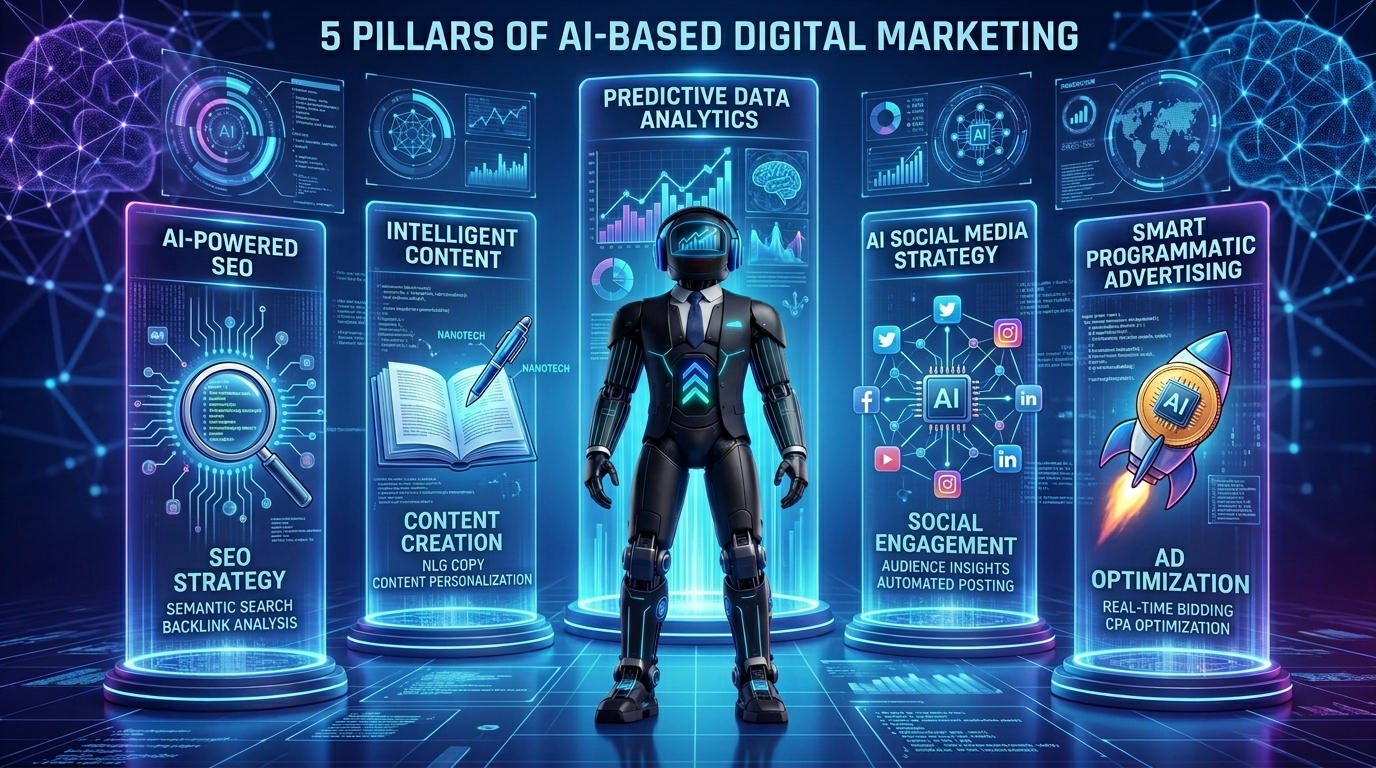
The 5 Pillars of AI Based Digital Marketing
Before diving into implementation, it helps to understand the five pillars that define a complete AI-powered digital marketing strategy. These are the core capability areas where AI delivers measurable impact.
Pillar 1 — Audience Intelligence and Customer Segmentation
Traditional customer segmentation divides audiences by demographics — age, location, income. AI-based segmentation goes far deeper.
Machine learning algorithms analyze behavioral data, purchase history, browsing patterns, engagement signals, and contextual factors to create dynamic audience segments that update in real time. This is not a static list in a CRM. It is a living model that identifies:
- Which customers are most likely to convert in the next 30 days
- Which segments are showing early signs of churn
- Which prospects share behavioral patterns with your highest-value customers
- How customer lifetime value differs across acquisition channels
Recommendation engines use these segments to deliver personalized product suggestions, content recommendations, and offer sequencing tailored to each individual's position in the buyer journey. Customer data platforms unify this intelligence across all touchpoints — website, email, social, paid media, WhatsApp — so every channel benefits from the same audience understanding.
The business impact is direct. AI-powered customer segmentation improves targeting precision, reduces wasted ad spend, and increases conversion rates by ensuring the right message reaches the right person at the right stage.
Pillar 2 — Content Creation and Optimization
AI has transformed content from a bottleneck into a scalable engine. But the real value is not just in generating content faster — it is in creating content that is strategically informed and continuously optimized.
AI based content capabilities include:
- Content gap analysis — AI scans competitor content and search landscapes to identify topics your audience is searching for that you have not covered
- Natural language generation — GPT models and AI writing assistants produce first drafts for blog posts, email sequences, social media content, ad copy, and landing pages
- Content optimization — tools like Surfer SEO, Clearscope, and MarketMuse score your content against the competitive landscape and recommend specific improvements for keyword coverage, topical depth, and semantic analysis
- Content personalization — AI tailors content variations for different audience segments, devices, and funnel stages automatically
- Content repurposing automation — a single long-form piece is converted into social posts, email snippets, carousel content, video script outlines, and WhatsApp messages without manual reformatting
The critical human layer remains essential. AI drafts need editorial refinement for brand voice, factual accuracy, original insight, and the E-E-A-T signals (Experience, Expertise, Authoritativeness, Trustworthiness) that Google and AI search engines reward. The workflow that scales is AI handling 80% of the mechanical work while humans contribute the 20% that differentiates.
Pillar 3 — Paid Media and Programmatic Advertising
AI has fundamentally restructured how paid media operates. Manual campaign management — setting bids, choosing placements, testing creatives one variation at a time — is being replaced by intelligent systems that optimize in real time.
Core AI applications in paid media:
- Programmatic media buying — machine learning algorithms purchase ad inventory across thousands of publishers in milliseconds, optimizing for audience, context, and predicted conversion probability simultaneously
- Dynamic ad personalization — AI generates and serves different creative variations to different audience segments based on behavioral signals, device type, and funnel position
- A/B testing automation — instead of testing two variations manually, AI tests hundreds of headline, image, and copy combinations simultaneously and promotes the highest performers automatically
- Budget optimization — AI reallocates spend across channels and campaigns in real time based on live performance data, shifting budget toward what is converting and away from what is not
- Google Performance Max and Meta Advantage+ — platform-native AI systems that manage targeting, bidding, creative selection, and placement across multiple surfaces automatically
AI-driven campaigns are delivering 30 to 50% better performance on average compared to manually managed campaigns. For businesses operating on tight budgets, this is not an efficiency gain — it is a competitive requirement.
Pillar 4 — Customer Engagement and Conversational AI
Customer engagement has shifted from reactive support to proactive, AI-driven interaction across every touchpoint.
Key AI applications include:
- AI chatbots — modern chatbot integration goes beyond scripted FAQs. Conversational AI systems powered by natural language processing understand context, maintain conversation history, handle complex queries, qualify leads, and escalate to human agents when needed
- WhatsApp and messaging automation — for Indian businesses where WhatsApp is the primary customer communication channel, AI-powered messaging systems handle lead qualification, appointment booking, order updates, and remarketing sequences automatically
- Sentiment analysis — AI monitors brand mentions across social media, review platforms, and customer support channels in real time, identifying negative sentiment before it becomes a crisis and positive sentiment that can be amplified
- Hyper-personalization — AI customizes the entire customer experience based on individual behavioral data, from personalized website content and product recommendations to tailored email sequences and dynamic pricing
The impact on customer engagement metrics is significant. AI-powered chatbots reduce response times from hours to seconds. Personalized experiences increase engagement rates by 40% or more. Sentiment analysis catches brand issues before they escalate, protecting reputation and revenue.
Pillar 5 — Analytics, Attribution, and Performance Prediction
The final pillar closes the loop. AI-powered analytics transform marketing measurement from backward-looking reporting into forward-looking intelligence.
AI enables:
- Predictive analytics — machine learning models forecast campaign performance, audience behavior, and conversion probability before budget is spent
- Attribution modeling — AI tracks how every touchpoint across the customer journey contributes to conversions, replacing simplistic last-click attribution with multi-touch models that reflect actual influence
- Customer lifetime value prediction — AI estimates the long-term revenue potential of each customer segment, informing acquisition strategy and budget allocation
- Real-time performance dashboards — AI-powered analytics surfaces anomalies, trends, and optimization opportunities as they happen, not in monthly reports compiled after the fact
- Marketing automation workflows — AI triggers automated actions based on performance signals: scaling spend on high-performing campaigns, pausing underperformers, sending re-engagement sequences to churning customers, and adjusting content distribution based on engagement data
When analytics connects back to audience intelligence, content strategy, paid media optimization, and customer engagement, the entire system compounds. Every campaign makes the next one smarter because the data flows through a unified intelligence layer.
The Implementation Roadmap — Where to Start
Building an AI based digital marketing strategy does not require replacing everything at once. The most effective approach is phased implementation, starting where AI delivers the fastest measurable impact and expanding from there.
Phase 1 — Analytics and Intelligence (Weeks 1 to 4). Start with data. Implement AI-powered analytics to understand your current performance baseline. Set up customer segmentation, attribution modeling, and performance dashboards. This gives you the intelligence foundation that every subsequent AI application will rely on.
Phase 2 — Content and SEO (Weeks 4 to 8). Layer in AI-assisted content creation and optimization. Use AI for content gap analysis, first-draft generation, SEO scoring, and content repurposing. This is where most teams see the first tangible output gains — more content, better optimized, produced faster.
Phase 3 — Paid Media Optimization (Weeks 8 to 12). Integrate AI into your ad campaigns. Enable programmatic buying, dynamic creative optimization, automated budget allocation, and A/B testing at scale. This is where ROI impact becomes measurable in revenue terms.
Phase 4 — Customer Engagement (Weeks 12 to 16). Deploy conversational AI across your customer touchpoints — chatbots, WhatsApp automation, email personalization, and sentiment monitoring. This extends AI beyond marketing into the customer experience layer.
Phase 5 — Full System Integration (Ongoing). Connect all four layers into a unified system where data flows between analytics, content, paid media, and engagement. This is where AI stops being a collection of tools and becomes a marketing operating system.
The phasing matters because each stage builds on the previous one. AI-powered content is more effective when informed by AI analytics. AI ad optimization performs better when it draws on AI audience intelligence. AI customer engagement converts more when it is connected to AI-driven personalization data.
What This Means for Indian Businesses
The AI based digital marketing landscape has a specific challenge for Indian startups, MSMEs, and growing businesses. Most global AI marketing solutions are priced for enterprise budgets, designed for Western consumer behavior, and built for markets with different channel dynamics.
Indian businesses need AI marketing systems that account for WhatsApp-first customer journeys, Instagram and YouTube as primary discovery channels, Hindi and regional language content needs, price sensitivity at the lead acquisition level, and MSME-scale budgets that cannot absorb $5,000 to $15,000 monthly retainers.
This is where platforms built specifically for this market become relevant. FDS AI Studio offers 26 plus AI systems across all five pillars — audience intelligence, content creation, paid media, customer engagement, and analytics — inside a single platform designed for Indian businesses. Plans start at zero with 100 free credits and scale from INR 2,500, making genuine AI-powered digital marketing accessible at a price point that respects Indian business economics.
The gap between businesses that have built AI into their marketing infrastructure and those still operating manually will widen significantly through 2027. The tools exist. The frameworks are proven. The question is whether your marketing operation has made the shift.