How to Build an AI-Powered Lead Generation System for Your Business
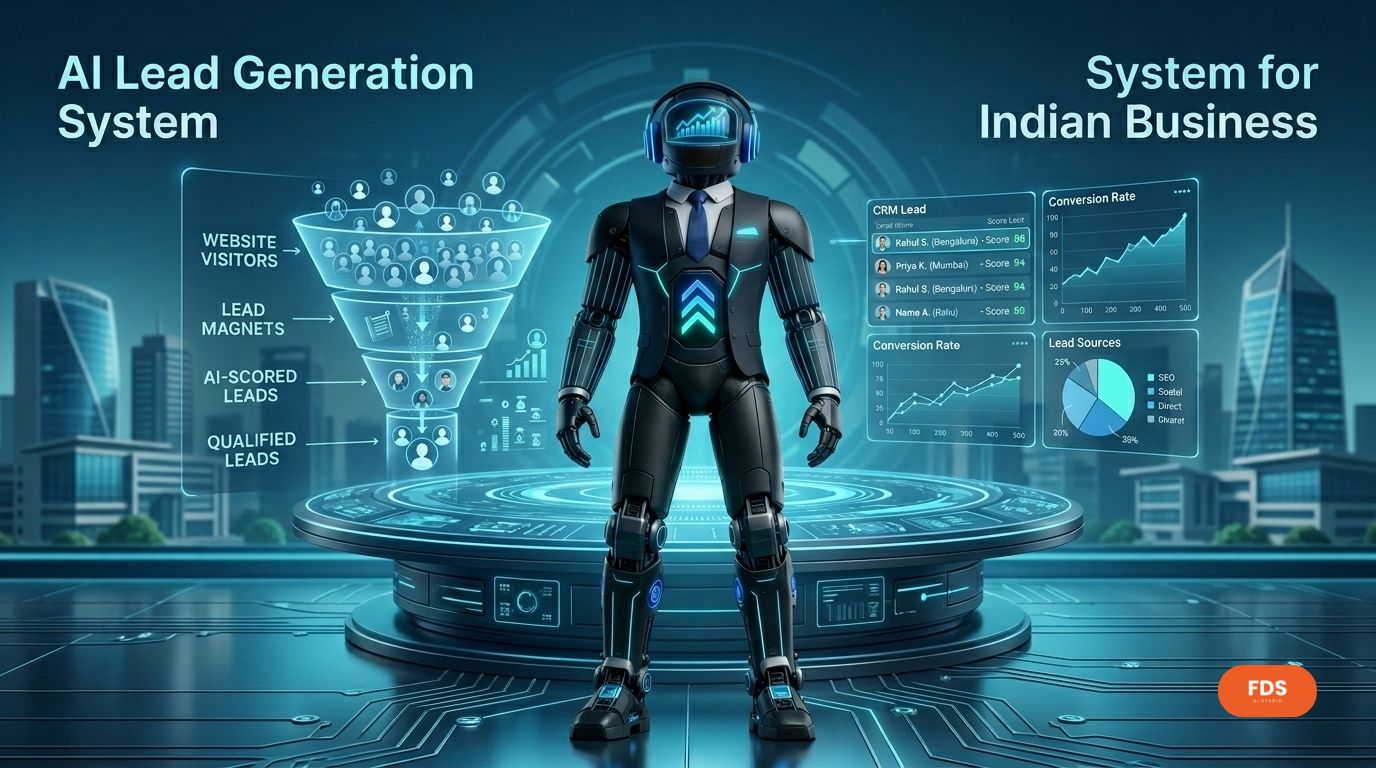
Here is a pattern that plays out across thousands of Indian small businesses every month. A founder or MSME owner decides to "do digital marketing." They either hire an agency at ₹30,000 to ₹50,000 per month or start running Meta ads themselves. They boost a few posts, launch a few campaigns, and wait for leads to come in.
Some leads trickle in. Most are unqualified. The cost per lead is ₹80, ₹150, sometimes ₹300. After two or three months, the budget is burned and there is nothing to show for it except a spreadsheet of phone numbers that never converted.
The problem is not the ads. The problem is not the budget. The problem is the absence of a system.
Most small businesses treat lead generation as a single action - run an ad, get a lead. But lead generation is not an action. It is a system with three distinct stages: attract cold audiences with the right message, nurture warm prospects until they trust you, and convert them when they are ready to buy. When any of these stages is missing, the entire flow breaks.
In 2026, AI has made it possible to build this complete system without a marketing team, without an expensive agency, and without spending months figuring it out manually. This guide walks through how.
Why Most Lead Generation Fails for Indian MSMEs
Before building the system, it helps to understand why the current approach is broken for most small businesses in India.
The ad creative problem. Most founders are not copywriters. When they sit down to write an ad, they either describe their product features (which nobody cares about in a scroll) or copy what competitors are doing (which means they blend into the noise). The result is ads that look like every other ad in the feed. No pattern interrupt. No emotional trigger. No reason for a prospect to stop scrolling.
The reality is that every customer buys for one of a handful of psychological reasons - cost pain, trust gap, time drain, fear of missing out, or a deep desire for a specific outcome. An ad that hits one of these triggers stops the scroll. An ad that describes features does not. Writing scripts that target these buying triggers used to require an experienced copywriter or a creative agency. AI has changed that equation entirely.
The positioning problem. Most small businesses cannot answer a simple question in 30 seconds: why should a customer choose you instead of any competitor? Not what you do. Not your product features. Why you, specifically.
Without clear positioning, every piece of marketing becomes generic. The ads sound like everyone else. The social media content looks like everyone else. The prospect has no reason to remember your brand. Positioning is the foundation of every marketing system, and most MSMEs skip it entirely because they do not have a framework to build it.
The content problem. Even businesses that manage to run decent ads often have no follow-up system. A prospect sees your ad, does not convert immediately, visits your social media profile, finds random posts with no strategy, and leaves. There is no buyer journey. No trust-building sequence. No remarketing content that re-engages cold leads. The ad brought attention, but there was nothing to catch it.
These three problems - weak ad creative, unclear positioning, and random content - are not separate issues. They are three missing pieces of the same system.
The 3-Stage AI Lead Generation System
A functioning lead generation system operates in three stages. Each stage has a specific job, and AI can now handle the heavy lifting at every stage.
Stage 1 - Attract: AI-Powered Ad Scripts That Stop the Scroll
The first stage is getting attention from cold audiences - people who have never heard of your business. This happens through paid ads, primarily on Meta (Facebook and Instagram) for most Indian MSMEs.
The key to effective ads is not production quality. It is the script. A well-written script shot on a phone will outperform a poorly written script with ₹2 lakh production value every time. The script determines whether someone stops scrolling, watches your ad, and takes action.
An AI-powered approach to ad scripting works like this:
- You provide a single input - your business, your offer, and your target audience
- The AI generates multiple complete scripts, each targeting a different psychological buying trigger
- Each script follows a proven persuasion structure: hook the viewer in the first 3 seconds, agitate the pain, present your solution, provide proof, and close with a clear call to action
- The output is ready-to-shoot - hand the script to a videographer or shoot it yourself on a phone
The difference between one ad and five ads targeting five different buying triggers is massive. Instead of betting your entire budget on one message, you test five angles simultaneously. The data tells you which trigger resonates most with your audience, and you scale the winner.
The FDS Marketing Tools suite includes a Meta Video Ads tool that does exactly this - generating 5 complete scripts from a single input, each hitting a different buying trigger (Cost Pain, Trust Gap, Time Drain, Fear of Loss, Big Desire), all written in Hinglish because that is how Indian audiences actually speak and respond. The scripts are built on the Stab & Twist persuasion engine refined across 65+ real brand campaigns that have delivered leads under ₹10.
Stage 2 - Position: A 30-Second Video That Answers "Why You?"
The second stage happens in parallel with advertising. Before a prospect converts, they need to understand one thing: why your business and not any of the dozen alternatives they have seen this week.
This is the positioning stage, and it is the most neglected part of lead generation for small businesses. Most founders skip it because they think positioning is a "brand exercise" for big companies. It is not. Positioning is the reason your ad converts at ₹10 per lead instead of ₹100.
A strong positioning video is 30 seconds. It answers one question: why you, not them. The structure that works:
- Hook (0 to 5 seconds) - a pattern interrupt that speaks the customer's exact frustration. Not a generic opening. A sentence they have thought but never heard an ad say out loud.
- Pain (5 to 10 seconds) - name the real problem. Not the surface problem. The deeper systemic issue that competitors are not solving.
- Differentiation (10 to 20 seconds) - what you do differently and why it matters. Not features. The structural advantage.
- Proof (20 to 25 seconds) - numbers, screenshots, results. Something concrete that builds credibility in one breath.
- CTA (25 to 30 seconds) - one action. Low friction. Hinglish-native close.
AI can generate this entire script from a single business input using a positioning framework. The Positioning Video tool inside FDS Marketing Tools uses the FDS positioning skeleton combined with the Stab & Twist engine to produce this 5-beat script in seconds. It is designed for cold audiences who have never heard of your brand, making it the ideal first piece of content at the top of any funnel.
Stage 3 - Nurture and Convert: A 3-Month Buyer-Journey Content System
Here is where most lead generation systems fall apart. The ad brought attention. The positioning video created interest. But the prospect did not convert immediately - and 90% of them will not on the first interaction.
What happens next determines whether those ad rupees were an investment or a waste. If the prospect visits your social media and finds random, unplanned content, they leave and forget you. If they find a structured content system that builds trust over time, they convert when they are ready.
A buyer-journey content system works across three months:
- Month 1 - Attract and Connect. Content designed for cold audiences who saw your ads but did not convert. Problem-hook reels, educational carousels, behind-the-scenes content, and polls that create engagement. The job is recognition and relevance.
- Month 2 - Build Trust. Content designed for warm leads who are aware of your brand but not yet convinced. Case studies, testimonials, framework explanations, client before-and-after stories, and comparison content (your approach vs the generic alternative). The job is credibility.
- Month 3 - Convert. Content designed to move warm leads to action. Limited-time offers, direct CTA posts, urgency-driven reels, WhatsApp call-to-action stories, and remarketing content that re-engages cold leads from Month 1 who never came back.
Every post has a job. Nothing is random. The content types are mixed - reels, carousels, testimonials, stories, offers - and distributed across Instagram, Facebook, and LinkedIn based on where your audience is active. Remarketing triggers are built in, so prospects who saw your ads but did not convert get re-engaged through organic social at zero additional spend.
Building this calendar manually takes weeks. AI can generate the entire 3-month grid from a single business input, with every post mapped to a buyer journey stage and a specific content type. The Social Media Grid tool inside FDS Marketing Tools does this using the MCB research method (Problem → Solution → Practical step), producing a complete weekly post plan with remarketing integration built in.
How the Three Stages Work Together as One System
Each stage solves a problem independently:
- Meta Video Ads solves the "I don't know what to say in my ads" problem
- Positioning Video solves the "prospects don't know why to choose me" problem
- Social Media Grid solves the "my content has no strategy" problem
But the real power is when all three run together as one lead engine.
The Meta Video Ads bring cold traffic. The Positioning Video gives them a reason to remember you. The Social Media Grid nurtures them over 3 months until they are ready to buy. Cold leads who saw your ads in Month 1 get re-engaged through organic content in Month 2 and 3 - no additional ad spend required. The system runs on autopilot once the content is created and scheduled.
This is the difference between running ads and running a lead generation system. Ads bring attention. A system converts that attention into revenue.
The numbers from businesses that have run this system speak directly. 871 qualified leads at ₹9.54 average cost per lead with a peak ROAS of 9.86×. These are not projections. They are results from real campaigns across 65 plus Indian brands over 13 years.
Who This System Is Built For
This is specifically designed for:
- Indian founders and MSME owners who are spending on ads but not seeing consistent leads
- Solopreneurs who do not have a marketing team and cannot afford a ₹50,000 monthly agency retainer
- D2C brands that need a predictable lead flow without depending entirely on paid ads
- Service businesses - modular kitchens, coaching institutes, clinics, real estate agents, interior designers - where each lead has high lifetime value and the cost per lead needs to stay in single digits
- Anyone who has tried random social media posting and knows it is not working but does not know what to do instead
You do not need to be a marketer. You do not need to write copy. You describe your business in plain language. The AI handles the scripts, the positioning, and the content calendar. You shoot, publish, and watch the system work.
Getting Started
The fastest way to experience this system is through FDS Marketing Tools - three AI-powered tools built on 13 plus years of real ad results, engineered specifically for Indian founders and MSMEs.
Start with the Meta Video Ads tool if your immediate bottleneck is ad creative. Start with the Positioning Video if you need to sharpen your brand message. Start with the Social Media Grid if your content has no strategy. Or run all three together and put your entire lead generation and lead nurturing flow on autopilot.
The first step is free. No contracts. Limited onboarding slots each week so every brand gets real attention.
You can also explore all 26 plus AI systems inside FDS AI Studio - the complete marketing operating system covering creative, B2B marketing, sales, retention, analytics, and community - all at MSME-friendly pricing starting from zero.
Stop guessing. Start a system.