AI Marketing Tools: The Decision Framework for Marketers
There are hundreds of AI marketing tools available in 2026. That is not the problem. The problem is choosing the right ones, connecting them into a workflow that actually functions, and avoiding a martech stack that looks impressive on paper but creates more friction than it eliminates.
Every listicle on the internet will give you a ranked list of tools. This guide does something different. It organizes the best AI marketing tools by the function they serve, explains what to look for at each layer of your marketing stack, identifies where free tools are genuinely sufficient and where paid tools earn their cost, and addresses the strategic question most marketers are not asking: should you build a stack of point solutions or use an integrated AI marketing platform?
If you are a marketer, agency professional, or business owner evaluating AI tools for digital marketing, this is the decision framework.
How to Think About AI Marketing Tools — The Stack Architecture
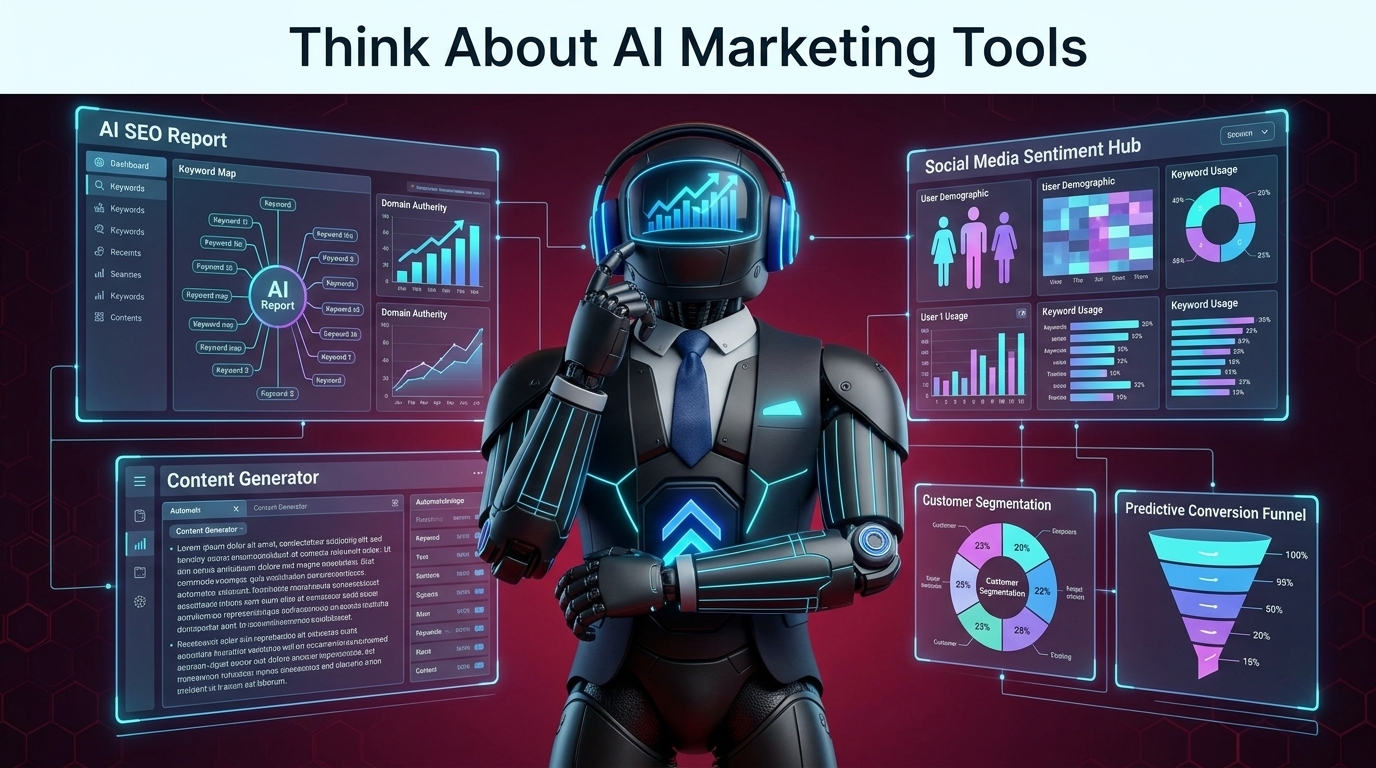
Before evaluating individual tools, it helps to understand the architecture of a marketing AI stack. Every marketing operation needs AI capability across six functions:
- Content creation — writing, image generation, video production
- SEO and search optimization — keyword research, content scoring, GEO/AEO optimization
- Paid media and advertising — ad creative, bid optimization, audience targeting, performance analysis
- Social media — scheduling, content adaptation, sentiment analysis, engagement automation
- Automation and workflows — connecting tools, triggering actions, orchestrating multi-step campaigns
- Analytics and intelligence — performance dashboards, attribution modeling, predictive analytics
Most marketing teams build their AI stack by adding tools one at a time as needs arise. The result is typically 8 to 12 separate subscriptions, each with its own login, its own data silo, and its own learning curve. The tools work individually but do not communicate with each other. Data from your analytics platform does not inform your content briefs. Insights from your SEO tool do not feed into your ad targeting. Performance signals from your campaigns do not trigger automated workflow adjustments.
This is the tool sprawl problem. And it is the single biggest reason why marketing teams adopt AI tools but do not see the compounding returns that AI should deliver.
The framework below covers the best tools in each category, then addresses the alternative: integrated AI marketing platforms that combine multiple functions into a single system.
Best AI Marketing Tools by Category
Content Creation
Content creation is where most marketing teams start their AI journey. The tools are mature, the use cases are clear, and the productivity gains are immediate.
ChatGPT remains the most widely used AI writing assistant in 2026. Its strength is versatility — blog drafts, email copy, social captions, brainstorming, research summaries, and ad copy all fall within its capability. The free tier is functional for light use. The Plus plan at $20 per month unlocks GPT-4o and longer context windows. Best for teams that need a general-purpose writing assistant across multiple content types.
Claude has emerged as the preferred choice for long-form content, nuanced writing, and tasks requiring careful reasoning. Its extended context window handles entire documents, making it particularly strong for content strategy work, competitive analysis, and editorial refinement. Free tier available. Pro plan at $20 per month.
Jasper is purpose-built for marketing content. It offers brand voice training, campaign-specific templates, and team collaboration features that general-purpose models lack. Best for agencies and larger teams that need consistent brand voice across multiple writers. Plans start at $49 per month.
Midjourney and Canva AI lead the visual content space. Midjourney produces high-quality AI-generated images for ad creative, social media, and branding. Canva AI integrates image generation, background removal, and design assistance directly into a familiar design workflow. Canva offers a generous free tier. Midjourney starts at $10 per month.
Descript, CapCut, and OpusClip cover video. Descript handles podcast and video editing with AI-powered transcription and filler-word removal. CapCut provides accessible short-form video editing with AI effects. OpusClip automatically converts long videos into short-form clips optimized for social platforms. All offer free tiers with paid plans for advanced features.
What to look for: Does the tool support your specific content formats? Does it allow brand voice customization? Can it integrate with your distribution workflow, or does it produce isolated outputs that require manual reformatting?
SEO and Search Optimization
SEO tools were among the earliest marketing applications of AI, and the category has matured significantly.
Surfer SEO is the leading content optimization platform. It analyzes top-ranking pages for any target keyword and provides a real-time content score based on keyword coverage, topical depth, heading structure, and word count. It turns SEO optimization from guesswork into a data-driven process. Plans start at $99 per month.
Semrush offers the broadest SEO toolkit — keyword research, competitor analysis, site audits, backlink tracking, and content planning all in one platform. Its AI features include keyword clustering, content gap analysis, and automated site health monitoring. Plans start at $139.95 per month.
Clearscope focuses specifically on content optimization with a clean interface and strong semantic analysis. It is particularly popular with content teams that want optimization guidance without the complexity of a full SEO suite. Plans start at $189 per month.
Frase combines content research, outline generation, and SEO optimization in a single workflow. It is strong at the planning stage — generating content briefs from SERP analysis with recommended headings, questions to answer, and topics to cover. Plans start at $15 per month, making it the most budget-friendly option.
MarketMuse operates at the content strategy level, using AI to model topical authority across your entire content library. It identifies content gaps, prioritizes topics by potential impact, and scores existing content for comprehensiveness. Best for teams managing large content libraries. Plans start at $99 per month.
What to look for: Does the tool cover both keyword research and content optimization? Does it account for GEO and AEO, or only traditional search rankings? Does it integrate with your content creation workflow?
Paid Media and Advertising
AI has transformed paid media from manual bid management into intelligent, self-optimizing campaign systems.
Google Performance Max is not a standalone tool but a campaign type that uses Google's machine learning across Search, Display, YouTube, Gmail, and Discover simultaneously. It optimizes targeting, bidding, creative selection, and placement automatically. Available within Google Ads at no additional cost beyond ad spend.
Madgicx provides AI-powered ad management for Meta (Facebook and Instagram) campaigns. It automates audience targeting, budget allocation, creative testing, and performance analysis. Its strength is turning Meta's complex advertising system into actionable, automated workflows. Plans start at $44 per month.
Unbounce Smart Traffic uses AI to automatically route landing page visitors to the variant most likely to convert them based on behavioral attributes. It turns A/B testing from a manual, sequential process into continuous, AI-driven optimization. Plans start at $99 per month.
What to look for: Does the tool optimize in real time or on a schedule? Does it support multi-platform campaigns or just one channel? Does it provide transparent attribution data, or is performance reporting opaque?
Social Media
Sprout Social AI combines social media management with AI-powered analytics, sentiment analysis, and optimal posting time recommendations. It is an enterprise-grade platform with comprehensive listening and engagement features. Plans start at $199 per month.
Predis.ai generates complete social media posts — caption, image, hashtags — from a single text prompt. It is purpose-built for social content at volume. Particularly useful for small teams and solopreneurs who need to maintain consistent social presence without dedicating hours daily. Free tier available. Paid plans start at $36 per month.
Brand24 is a social listening and sentiment analysis tool that monitors brand mentions across social media, news, blogs, forums, and podcasts in real time. It surfaces emerging conversations, tracks sentiment trends, and alerts teams to potential issues. Plans start at $199 per month.
What to look for: Does the tool cover listening and engagement, or only publishing? Does it support the specific platforms your audience uses? For Indian businesses, does it integrate with WhatsApp and Instagram Reels workflows?
Automation and Workflows
This is the connective tissue of any AI marketing stack. Automation tools link your other tools together and orchestrate multi-step workflows.
Gumloop is the emerging leader for complex, AI-native automation. Unlike traditional automation platforms, it supports multi-model LLM chains and dynamic logic paths. Marketing teams use it to build workflows that combine data ingestion, AI processing, and multi-platform distribution in a single flow. Plans start at $97 per month.
Zapier AI connects over 7,000 apps with AI-enhanced automation that can interpret natural language instructions and build workflows automatically. Its strength is breadth of integration. Free tier connects up to 100 tasks per month. Paid plans start at $29.99 per month.
n8n is the open-source alternative for teams that want full control over their automation infrastructure. It is self-hostable, offers complete data ownership, and supports complex workflows with visual node-based editing. Free to self-host. Cloud plans start at $24 per month.
What to look for: How many of your existing tools does the platform integrate with? Can it handle conditional logic, or only linear sequences? Does it support AI-native actions (triggering LLM calls within workflows)?
Analytics and Intelligence
Google Analytics 4 remains the foundation for web analytics with AI-powered insights, predictive audiences, and automated anomaly detection. Free for standard use. The platform's AI features surface trends and opportunities that manual analysis would miss.
Adobe Sensei powers AI features across Adobe's marketing suite — predictive analytics, automated audience segmentation, content intelligence, and attribution modeling. Best for teams already in the Adobe ecosystem. Enterprise pricing.
Perplexity is emerging as a research and competitive intelligence tool for marketers. Its citation-backed AI search provides quick, reliable answers for market research, trend analysis, and competitor monitoring. Free tier available. Pro plan at $20 per month.
What to look for: Does the tool provide predictive insights or only historical reporting? Does it offer multi-touch attribution? Can it connect data across your marketing channels into a unified view?
The Strategic Question: Point Solutions vs Integrated Platforms
Here is the question most AI marketing tool guides do not address.
Building a stack of 8 to 12 best-in-class point solutions gives you strong individual capabilities. But it also gives you:
- 8 to 12 separate subscriptions costing $500 to $2,000 or more per month combined
- 8 to 12 separate logins, interfaces, and learning curves
- Data silos between every tool with no unified intelligence layer
- Manual work connecting outputs from one tool to inputs of another
- No compounding effect — each tool operates independently, so performance in one area does not automatically improve performance in another
For enterprise teams with dedicated marketing operations staff, this fragmented approach is manageable. For startups, MSMEs, solopreneurs, and lean marketing teams — particularly in markets like India where budget efficiency is critical — it is unsustainable.
This is why integrated AI marketing platforms have emerged as an alternative. Instead of buying a content tool, an SEO tool, a social tool, an ad tool, an automation tool, and an analytics tool separately, you access all of these capabilities inside a single system where data flows between functions and every campaign informs the next.
FDS AI Studio is built on this principle. It combines 26 plus AI systems across six pillars — Creative AI (content writing, image generation, video creation, carousel design, UGC production), B2B Marketing AI (brand research, strategy, competitor intelligence, email engine), Sales and Conversion (AI calling, WhatsApp automation, CRM), Retention and Growth (reviews, referrals, social media automation), Analytics and Intelligence (marketing score, ad analyzer, ROI tracking, SEO monitoring), and Community (hub, academy, marketplace).
The pricing reflects the platform approach. Instead of paying $500 to $2,000 per month across multiple subscriptions, FDS AI Studio starts at zero with 100 free credits. Paid plans run from INR 2,500 (500 credits) to INR 75,000 (15,000 credits), with credits that never expire. Every tool in the platform shares the same data layer, so content insights inform ad targeting, analytics drive content strategy, and customer engagement data feeds back into campaign optimization automatically.
This is not about replacing every individual tool. Some teams will always prefer Surfer SEO for content scoring or Semrush for keyword research. The question is whether the rest of your marketing operation benefits more from five additional point solutions or from an integrated system that handles content, creative, sales, distribution, and analytics in one place.
The Decision Framework
Before adding another AI marketing tool to your stack, run through these five questions:
What specific problem does this tool solve? If you cannot name a concrete workflow it improves, you do not need it. AI tools should eliminate friction, not add another dashboard to check.
Does this tool integrate with my existing workflow? A powerful tool that operates in isolation often creates more work than it saves. Check whether it connects to your other platforms through native integrations or automation tools like Zapier or Gumloop.
Am I paying for overlapping capabilities? Many AI marketing tools now include features that overlap with other tools in your stack. Your SEO tool may include content generation. Your social media tool may include analytics. Audit for overlap before adding new subscriptions.
Does this tool contribute to a compounding system or just perform a task? The highest-value AI marketing tools are those that get smarter over time because they learn from your data. Tools that perform isolated tasks without learning or connecting to other data sources deliver diminishing returns.
Would an integrated platform serve me better than another point solution? If you are already managing 5 or more separate AI marketing tools, the overhead of managing the stack may be costing more than the tools are saving. This is the point where an integrated platform typically delivers better total value.
Where to Start if You Are Building From Zero
If you are a small team or solopreneur building your first AI marketing stack on a limited budget, here is a practical starting point using free and low-cost tools:
- Content creation — ChatGPT or Claude free tier for writing, Canva free for design
- SEO — Frase ($15 per month) for content optimization, Google Search Console (free) for performance tracking
- Social media — Predis.ai free tier for post generation, native platform scheduling
- Analytics — Google Analytics 4 (free) for web analytics, Perplexity free for research
- Automation — Zapier free tier (100 tasks per month) to connect your tools
Total cost: under $50 per month for a functional AI marketing stack.
As your needs grow, evaluate whether to upgrade individual tools or move to an integrated platform that consolidates multiple functions. The right answer depends on your budget, team size, and how many disconnected tools you are willing to manage.