Why the AI vs Traditional Marketing Debate Misleads You
Most founders asking "AI marketing or traditional marketing — which is better?" are actually asking the wrong question entirely.
The real question is simpler and more practical: where does your marketing rupee go, what does it return, and how quickly do you know whether it is working?
This article gives you an honest, number-grounded comparison — not a global framework built for Fortune 500 companies, but a ground-level look at what Indian MSMEs and growing businesses actually face when they choose between a traditional agency retainer and an AI-powered marketing system. By the end, you will have a clear picture of what each approach delivers, where each one fails, and why the smartest businesses in 2026 are not choosing between them.
What We Actually Mean by AI Marketing and Traditional Marketing
Before comparing the two, it is worth being precise about what each term means — because both are frequently misunderstood.
What Is Traditional Marketing
Traditional marketing covers any approach where human teams — either in-house or at an agency — manually plan, create, place, and optimise marketing campaigns. This includes:
- Television, radio, newspaper, and outdoor advertising
- Agency-managed social media and Google Ads
- Manual content calendars, email campaigns, and PR
- Retainer-based relationships with creative or performance agencies
The defining characteristic of traditional marketing is that human judgment drives every decision — from targeting to creative to budget allocation — and that process takes time, costs money in labour, and scales slowly.
What Is AI Marketing
AI marketing uses artificial intelligence, machine learning, and automation to handle functions that traditional marketing does manually. This includes:
- Predictive analytics that identify the highest-converting audience segments before a campaign launches
- Automated ad script generation trained on real performance data
- Personalization at scale — different messages for different buyer stages without manual creative production
- Real-time budget reallocation based on ROAS signals
- Buyer's journey mapping and remarketing automation that keeps leads warm without human follow-up
The defining characteristic of AI marketing is speed, precision, and the ability to operate at scale without proportional increases in cost or headcount.
The Real Cost Comparison: Retainer vs System
This is where most comparison articles go wrong — they talk about capabilities without talking about what things actually cost Indian businesses.
The Traditional Agency Retainer Model
A mid-tier marketing agency in India — one capable of handling social media, paid ads, and basic content — typically charges between ₹30,000 and ₹80,000 per month on retainer. At ₹50,000 per month, that is ₹6 lakh per year, before ad spend.
What that retainer typically includes:
- A dedicated account manager (shared across multiple clients)
- Monthly content calendar with 12 to 20 posts
- Basic Meta or Google Ads management
- Monthly performance report
- Creative production at a fixed volume
What it typically does not include:
- Proprietary frameworks built around your specific buyer psychology
- Scripts written from tested persuasion models
- Remarketing systems that nurture cold leads across platforms
- Real-time campaign optimisation at the signal level
- Transparent attribution — you often get a report, not a dashboard
The agency owns the system. When you stop paying, the system stops running. You have paid for access, not ownership.
The AI Marketing System Model
An AI-powered marketing system replaces the manual agency layer with automation, trained frameworks, and tools that generate output — ad scripts, nurture content, buyer journey plans — at a fraction of the time and cost.
What a well-built AI marketing system delivers:
- 5 complete, ready-to-shoot ad scripts in seconds — each targeting a different buying trigger
- A 3-month social media plan with the buyer's journey built in
- Remarketing sequences that keep cold leads warm across platforms automatically
- CPL (cost per lead) tracking at the campaign level — not a monthly PDF
- ROAS visibility in real time, not after the fact
The critical difference: you own the system. The frameworks, the content, the audience data — all of it stays with your business. The cost does not scale with output volume the way an agency retainer does.
For reference — campaigns built on this model have delivered qualified leads at ₹6 to ₹10 per lead, with ROAS reaching 7x to 9.8x on e-commerce campaigns. These are not projections. These are live ad account results.
Where Traditional Marketing Still Wins
Being honest about AI marketing means being honest about where traditional marketing continues to outperform it.
Brand Building and Emotional Storytelling
AI can generate scripts, optimise targeting, and personalise at scale. It cannot replace the human intuition behind a campaign that builds genuine emotional resonance over years. Traditional marketing — particularly television, cinema, and well-crafted long-form brand storytelling — has a depth of emotional impact that performance-focused AI systems are not designed to replicate.
For established brands investing in trust-building over multi-year horizons, traditional brand campaigns remain relevant.
Trust in High-Consideration Categories
In categories where purchase decisions involve significant emotional or financial risk — luxury real estate, healthcare, premium financial services — buyers want human touchpoints. A well-staffed traditional agency with relationship-based PR and event marketing builds the kind of trust that a performance ad funnel does not.
Reach in Non-Digital Markets
A significant portion of Indian consumers — particularly in Tier 2 and Tier 3 cities and in older demographics — are still reached more effectively through print, radio, and on-ground activations than through digital channels. Traditional marketing retains a structural advantage here that AI marketing cannot overcome with targeting alone.
Where AI Marketing Wins — and It Is Not Even Close
For most Indian MSMEs, D2C brands, and service businesses operating with defined monthly marketing budgets, AI marketing outperforms traditional marketing on every metric that directly affects business outcomes.
Speed from Brief to Launch
A traditional agency content calendar takes 7 to 14 days to produce and approve. An AI system generates 5 complete ad scripts from a single input in seconds. The difference in speed-to-market is not marginal — it is structural.
Precision Targeting and Personalization at Scale
Traditional marketing targets broad demographic segments. AI marketing targets behavioural signals — who clicked, who watched past 15 seconds, who visited the pricing page but did not convert. Remarketing automation built on these signals delivers the right message to the right prospect at the right stage of their buying journey, automatically.
This is personalization at scale — something a manual agency cannot operationally replicate without proportional cost increases.
Measurable ROI and Real-Time Attribution
Traditional marketing attribution is famously difficult. You run a newspaper ad or a television spot — and then you try to correlate it with a sales spike that may have been caused by five other factors simultaneously. The data is lagging, aggregated, and often directional at best.
AI marketing attribution is granular and real-time. You know your CPL, your ROAS, your cost per qualified conversation, and your return per campaign — while the campaign is running, not after it ends. That visibility changes how quickly you can make decisions and redirect budget.
Cost Per Lead at Scale
This is the number that matters most for most Indian businesses. A traditional agency retainer at ₹50,000 per month — before ad spend — means you are paying for output regardless of result. An AI-powered system where campaigns deliver qualified leads at ₹6 to ₹10 each means your cost is directly tied to performance.
At 871 qualified leads for ₹8,305 total spend — that is ₹9.54 per lead — the economics of AI marketing are not comparable to a fixed retainer model for volume-driven lead generation.
The Honest Answer: It Is Not Either/Or
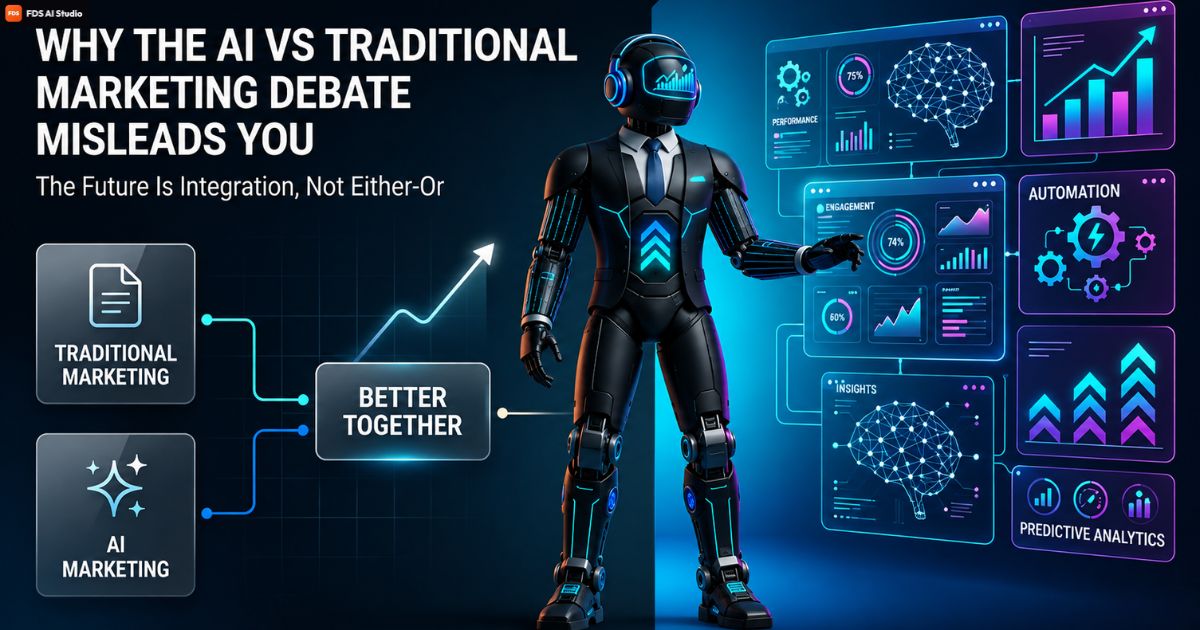
The founders and marketers who get this right in 2026 are not choosing between AI marketing and traditional marketing. They are building a system where AI handles the performance layer — lead generation, nurturing, attribution, remarketing — and traditional human judgment handles the brand layer — positioning, emotional storytelling, high-trust relationship building.
A practical framework for Indian businesses:
- Early-stage and budget-constrained — Start entirely with AI marketing. Build the performance engine first. Generate leads, track CPL, prove the model. Do not pay a retainer you cannot measure.
- Growth stage with proven product-market fit — Layer traditional brand-building on top of a working AI performance system. Use the data from your AI campaigns to inform your brand messaging.
- Established brand with multi-channel presence — Run both in parallel. AI handles performance and attribution. Traditional handles brand equity and trust in high-consideration channels.
The mistake most businesses make is starting with brand-building when they have not yet built a lead generation system. You cannot afford emotional storytelling if you cannot afford consistent lead flow.
What FDS AI Studio Does Differently
FDS AI Studio is not a traditional agency and not a generic AI tool. It is a complete Lead Generation and Lead Nurturing system built on 13 years of real ad results across 65+ brands — now running on autopilot.
The system has three gears that work together:
- Gear 1 — Video Ads Engine: Five complete, ready-to-shoot ad scripts generated from a single input, each targeting a different buying trigger — cost pain, trust gap, time drain, fear of loss, and the big desire.
- Gear 2 — First Impression Video: The first video your lead sees. In 30 seconds, it answers one question — why you, not the competitor.
- Gear 3 — Remarketing Engine: A 3-month buyer's journey social plan plus remarketing that follows cold leads across platforms and warms them until they convert.
When all three run together, qualified leads do not trickle in — they run on autopilot. The target is under ₹10 per qualified lead. The results from live campaigns show it is achievable — consistently.
For more on how the system works and what results look like across different business categories, visit the FDS AI Studio Blog
The Bottom Line
The AI marketing versus traditional marketing debate is mostly a distraction. The real question is whether your marketing is generating qualified leads at a cost that makes business sense — and whether you know, in real time, whether it is working.
For most Indian businesses in 2026, AI marketing wins on speed, cost, precision, and attribution. Traditional marketing still wins on emotional depth and trust in high-consideration categories. The best businesses use both — AI for the performance engine, traditional for the brand layer — and they always build the engine first.
Stop running ads on luck. Build a system.