The Reason Indian Customers Pick Competitors Over You
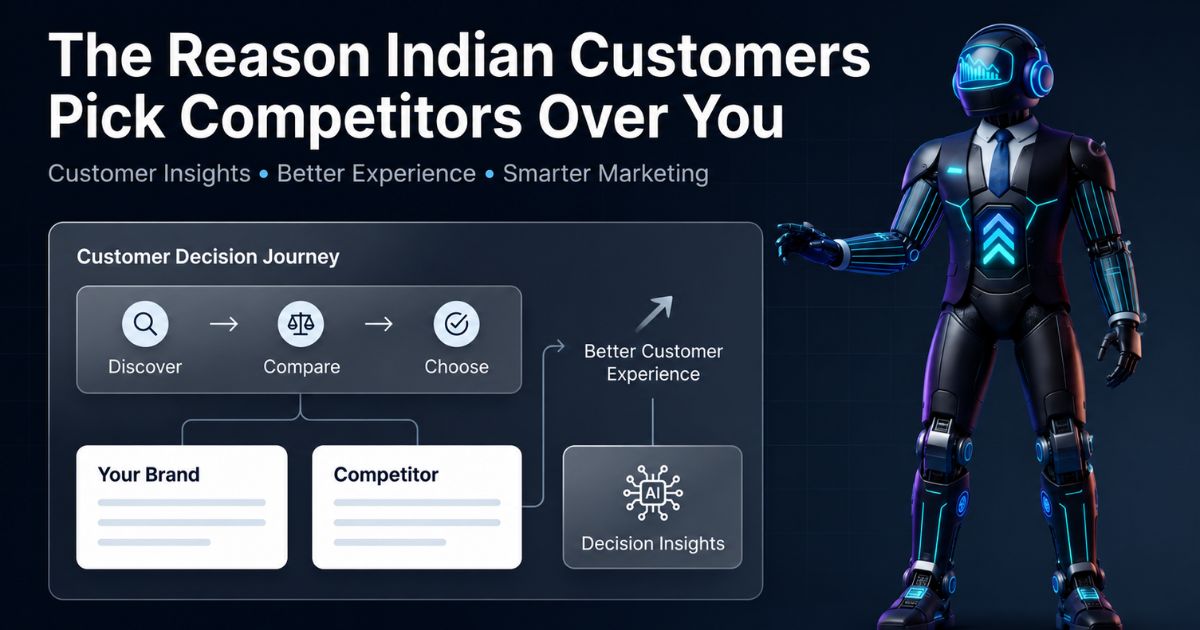
Your product is good. Your service is solid. Your clients who stay, stay for years.
So why does a stranger on Instagram or WhatsApp look at your page for eleven seconds and then call your competitor?
Not because the competitor is better. Because they were clearer, faster. Their profile answered the prospect's real question — why you and not everyone else — before the prospect had to ask it.
That is a positioning problem. And it is the most expensive silent problem an Indian small business carries.
This article gives you the framework to fix it — not a marketing-textbook lecture, but a working 30-second structure you can shoot on your phone, write on your WhatsApp status and paste into your Google Business Profile description today.
What Brand Positioning Actually Means for a Small Business
Positioning is not your logo. It is not your tagline. It is not your brand colours.
Brand positioning is the single sentence that lives in your customer's mind and explains why they chose you.
Philip Kotler's academic definition talks about occupying a "distinct place in the consumer's mind." That is correct but useless without translation.
Here is the translation: when a prospect finishes looking at your business and someone asks them "so what does this company do?", whatever they say back is your actual positioning. Not the version you wrote. The version they retained.
For most Indian MSMEs, what they retain is nothing specific. "Some company that does design things" or "some property guy, I think." That blank is costing you business every week.
Why This Hits Indian Small Businesses Harder
India's market has a particular dynamic that makes weak positioning more damaging here than in most other countries:
- Price sensitivity is sky-high. Without a clear differentiator, every conversation defaults to "bhai, thoda discount milega?" Price negotiation becomes unavoidable when there is no other reason to choose you.
- Trust travels through networks. Indian buyers rely on referral and social proof more than most markets. A sharp positioning statement gives your existing customers something specific to say when they refer you.
- WhatsApp is your sales floor. The first impression most prospects get is your WhatsApp Business description, your status, or a forwarded message. Those mediums reward clarity ruthlessly — you have three seconds and 40 words.
- Founder = Brand in the early stages. You are not Unilever. You do not have a marketing department. You are the face of the business, and your ability to position yourself in a room, a DM or a five-second reel decides the deal.
The Positioning Mistake Every Indian MSME Makes
Most small businesses describe what they do instead of why it matters to the person reading it
Look at the difference:
What they write
What the prospect hears
"We provide quality digital marketing services"
So does everyone
"15 years of experience in interior design"
That's your problem, not mine
"End-to-end branding solutions"
What does that even mean
"We help mid-sized manufacturers in Delhi generate B2B leads through AI-powered content in 90 days"
I need to know more
The last one works because it answers five questions simultaneously — who you serve, what outcome you deliver, where you operate, how you do it, and by when. Everything else is noise.
The Patanjali Example Nobody Explains Properly
Patanjali did not grow by having better products than HUL or P&G. Many of their early products were functionally similar to established alternatives.
They grew because their positioning was pre-loaded with meaning. Swadeshi. Natural. Indian. Baba Ramdev. Every one of those words carried an existing emotional association with a large segment of Indian buyers who already felt that multinationals did not truly belong to them.
Patanjali did not create a market. They occupied a position that was sitting empty — the unapologetically Indian FMCG brand. Once that position was claimed, it was nearly impossible for a Colgate or a Lifebuoy to follow them there without looking ridiculous.
Your opportunity is identical, at your scale. Find the position in your category that is sitting empty. Occupy it with a specific, repeatable, visual statement. Own it before someone else does.
The Brand Positioning Framework for Indian Small Businesses
The 30-Second Positioning Skeleton
This structure has five beats. Each beat is one sentence. Together they form a pitch you can speak, shoot, type or display in under 30 seconds.
Beat 1 — Hook the Pain Name the specific frustration your target customer is sitting with right now.
"Most [target customer] are tired of [specific problem] that is costing them [consequence]."
Beat 2 — Name the Villain Identify what or who has been causing that pain. Not a competitor — a category of failure.
"Most agencies / vendors / solutions they have tried [specific reason they keep failing]."
Beat 3 — Present Your Differentiation State what you do differently. This is your USP — but stated as a contrast, not an announcement.
"We are the only [category] in [market] that [specific differentiator]."
Beat 4 — Proof One number. One specific result. One named transformation. Not a list. One.
"In the last [timeframe], we have helped [number] [customer type] achieve [specific result]."
Beat 5 — CTA Tell them exactly what to do next. One action, no alternatives.
"If that sounds like what you need, [specific action] right now."
Positioning Statement Examples for Indian Businesses
Example 1 — Interior Designer, Delhi "Most homeowners in Delhi get beautiful interiors that go ₹3 lakh over budget before the sofa arrives. Most interior designers underquote and overpromise. We fix the budget problem first — every project is delivered with a signed cost guarantee before we buy a single fitting. 47 homes completed, not one cost overrun. Book a free walk-through call today."
Example 2 — CA Firm, Ahmedabad "Most small manufacturers in Gujarat spend 8 to 12 hours a month fighting GST filing anxiety they shouldn't have. Most CA firms file your returns and disappear. We file, audit, and audit-proof — every quarter, every return, with a dedicated contact who answers your WhatsApp within four hours. 200 manufacturers, zero missed deadlines in three years. Message us to check if you're making any of the three most common GST errors right now."
Example 3 — AI Marketing Agency "Most MSMEs are invisible to the buyers who are actively searching for what they sell. Most digital agencies give you posts and reports — not leads. We build AI-powered content systems that move prospects from discovery to inquiry in 90 days. 65+ brands, documented lead growth. Tell us your target customer and we will show you exactly where they are searching right now."
Notice what every example has: a named target, a named problem, a specific differentiator, a single proof point, and one next action. That formula is not a coincidence — it is the structure that converts.
How to Build Your Own Positioning Statement: Step by Step
Step 1 — Define Your Target Customer in One Line
Not "everyone who needs a website." Not "MSMEs." The narrower the better.
"30–45 year old male manufacturers in Rajasthan with a B2B customer base and a sales team of 5–15 people."
Narrowing feels terrifying. It is actually what makes the rest of the statement sharp.
Step 2 — Name the Pain They Are Actively Feeling
Not a problem you think they have. The exact frustration they would type into Google at 11 PM when they cannot sleep.
Spend 20 minutes reading reviews of your closest competitors on Google Business Profile. The one-star and two-star reviews are a masterclass in real customer pain. Use their exact language — not your professional translation of it.
Step 3 — State Your Differentiator as a Contrast
Avoid these dead phrases:
- "We provide quality service"
- "Customer satisfaction is our priority"
- "Best in class"
- "One-stop solution"
These phrases exist in every business's description. They are positioning noise, not positioning signals.
Instead, finish this sentence: "We are the only _____ that _____."
If you cannot finish that sentence, your differentiation is not yet clear enough to communicate.
Step 4 — Find Your One Number
A number transforms a claim into evidence. Not a range. Not "many clients." One specific number.
- 47 projects
- 300% average follower growth
- ₹2.4 crore in client revenue attributed
- 11 states served
If you do not have a number yet, start tracking one today. Even if it is small, a specific number beats a vague superlative every time.
Step 5 — Write the Positioning Statement
Combine all four elements in the skeleton above. Write it. Then cut it by 30 percent. Then say it out loud and time yourself. If it takes longer than 30 seconds, cut again.
Where to Deploy Your Positioning Statement
A positioning statement you keep in a document is not positioning. Deploy it everywhere your prospect might encounter you in the first three seconds.
Essential Touchpoints for Indian Small Businesses
- WhatsApp Business description — 139 characters, make every one count
- WhatsApp Status — 30-second video using the five-beat framework, updated weekly
- Google Business Profile description — first 250 characters are what most people see
- Instagram bio — one line, your target customer + your differentiation
- Instagram/Facebook Reel hook — the first 3 seconds must be Beat 1 (the pain)
- Website hero headline — not your company name, your positioning statement
- Email signature — one sentence under your name
- First message when responding to an inquiry — position before you pitch
The Founder Brand Problem and How to Solve It
Most Indian small businesses start as founder brands. The founder is the face, the trust builder, the relationship. That works at ₹50 lakh revenue. It breaks at ₹2 crore.
The transition happens when the business positioning becomes distinct from the founder's personal positioning. That means your business statement needs to stand without your photo next to it.
Test this: send your positioning statement to someone who has never met you. Ask them: "What kind of company is this and why would you choose them?" Their answer is your current positioning reality.
Positioning Red Flags to Fix Before You Publish Anything
- You describe your services but not your customer's outcome
- Your bio says "passionate" or "dedicated" — words that mean nothing
- Your WhatsApp Business description is blank or uses your address as the description
- Your website headline is your company name with a tagline that sounds like a mission statement
- You have never written down the one thing you do that no direct competitor does
- You change your "messaging" every month because nothing sticks
- You have testimonials but none of them say anything specific
The Bottom Line
Your competitor is not beating you on product quality. They are beating you on clarity.
The 30-second skeleton above — Hook Pain, Villain, Differentiation, Proof, CTA — is not theory. It is the exact structure used in every high-converting reel, every cold outreach message, and every founder introduction that actually converts a stranger into a paying customer.
Write your version today. Say it out loud. Time it. Trim it. Then post it as your WhatsApp status tonight.
You have been building the right business. Start saying the right thing about it.
For a deeper dive into brand systems, content frameworks and the AI tools that scale positioning across every touchpoint, visit FDS AI Studio or browse the full FDS AI Studio blog for implementation guides built specifically for Indian MSMEs.