Buyer Journey Content Strategy for Every Indian Business
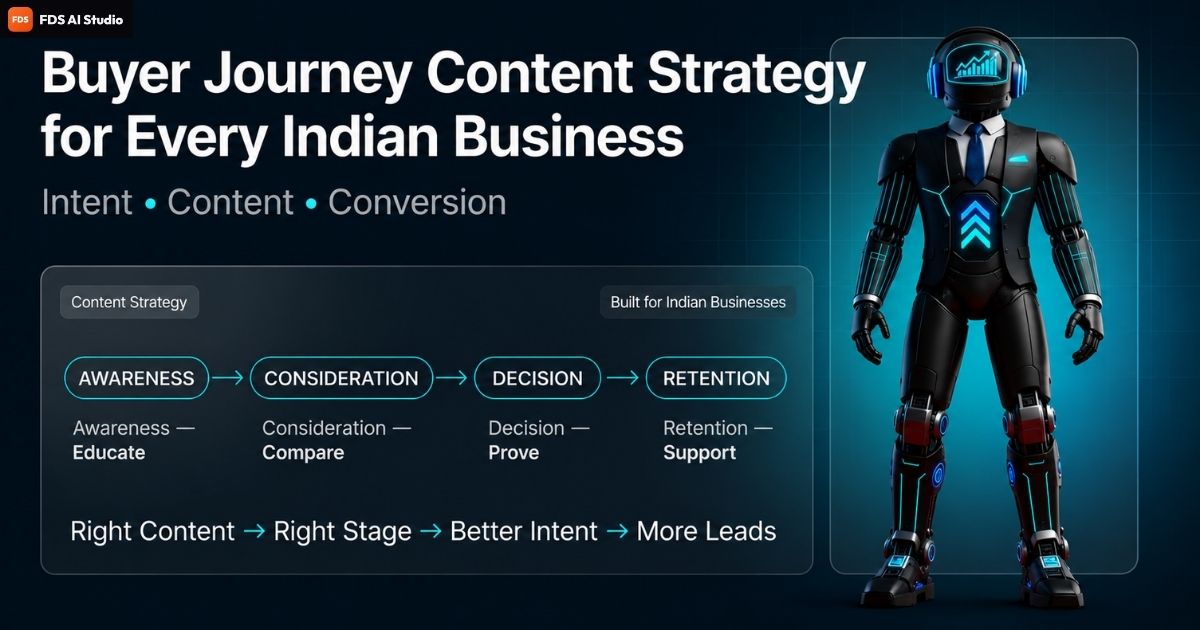
Indian businesses often face a familiar content marketing problem. You are posting consistently on Instagram, LinkedIn, Facebook, or your blog, but the enquiries and conversions do not seem to match the effort.
The problem may not be the frequency of your content. It may be that your content is not connected to the buyer journey.
A person discovering your business for the first time needs very different content from someone comparing your service with three competitors. Similarly, someone who already trusts your brand needs decision-focused content rather than another generic educational post.
For Indian businesses, this journey also has an important layer that generic Western funnel models often overlook: WhatsApp conversations, referrals, price sensitivity, social proof, family or peer influence, repeated follow-ups, and trust before purchase.
This is where a buyer journey content strategy becomes useful.
What Is a Buyer Journey Content Strategy?
A buyer journey content strategy maps your content to the different stages a prospect passes through before becoming a customer.
The traditional model has three broad stages:
- Awareness: The prospect identifies a problem or need.
- Consideration: The prospect researches solutions and compares alternatives.
- Decision: The prospect evaluates providers and decides whether to buy.
These are commonly called TOFU, MOFU, and BOFU, or Top of Funnel, Middle of Funnel, and Bottom of Funnel.
However, Indian purchase behaviour is rarely this linear.
A prospect may see your Instagram Reel, ignore your brand for two months, ask a friend about you, visit your website, check Google reviews, send a WhatsApp message, negotiate pricing, and then finally purchase.
Your content strategy therefore needs to support the entire audience journey, rather than treating the buyer funnel as a straight line.
Why Indian Businesses Need an India-Aware Content Funnel
A generic buyer funnel tells you what stage someone is in. An India-aware content strategy also considers how the person is likely to make the decision.
For many Indian businesses, trust is a major part of the buying process.
A prospect may ask:
- Is this business genuine?
- Has anyone I know used this service?
- What do previous customers say?
- Is the price justified?
- Can I speak to someone on WhatsApp?
- What happens after I make the payment?
- Is there a better option available?
- Can I negotiate?
- Does this company understand my specific requirement?
This means your content should not simply educate people about your product or service.
It should progressively answer the questions that prevent them from buying.
The three content objectives should be simple
Month 1: Attract
Build visibility and address problems your target audience already cares about.
Month 2: Trust
Demonstrate expertise, credibility, results, processes, and customer experiences.
Month 3: Convert
Give qualified prospects reasons and opportunities to take the next step.
This creates a practical MCB framework: Month 1 Attract, Month 2 Trust, Month 3 Convert.
Map Content to the Three Buyer Stages
A strong customer journey content map India strategy starts by asking one question:
What does the buyer need to know before moving to the next stage?
Buyer Stage
Buyer Mindset
Content Goal
Suitable Content
Awareness
"I have a problem."
Attract attention
Educational posts, Reels, blogs, checklists
Consideration
"What solution should I choose?"
Build trust
Case studies, comparisons, FAQs, guides
Decision
"Which provider should I choose?"
Remove hesitation
Testimonials, demos, offers, consultations
Let's look at each stage in detail.
1. Awareness Content: Help Buyers Recognise the Problem
At the awareness stage, the buyer may not even know your business exists.
They are searching for answers rather than companies.
For example, an Indian SME owner may search:
"Why am I getting website traffic but no leads?"
They are not necessarily looking for an agency yet.
This is where educational content works.
Good awareness content includes:
- "Why Your Website Gets Traffic but No Enquiries"
- "5 Reasons Your Instagram Posts Get Views but No Leads"
- "How Indian Customers Research Local Businesses"
- "Common Digital Marketing Mistakes Made by Small Businesses"
- "Why Posting Every Day Does Not Guarantee Sales"
The objective is not to sell immediately.
The objective is to make the prospect think:
"This business understands my problem."
That recognition creates the first layer of trust.
2. Consideration Content: Build Trust
Once prospects understand their problem, they start evaluating possible solutions.
This is where many businesses make a mistake.
They continue publishing awareness content when the audience has already moved forward.
A prospect who understands the problem now wants evidence.
They want to know:
"Can this actually work for a business like mine?"
This is where consideration content becomes important.
Use content such as:
- Case studies
- Before-and-after examples
- Client success stories
- Service comparisons
- Detailed guides
- Process explainers
- FAQs
- Expert opinions
- Industry-specific strategies
- Pricing explanations
- Common objections
For example, instead of another post about "Why SEO Matters", create:
"How We Structured SEO for a Local Indian Business to Build Qualified Organic Leads."
The second topic gives the audience something concrete to evaluate.
This is trust-building content, not simply educational content.
3. Decision Content: Make Conversion Easier
At the decision stage, the prospect already understands the problem and has probably researched multiple solutions.
Your job is to reduce uncertainty.
Decision-stage content can include:
- Client testimonials
- Detailed case studies
- Service demonstrations
- Product or service walkthroughs
- Free consultations
- Strategy calls
- Pricing guides
- Implementation timelines
- Guarantees where applicable
- FAQs addressing objections
- Strong calls to action
For an Indian business, the CTA should also match the way people prefer to communicate.
Instead of relying exclusively on:
"Book a Demo"
you may also use:
"Talk to an Expert on WhatsApp"
or
"Send Us Your Requirement on WhatsApp."
The important point is not that WhatsApp should replace your website or CRM. It should become one possible bridge between content consumption and sales conversation.
The MCB Framework for a 90-Day Content Plan
If your existing content feels disconnected, restructure your next three months around the MCB framework.
Month 1: Attract
The first month should focus heavily on awareness.
A practical content mix could include:
- Problem-focused blogs
- Educational social posts
- Short-form videos
- Industry tips
- Myth-busting content
- Beginner guides
- Search-focused content
- Common mistakes
Your audience should finish Month 1 knowing:
"This brand understands my problem."
Month 2: Trust
Now move deeper.
Create content that demonstrates expertise and credibility.
For example:
- 2 case studies
- Client results
- Expert-led videos
- Service comparison posts
- Process explainers
- Customer FAQs
- Behind-the-scenes content
- Testimonials
- Detailed LinkedIn posts
- Industry-specific guides
The audience should now think:
"This brand knows how to solve my problem."
Month 3: Convert
The final stage focuses on qualified prospects.
Create content around:
- Service pages
- Product demonstrations
- Consultation offers
- Client testimonials
- Case studies
- Pricing FAQs
- Objection-handling posts
- Comparison content
- Strong CTA posts
- Retargeting campaigns
The desired response becomes:
"I am ready to talk."
How to Align Content With Buyer Stages in India
One of the easiest ways to implement a buyer journey content strategy for Indian business is to create a simple content matrix.
Buyer Question
Content Type
Funnel Stage
CTA
What is my problem?
Educational blog
TOFU
Read more
Why is this happening?
Reel/guide
TOFU
Follow
What solutions exist?
Comparison
MOFU
View guide
Which solution is suitable?
Case study
MOFU
See results
Why should I choose you?
Testimonial
BOFU
Talk to us
How does it work?
Demo
BOFU
Book consultation
What will it cost?
Pricing FAQ
BOFU
Get quote
Can I trust you?
Reviews/case study
BOFU
WhatsApp us
This prevents your social media calendar from becoming a collection of unrelated posts.
Every piece of content has a job.
Build an FDS Social Media Grid
A useful way to operationalise the strategy is to divide your social media content into four broad categories:
Attract
Content designed to reach new audiences.
Examples:
- Industry trends
- Problems
- Mistakes
- Tips
- Educational Reels
- Search-driven topics
Educate
Content that demonstrates expertise.
Examples:
- How-to posts
- Frameworks
- Tutorials
- Checklists
- Expert insights
Trust
Content that reduces perceived risk.
Examples:
- Testimonials
- Case studies
- Client results
- Team expertise
- Behind-the-scenes content
- Process explanations
Convert
Content that encourages action.
Examples:
- Offers
- Consultations
- Product demonstrations
- Service explainers
- Lead magnets
- WhatsApp CTAs
This creates a more balanced FDS Social Media Grid rather than publishing promotional posts every day.
Don't Treat the Buyer Funnel as a Straight Line
One important principle in modern content marketing is that buyers do not always move neatly from awareness to consideration to decision.
Someone may:
See Reel → Visit Website → Leave → Read Blog → Search Brand → Check Instagram → Ask Friend → WhatsApp → Compare Competitor → Return to Website → Purchase
Your content needs to support these jumps.
This is particularly important for Indian businesses because trust can develop across multiple channels.
A buyer may discover you on Instagram but validate you through Google reviews.
They may read your blog but ultimately contact you through WhatsApp.
They may find you through Google but make the final decision after seeing a friend's recommendation.
Therefore, think in terms of a buyer journey, not just a funnel.
Use WhatsApp as a Journey Layer
For many Indian businesses, WhatsApp can sit between content marketing and sales.
For example:
Awareness content → Website → Case study → WhatsApp → Sales conversation
Your content can naturally encourage the next step without making every post aggressively promotional.
For example:
"Not sure which approach is suitable for your business? Send us your requirement on WhatsApp and our team can help you identify the right starting point."
The key is to maintain context.
If someone comes from a specific campaign, your sales team should ideally know what content or offer generated the conversation.
That makes the WhatsApp journey more relevant and reduces repetitive questioning.
Create Content Around Indian Purchase Behaviour
Indian buyers can be highly research-oriented, price-conscious, trust-driven, and influenced by recommendations.
That doesn't mean every Indian customer behaves identically. It means your content strategy should account for common decision factors rather than assuming one universal buying pattern.
Build content around questions such as:
Trust
"Who have you worked with?"
Value
"What am I getting for the money?"
Risk
"What happens if this doesn't work?"
Proof
"Can you show me results?"
Relevance
"Have you solved this problem for businesses like mine?"
Convenience
"Can I speak to someone quickly?"
Social validation
"What are other customers saying?"
When your content answers these questions before the sales call, prospects can enter the conversation with significantly more context.
A Simple Buyer Funnel Content Plan for Indian Businesses
Here is a practical 90-day structure.
Month
Primary Goal
Content Focus
Buyer Psychology
Month 1
Attract
Problems, education, trends, tips
"I have this problem."
Month 2
Trust
Case studies, proof, comparisons, expertise
"This could solve my problem."
Month 3
Convert
Demos, testimonials, offers, FAQs
"I should contact them."
You can then break each month into weekly themes.
Week 1
Identify the problem.
Week 2
Explain the problem.
Week 3
Present possible solutions.
Week 4
Show proof.
Then repeat the cycle for different customer pain points.
This gives your content calendar a strategic structure instead of forcing you to find random topics every morning.
How to Measure Whether Your Content Is Moving Buyers
Do not evaluate every post using likes and impressions alone.
Different buyer stages have different success metrics.
Stage
Useful Metrics
Awareness
Reach, impressions, organic traffic, video views
Consideration
Time on page, returning visitors, saves, shares, case-study views
Decision
Leads, WhatsApp conversations, enquiries, demos, consultations
Conversion
Qualified leads, sales, conversion rate, revenue
A TOFU Reel generating 50,000 views may be successful even if it generates few direct leads.
A BOFU case study generating 500 views but five qualified enquiries could be significantly more valuable.
The metric should match the buyer stage.
Turn Your Content Calendar Into a Buyer Journey Map
Before creating your next month's content, make a simple spreadsheet with these columns:
Content Topic | Buyer Stage | Customer Problem | Content Format | CTA | Next Step | KPI
For example:
Content Topic
Stage
Format
CTA
5 reasons your website isn't generating leads
Awareness
Reel
Read blog
SEO vs Paid Ads for SMEs
Consideration
Carousel
Download guide
Client SEO case study
Trust
Case study
View services
How our SEO process works
Decision
Video
WhatsApp us
Frequently asked questions
Decision
Carousel
Book consultation
Now every post has a relationship with the next stage.
That is the difference between posting content and building a content system.
Final Takeaway
A successful buyer journey content strategy for Indian business should not be built around posting more content.
It should be built around moving the right audience from attention to trust and from trust to action.
Use the MCB framework:
Month 1: Attract
Create content that identifies problems and earns attention.
Month 2: Trust
Use expertise, proof, case studies, and social validation to reduce uncertainty.
Month 3: Convert
Use demos, testimonials, offers, FAQs, and WhatsApp conversations to create action.
Most importantly, stop asking:
"What should we post today?"
Instead ask:
"Which buyer stage does this content serve, and what should the prospect do next?"
That single change can turn a disconnected content calendar into a strategic buyer journey content map for India, where blogs, social media, remarketing, WhatsApp, and sales content work together toward the same business objective.
For more practical AI-powered content and marketing strategies, visit FDS AI Studio and explore its blog.