Map Your Social Media to the Buyer Journey and Win Leads
Most businesses treat social media as a broadcast channel. They post when they have something to say, create content around what feels relevant that week, and measure success by likes and follower growth. Then they wonder why the enquiries never arrive.
The problem is not the content. The problem is the sequence.
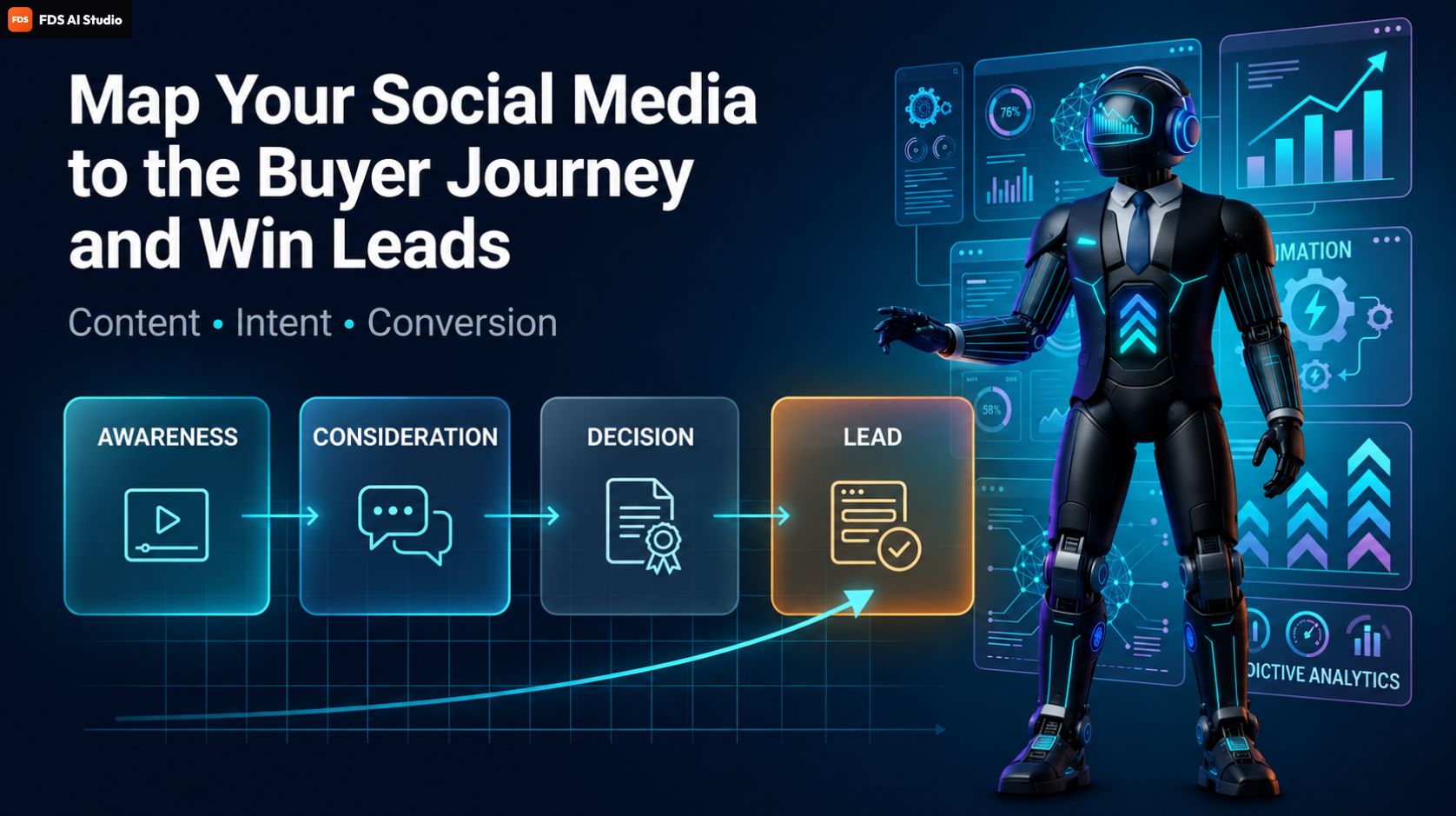
A buyer does not go from first seeing your page to sending an enquiry in a single step. They move through a journey — from not knowing you exist, to being aware of what you do, to evaluating whether you are the right choice, to finally deciding to act. Each of these stages requires a different type of content, a different tone, and a different call to action.
When your social media posts are not mapped to these stages, every piece of content is trying to do too many things at once — attract new audiences, build trust, and convert to enquiry — and succeeds at none of them. When your posts are mapped correctly, every piece of content has a single, clear job and builds on the one before it.
The Buyer Journey on Social Media: Why It Is Not Linear
Before mapping content to buyer stages, it is important to understand one thing that most TOFU-MOFU-BOFU guides get wrong: the buyer journey on social media is not a straight line.
A person does not see one awareness post, then one consideration post, then one decision post and convert. They loop. They see your Reel, scroll past, see it again three days later, save it, see a testimonial post a week after that, read your FAQ carousel, forget about you for two weeks, then see a remarketing post and finally send a message.
This looping, non-linear behaviour has two practical implications for your content strategy:
First, you need all three types of content — awareness, consideration, and conversion — running simultaneously at all times. A strategy that focuses entirely on awareness for a month and then switches to conversion misses the people who entered the loop at different points.
Second, remarketing is not optional. The people who have already seen your content but have not yet converted are your warmest audience. They need specific conversion-stage content served to them directly — not the same awareness content they already saw.
With this in mind, here is how to build the strategy correctly.
Stage 1: Awareness Content (TOFU — Top of Funnel)
Awareness content is for people who do not know you exist yet, or who have seen your page once but have no strong reason to pay attention. Its only job is to stop the scroll and create enough relevance that the viewer follows, saves, or engages.
Awareness content succeeds when a stranger thinks: "This page understands my problem."
What Awareness Content Looks Like
Problem identification posts: Describe a specific pain point your target customer experiences — in precise, relatable language. Not "running a business is hard" but "you are spending hours every week on tasks that still produce no consistent leads." The more specific the problem description, the more powerfully it resonates.
Myth-busting content: Challenge a common assumption in your industry. "Everyone says you need a big budget to generate leads on social media. Here is why that is wrong." This format creates a pattern interrupt — the viewer expects one answer and receives the opposite.
Educational hooks: One surprising fact, one counterintuitive insight, one statistic that changes how the viewer thinks about a topic they care about. These perform well as Reels and carousels because they deliver immediate value in a short format.
Relatable observations: Content that mirrors the daily reality of your target customer — their frustrations, their workarounds, their unspoken problems. When the viewer thinks "that is exactly what I do," you have created identification without selling anything.
What Awareness Content Is Not
Awareness content is not product promotion, service listings, testimonials, or offers. None of these belong at the top of the funnel for a cold audience. A person who does not know you yet has no frame of reference for your offer — it means nothing to them. Show them you understand their world first.
Platform Priority for Awareness Content
Instagram Reels and Facebook video content are the highest-reach formats for awareness. Both platforms algorithmically surface short video content to non-followers when engagement signals are strong. Awareness content should be optimised for non-follower discovery — which means hooks that work without any prior knowledge of your brand.
Stage 2: Consideration Content (MOFU — Middle of Funnel)
Consideration content is for people who have already seen you — they follow your page, they have encountered two or three of your posts, they have a general sense of what you do. Its job is to deepen trust, demonstrate genuine expertise, and build the belief that you specifically can solve their specific problem better than the alternatives.
Consideration succeeds when a warm follower thinks: "This person actually knows what they are talking about."
What Consideration Content Looks Like
Case studies with specific results: Not "we helped a client grow their business" but "this client had three enquiries per week before working with us. Four days after launching the new campaign, they had twenty-three." Specific numbers, real timelines, named outcomes. Vague success stories do not build trust — precision does.
Behind-the-scenes process content: Show how you actually work. Your methodology, your quality standards, your decision-making process, your tools. This content demystifies what it is like to work with you and reduces the uncertainty that stops warm audiences from enquiring.
FAQ and objection-handling content: Address the specific questions and doubts your prospects have before deciding. "Is this too expensive for a small business?" "How long does it take to see results?" "What makes this different from what I have already tried?" Answering these questions in content removes the barriers that stop warm audiences from converting.
Detailed testimonials: Not generic five-star graphics — specific testimonials that describe a named problem, a named solution, and a measurable outcome. "Before working with FDS AI Studio, I was generating zero inquiries from social media. Within three months of implementing the buyer journey content plan, I had consistent weekly leads." This format builds far more trust than a generic endorsement.
Educational frameworks and tools: Content that teaches something genuinely useful — a framework, a checklist, a comparison, a step-by-step process — demonstrates depth of knowledge that generic content cannot. Viewers who save and revisit your framework posts are your warmest consideration-stage audience.
What Consideration Content Is Not
Consideration content is not a direct offer or a hard CTA pushing for immediate purchase. The middle of the funnel is where trust is built — rushing to the offer at this stage breaks the trust you are trying to create. The viewer needs to believe you before they are ready to buy from you.
Platform Priority for Consideration Content
Instagram carousels are the highest-save format on the platform — and saves are the strongest signal of consideration-stage engagement. A carousel that teaches a complete framework, addresses multiple objections, or walks through a detailed case study performs better as a trust-building tool than any single-image post. Facebook long-form posts also work well for consideration of content with audiences that read and engage with text.
Stage 3: Conversion Content (BOFU — Bottom of Funnel)
Conversion content is for people who are warm — they follow you, they engage with your posts consistently, they have seen your proof and your expertise. Its job is to give them a specific, low-friction next step that moves them from warm follower to active enquiry.
Conversion content succeeds when a warm follower thinks: "I am ready to take the next step."
What Conversion Content Looks Like
Direct offer posts: A specific, time-anchored offer with clear value and a clear CTA. Not "contact us to learn more" but "we are taking on three new clients this month — send us a message with the word SYSTEM and we will map your lead generation plan."
Lead magnet posts: A free resource — checklist, template, audit, consultation — that delivers immediate value in exchange for a WhatsApp message or DM. The lead magnet should solve a specific problem your warm audience has been thinking about. When they claim it, you have a direct communication channel.
Social proof at decision point: Testimonials and results specifically framed around the decision moment — "here is what happened for someone exactly like you, who had the same hesitation you have right now." This format addresses the final objection that stops warm audiences from acting.
Scarcity and urgency content: Limited availability, limited time, or a specific trigger that makes acting now more compelling than waiting. This is only effective with a warm audience — scarcity with a cold audience creates pressure without trust and fails to convert.
Remarketing content: Content specifically designed for people who have engaged with your Stage 1 and Stage 2 posts but have not yet enquired. This can be delivered through Instagram Stories to close followers, Facebook retargeting to warm page visitors, or WhatsApp broadcasts to opted-in contacts. Remarketing content references the journey — "you have been following along, here is the next step."
Platform Priority for Conversion Content
Instagram Stories with DM stickers and link stickers are the lowest-friction conversion mechanisms on the platform. WhatsApp CTAs in Facebook posts and Instagram captions drive direct messaging for Indian audiences. WhatsApp broadcast messages to opted-in contacts are the highest-converting nurture channel for warm audiences who have not yet acted.
The MCB Framework: Writing Posts That Move People Forward
Every post in a buyer journey content strategy — regardless of stage — should follow the MCB framework: Message, Connect, Buy. This three-part structure ensures every piece of content has a clear point, builds identification, and moves the viewer toward a next step.
Message
State the single most important thing this post is about — the hook, the problem, the insight, the claim. One sentence. Unmissable. The Message is what stops the scroll and earns the viewer's attention for what follows.
At awareness stage: The Message is a problem statement or a surprising observation.
At consideration stage: The Message is a proof point or an educational promise.
At conversion stage: The Message is an offer or an outcome claim.
Connect
Expand on the Message in a way that the target viewer personally identifies with. Specific details, specific situations, specific language that mirrors how they think and talk about this problem or this goal. The Connect section is where trust is built within a single post.
At awareness stage: Connect describes the pain in enough detail that the viewer thinks "this is exactly my situation."
At consideration stage: Connect shows your process, your proof, or your framework in enough depth that the viewer believes you genuinely understand the solution.
At conversion stage: Connect addresses the final objection — cost, timing, uncertainty — that the warm viewer still has before acting.
Buy
Tell the viewer exactly what to do next. One action. Specific. Low friction. The Buy step at awareness stage is a soft CTA — follow, save, share. At consideration stage it is a value exchange — "download this," "save this framework." At conversion stage it is a direct lead capture — "DM me this word," "send us a WhatsApp message," "click the link in bio."
Every post that ends without a Buy step is a missed opportunity — not necessarily a lost lead, but a moment where the viewer's momentum was not directed anywhere.
The 3-Month Buyer Journey Execution Grid
This is what makes the strategy operational rather than theoretical — a monthly posting structure that maps content types to buyer stages across ninety days, with the ratio shifting progressively toward conversion as the audience warms.
Month 1: Attract and Connect
Primary objective: Build audience, establish content identity, earn follows and saves from the right people.
Content ratio:
- 50 percent Stage 1 awareness content
- 30 percent Stage 2 consideration content
- 20 percent Stage 3 conversion content
Post types this month: Problem identification Reels, myth-busting carousels, relatable observations, light behind-the-scenes content, introductory case studies, one lead magnet introduction with a soft CTA.
Posting frequency: Minimum four posts per week — two Reels, one carousel, one Story series.
Month 1 success signal: New followers who match your target audience profile. Saves on educational posts. Comments that ask questions rather than leaving generic reactions. These signals confirm that the right audience is entering the funnel.
Month 2: Build Trust and Warm the Audience
Primary objective: Move the audience attracted in Month 1 from awareness to genuine consideration. Build enough trust that warm followers begin engaging with conversion content when it appears in Month 3.
Content ratio:
- 30 percent Stage 1 awareness content — maintain top-of-funnel reach
- 50 percent Stage 2 consideration content — heavy trust-building phase
- 20 percent Stage 3 conversion content — lead magnet offers, soft direct CTAs
Post types this month: Detailed case studies with specific results, FAQ carousels addressing common objections, behind-the-scenes process content, specific testimonials with named outcomes, educational framework posts, WhatsApp CTA for warm audiences.
Posting frequency: Minimum four to five posts per week — maintain the Month 1 format mix but with heavier carousel and educational content weight.
Month 2 success signal: Engagement quality improves. Comments become questions rather than generic reactions. DMs increase even without explicit CTAs. Story views from consistent accounts — the same people watching every Story — indicate a warm, loyal segment forming.
Month 3: Convert and Capture
Primary objective: Systematically convert the warm audience built in Months 1 and 2 into active enquiries. Remarketing content targets people who engaged with earlier content but have not yet acted.
Content ratio:
- 20 percent Stage 1 awareness content — maintain algorithm reach and new audience entry
- 30 percent Stage 2 consideration content — continued trust reinforcement for mid-funnel audiences
- 50 percent Stage 3 conversion content — direct offers, lead magnets, WhatsApp CTAs, remarketing content
Post types this month: Direct offer posts with specific CTAs, urgency and scarcity content, decision-point testimonials, remarketing Stories to engaged followers, WhatsApp broadcast messages to opted-in contacts, limited availability posts.
Posting frequency: Minimum five posts per week — higher frequency in the conversion month amplifies bottom-funnel content reach.
Month 3 success signal: Enquiries arrive through DMs, WhatsApp messages, and comment conversations — not just link clicks. The content system is working when the platform itself becomes the lead capture mechanism.
Why the Buyer Journey Beats the Content Calendar
Most content calendars answer one question: what should I post this week? A buyer journey content strategy answers a more important question: what should this person be thinking and feeling at each stage of deciding to work with me — and what content creates that progression?
The difference in outcome between these two approaches is significant. A content calendar produces content. A buyer journey content strategy produces leads.
The 3-month grid in this article is the execution layer — but the underlying logic is the buyer journey mapping. Once you understand why each content type belongs at each stage, you can rebuild the grid for any business, any industry, and any platform combination.
FDS AI Studio builds complete buyer journey social media systems for Indian businesses — a 3-month content plan with every post mapped to an attraction, trust, or conversion stage, plus a remarketing engine that follows cold leads across platforms and warms them until they convert. The system is built on 13 years of real ad results across 65+ brands and is designed specifically for how Indian buyers discover, evaluate, and decide — not a generic global framework applied to an Indian context.
The Bottom Line
A buyer journey social media content strategy is the difference between posting and building a lead system. Every post has a stage. Every stage has a job. Every month builds on the last.
The 3-month execution grid — Month 1 for attraction, Month 2 for trust, Month 3 for conversion — is the operational version of a principle that most content strategy guides describe theoretically without showing how it runs in practice. Apply the ratio, follow the MCB framework for every post, and maintain the frequency. The result is a social media presence where the content itself generates enquiries — not as a side effect of consistency, but as the direct outcome of a system designed to produce them.
Stop posting without a strategy. Start mapping every post to a stage. The leads follow the system.
For more on building a complete social media lead system for your business, visit the FDS AI Studio Blog