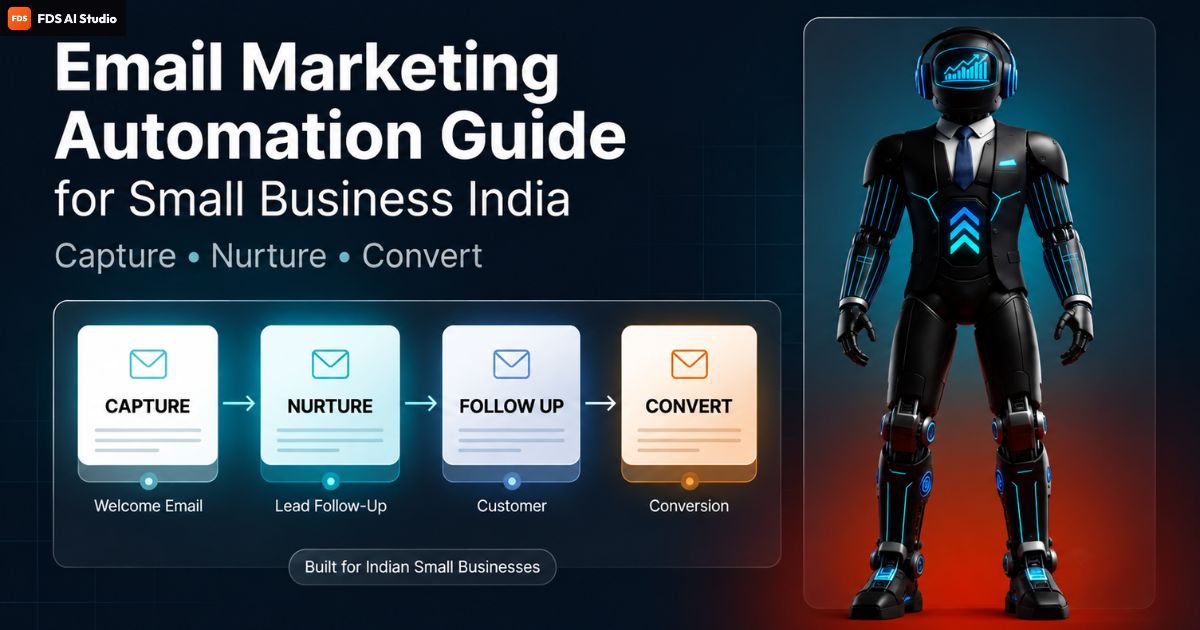
Email Marketing Automation Guide for Small Business India
Why Email Automation Matters More Than Manual Follow-Up
The Cost of Slow Follow-Up
Research consistently shows that the probability of converting a lead drops by over 80% if the first follow-up does not happen within 5 minutes of the inquiry. For a small business owner managing operations, client work, and marketing simultaneously, responding to every inquiry within 5 minutes manually is not realistic.
Email marketing automation closes this gap by removing the human delay entirely. The moment a lead submits a form, sends an inquiry, or joins your list, the automation sequence begins. They receive a response immediately. The follow-up happens on a schedule. The nurturing content arrives at the right intervals. All of this happens without you touching a single keyboard.
What Automation Does That Manual Follow-Up Cannot
A well-built email automation system delivers several capabilities that manual follow-up cannot match:
- Instant response at any time of day or night, including weekends and holidays
- Consistent messaging that does not vary based on how busy or tired you are when you write
- Segmented follow-up that sends different messages to different types of leads based on their behaviour
- Scheduled nurturing that keeps your brand in front of prospects for weeks or months without ongoing manual effort
- Trackable performance showing open rates, click rates, and conversion events that manual email cannot provide
The India-Specific Reality: Why Email Alone Is Not Enough
The Open Rate Gap
Here is the data point that most Indian email marketing guides skip entirely.
Email open rates in India average between 22% and 28% depending on the category and the quality of the list. This means that for every 100 people who receive your email, approximately 75 to 78 of them do not open it.
WhatsApp open rates in India sit at approximately 98%.
This is not a minor difference. It is a structural gap between two channels that serve the same purpose, delivering a message to a prospect, but produce dramatically different engagement outcomes in the Indian market. The reason is straightforward. Indian professionals and business owners treat email as a low-priority communication channel. WhatsApp is where they actually pay attention.
The Dual-Channel System
The businesses achieving the highest lead conversion rates in India are not choosing between email and WhatsApp. They are using both channels together in a coordinated system:
- Email carries long-form content, structured sequences, educational material, and formal communication that benefits from a longer format
- WhatsApp carries short, direct messages, reminders, quick follow-ups, conversational engagement, and time-sensitive offers
The dual-channel approach works because each channel does what it is best at. Email builds depth and delivers detailed content. WhatsApp creates immediacy and drives response. Together they reach the prospect across two habits rather than betting everything on one.
A prospect who ignores your email on Monday morning because they are in back-to-back meetings will often reply to a WhatsApp message on Tuesday afternoon when they are between tasks. The email planted the idea. The WhatsApp message prompted the action.
The system described in this article covers the email automation layer in detail. If you are building in India, plan to run WhatsApp automation alongside it from day one rather than treating email as a standalone channel.
How to Structure Your Email Drip Sequence
Understanding Drip Sequences
A drip campaign is a series of pre-written emails sent automatically on a schedule triggered by a specific action. The trigger might be a form submission, a free download, a Meta ad lead form, a WhatsApp opt-in, or a website signup. Once triggered, the sequence runs without manual input.
The goal of a drip sequence is not to sell immediately. It is to move the prospect through the buyer journey at the pace they are comfortable with, building trust and providing value at each stage until they are ready to convert.
The 7-Email Sequence Framework for Indian MSMEs
Here is a practical drip sequence structure built for Indian small business contexts:
Email 1: The Welcome and Expectation Setter (Send immediately)
This email arrives the moment the inquiry or signup is received. It does three things:
- Confirms that the inquiry has been received and tells them exactly what to expect next
- Introduces the business and the specific value it delivers in two to three sentences
- Sets the tone as helpful and knowledgeable without being pushy
Do not try to sell in Email 1. The prospect does not know you yet. The job of this email is to establish that you are responsive, professional, and worth listening to.
Email 2: The Problem Framing Email (Send on Day 2)
This email names the real problem the prospect is trying to solve. Not the surface problem. The deeper systemic issue underneath it.
If you are a lead generation platform, the surface problem is "getting more leads." The real problem is spending money on marketing with no predictable system and no way to know what is working. Email 2 demonstrates that you understand this distinction. When a prospect reads an email that articulates their situation more clearly than they could themselves, trust accelerates dramatically.
Email 3: The Education Email (Send on Day 4)
This email provides genuine value with no ask attached. A framework, a checklist, a data point, a case study, or an insight the prospect can use regardless of whether they buy from you.
The education email is the most important email in the sequence for Indian audiences because it establishes expertise through demonstration rather than claims. Any business can say they are the best. Very few businesses can explain why cost per lead is high for most Indian MSMEs and what specifically causes it at a structural level.
Email 4: The Proof Email (Send on Day 7)
This email introduces specific, verifiable results. Not testimonials with no context. Not vague claims about hundreds of satisfied clients. Specific numbers from real outcomes:
- Before and after comparisons
- Specific cost per lead or ROAS figures from documented campaigns
- Client category and outcome with enough specificity to be credible
For Indian audiences, proof must be India-specific. A US-based case study with dollar-denominated results does not land the same way as a result from an Indian business owner in a similar category.
Email 5: The Objection Handler (Send on Day 10)
At this point in the sequence, the prospect is engaged but has not converted. The most common reason is that they have an unaddressed objection. This email directly names and answers the most frequent objections in your category.
Common objections for Indian MSME marketing contexts include:
- "This is too expensive for my budget"
- "I tried something similar before and it did not work"
- "I do not have time to learn a new system"
- "I am not sure this will work for my specific industry"
Address each of these directly and honestly. Do not dismiss them. Validate the concern and then explain specifically why your approach handles it differently.
Email 6: The Comparison Email (Send on Day 14)
This email addresses the alternative options the prospect is considering. Not by attacking competitors, but by clearly articulating the structural difference between approaches.
The comparison most relevant for Indian MSMEs is the agency model versus a system-based approach. An email that walks through the retainer model, what it typically delivers, and how a system-based alternative compares on cost, accountability, and outcome gives the prospect the framework to make their own decision.
Email 7: The Direct Offer (Send on Day 18)
The final email in the initial sequence makes a direct, specific offer with a clear call to action. By this point in the sequence, the prospect has received education, proof, objection handling, and comparison context. They are as prepared to make a decision as they are going to be from email alone.
The offer should be low-friction. A free first step, a no-commitment audit, a free credit allocation, or a limited-availability consultation. Something that moves them from email engagement to actual conversation without requiring a large commitment.
Email Automation Tools for Indian Small Businesses
Choosing the Right Tool
The right email automation tool for an Indian small business depends on three factors: budget, technical comfort level, and the complexity of the sequences you need to run.
Here are the most relevant options across price points:
Brevo (formerly Sendinblue) Brevo is the strongest all-round option for Indian small businesses. It offers email automation, SMS, and WhatsApp integration in a single platform, making the dual-channel approach described above significantly easier to implement. The free plan supports up to 300 emails per day. Paid plans start at approximately ₹1,500 per month for Indian pricing, making it accessible at MSME scale. The automation workflow builder is visual and requires no coding.
Mailchimp Mailchimp remains the most widely recognised email marketing platform globally. Its automation features are comprehensive and the interface is beginner-friendly. The free plan supports up to 500 contacts and 1,000 sends per month. Paid plans start at $13 per month. For Indian businesses, the dollar pricing adds a currency consideration, but the platform quality justifies it for businesses with growing lists.
HubSpot Email HubSpot's email automation sits inside a broader CRM system. For businesses that need their email automation connected to a customer database, deal pipeline, and sales workflow, HubSpot provides the most integrated solution. The free CRM tier includes basic email marketing. Paid tiers start at $20 per month. Best suited for B2B businesses that need email automation connected to sales pipeline management.
Mailer Lite MailerLite is the best option for businesses prioritising simplicity and value. The free plan supports up to 1,000 subscribers and 12,000 emails per month. The automation builder covers all the standard drip sequence requirements. For a founder setting up their first email automation system with no prior experience, MailerLite has the lowest learning curve.
Setting Up Your First Automation Sequence: Step by Step
Step 1: Choose Your Entry Point
Decide what action triggers the sequence. Common entry points for Indian small businesses include:
- Meta Ads lead form submission
- Website contact form submission
- WhatsApp opt-in followed by email capture
- Free resource download
- Event or webinar registration
Step 2: Build Your Lead Capture Connection
Connect your lead source to your email tool. Most platforms connect to Meta Lead Ads, Google Forms, and website forms through native integrations or through Zapier. Set up a test lead to confirm the connection is working before running live traffic.
Step 3: Write the Seven Emails
Write all seven emails in the sequence before activating it. Use the framework above as your structure. Keep each email between 150 and 300 words. Short, clear, and purposeful outperforms long, comprehensive, and exhausting in every Indian email marketing test.
Step 4: Set Your Timing
Configure the send schedule based on the framework:
- Email 1: Immediately on trigger
- Email 2: Day 2
- Email 3: Day 4
- Email 4: Day 7
- Email 5: Day 10
- Email 6: Day 14
- Email 7: Day 18
Step 5: Segment Your List
Set up basic segmentation from day one. At minimum, separate leads who have opened at least three emails from those who have opened none. The engaged segment moves to a closer-focused sequence. The unengaged segment moves to a re-engagement sequence or to WhatsApp follow-up.
Step 6: Add Your WhatsApp Layer
Once your email sequence is running, set up a parallel WhatsApp sequence covering Days 1, 5, 12, and 20. These messages are short, conversational, and serve as reminders or prompts related to the email content. Brevo and AiSensy both support WhatsApp Business API integration for automated messaging.
Step 7: Measure and Improve
Track open rate, click-through rate, and reply rate for each email in the sequence. Email 1 should consistently achieve 40% or higher open rates. Emails 2 through 4 should maintain 25% to 35%. If any email drops significantly below the average, the subject line or content needs revision.
How FDS AI Studio Supports Your Email Marketing Automation
FDS AI Studio is built as a complete lead generation and lead nurturing operating system. The email automation layer sits inside the B2B Marketing AI pillar alongside LinkedIn automation, the brand research engine, and competitor intelligence tools.
The platform's email engine connects directly to the three-gear lead system described across the FDS suite. Cold leads generated by the Meta Video Ads engine enter an automated email sequence that corresponds to the buyer journey stage they are in. Month 1 leads receive awareness and education content. Month 2 leads receive proof and comparison content. Month 3 leads receive direct offers and conversion triggers.
This integration means email automation does not operate as a standalone tool but as one layer of a complete marketing system where ad creative, positioning, social media content, and email sequences all carry the same messaging framework and move prospects through the same buyer journey.
For Indian MSMEs who want email automation that works alongside their WhatsApp strategy, organic social media, and paid ad campaigns rather than separately from them, the integrated approach inside FDS AI Studio removes the need to connect five separate tools and keep them synchronised manually.
The One Thing Most Guides Get Wrong About Email Automation in India
Email automation guides almost universally treat email as the primary follow-up channel. For Indian businesses, it is not.
Email is the infrastructure channel. It carries depth, detail, and long-form value. WhatsApp is the response channel. It creates immediacy, drives replies, and prompts decisions.
Building email automation without a WhatsApp strategy alongside it means you are reaching 22% of your leads on a good day. Building both together means you are reaching close to 98%. The sequence structure, the tools, and the content are all available. The insight that changes the result is understanding which channel does which job in the Indian market.
Start with the seven-email sequence. Layer WhatsApp on top. Measure both together as a unified lead nurturing system, not as two separate campaigns. That is the email marketing automation approach that Indian small businesses are using to convert leads that everyone else is losing.