The Future of AI Marketing - 6 Trends That Will Define Businesses Grow
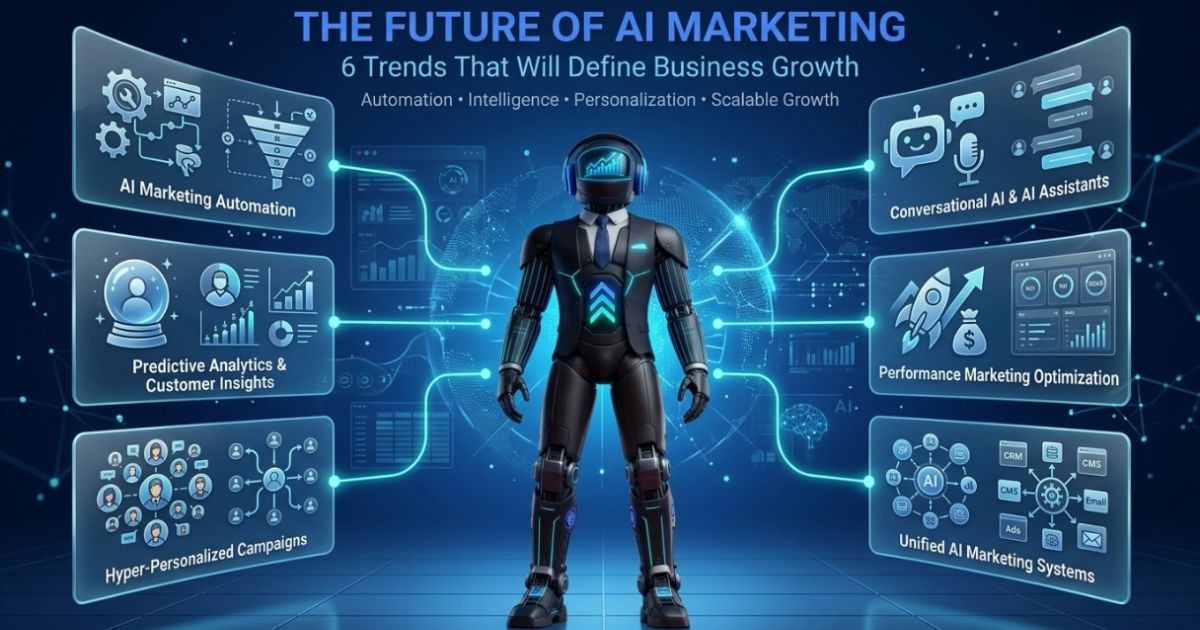
The wait-and-see era of artificial intelligence in marketing is over.
According to Salesforce's State of Marketing 2026 survey of nearly 4,500 marketers worldwide, 75% now use at least one form of AI — whether predictive, generative, or agentic. McKinsey's 2025 global survey found 79% of organisations using generative AI, up from just 33% in 2023. AI and machine learning now power 24.2% of all marketing activities, nearly doubling from 13.1% in 2024, with marketing leaders projecting that figure will reach 55.9% within three years.
The technology has crossed the adoption threshold. The question is no longer whether AI will shape the future of marketing. It already has. The question now is what the next phase looks like — and whether your business is positioned to benefit from it or left behind by it.
For Indian MSMEs, founders, and solopreneurs, the stakes are particularly high. Global trends in AI marketing do not always translate directly into the Indian market context — the channels, the buyer psychology, the budget constraints, and the customer journey are fundamentally different from what most Western marketing research assumes. This piece cuts through the global noise and maps what the future of AI marketing actually means for businesses operating in India in 2026 and beyond.
Trend 1 — Agentic AI Moves From Experiment to Infrastructure
The most significant shift in the future of AI marketing is not a new tool or a new channel. It is a new type of AI capability: agentic AI.
By the end of 2026, agentic AI systems will be able to plan, execute, and optimize full marketing campaigns without constant human input — operating across platforms, managing budgets, testing creatives, and refining strategies in real time. The HubSpot 2026 State of Marketing report shows that 19.20% of marketers are already leveraging AI agents to automate marketing initiatives end-to-end.
The practical meaning for Indian businesses: AI stops being a tool you prompt and starts being a system that runs. Instead of opening ChatGPT to generate a caption and then manually copying it into Instagram, an agentic marketing system generates the caption, schedules it at the optimal time, monitors its performance, and adjusts the next post based on what worked — without human instruction at each step.
For a solopreneur or a 3-person MSME team, this is not a luxury feature. It is the functional equivalent of hiring a marketing department. The cost of running a marketing operation drops dramatically when the AI handles execution autonomously. The human role shifts to setting direction, approving strategy, and making judgment calls — not managing repetitive tasks.
Yet only 6% of organisations currently qualify as high performers extracting real bottom-line value from AI. The majority are using AI tools without a system connecting them. Agentic AI closes this gap — but only for businesses that build the right foundation now.
Trend 2 — Multimodal and AI Search Replaces Traditional Discovery
Search is being rebuilt from the ground up. As AI search platforms like ChatGPT, Claude, and Google AI Overviews change how people find content, traditional search engines are slowly being left behind.
This is not incremental change. It is structural. A user who previously typed "best modular kitchen in Delhi" into Google and clicked through 5 blue links now asks ChatGPT or Perplexity "what should I look for in a modular kitchen, and which brands in Delhi are trusted?" The AI answers directly, citing a handful of sources. Businesses that are not cited in those answers are invisible — regardless of how well they rank on traditional Google.
Two new disciplines have emerged in response:
- Generative Engine Optimization (GEO) — structuring content so it is cited within AI-generated responses on ChatGPT, Perplexity, and Google AI Overviews
- Answer Engine Optimization (AEO) — ensuring your brand appears as the direct answer when users ask questions through AI interfaces
For Indian businesses, this trend has an additional layer. Voice search in regional languages is growing rapidly. A customer in Jaipur asking a voice assistant "iska rate kya hai" or "kaun sa better hai" expects an immediate answer. Brands that are not optimised for conversational AI queries — in English and Hinglish — will not appear in these answers.
The future of AI marketing requires content that is not just keyword-rich but citation-worthy. That means statistics, structured data, clear Q&A formatting, and the kind of specificity that AI engines can extract and present as a direct answer.
Trend 3 — Hyper-Personalization Becomes the Baseline, Not the Differentiator
Skills like digital dexterity, strategic thinking, and cross-functional problem solving will become core to how marketing teams create value, as AI handles personalization at a scale previously impossible.
In 2026, hyper-personalization is no longer a competitive advantage. It is the expectation. Customers who receive generic email newsletters, one-size-fits-all ad creative, and non-contextual social media posts are noticeably aware of the gap between what they receive and what brands like Amazon, Flipkart, and Swiggy deliver to them daily.
For Indian MSMEs, the challenge has always been that personalization at scale required large data teams, expensive CRM systems, and marketing automation platforms that started at ₹50,000 per month. AI collapses this cost barrier.
Personalization engines powered by machine learning can now:
- Customize email content and product recommendations for individual customers based on behavioral data
- Serve different ad creative to different audience segments based on intent signals
- Adapt landing page content based on how a visitor arrived and what they have previously engaged with
- Trigger WhatsApp follow-up sequences based on specific customer actions
For an Indian service business — a coaching institute, a real estate agent, a clinic — this means a prospect who watched your positioning video on Instagram gets different follow-up content than one who arrived through a Google search. The message is calibrated to where they are in the buyer journey. The cost of building this level of personalization is no longer prohibitive. The cost of not building it is becoming visible in declining conversion rates.
Trend 4 — First-Party Data Becomes the Most Valuable Marketing Asset
The cookie-based tracking infrastructure that digital marketing was built on is degrading. Privacy regulations are tightening globally and in India. Platform walled gardens are restricting data access. The third-party data layer that powered a decade of audience targeting is becoming unreliable.
The future of AI marketing runs on first-party data — information that customers voluntarily share with your business through direct interactions. Website behavior, WhatsApp conversations, email engagement, purchase history, survey responses, and loyalty program data.
For Indian businesses, first-party data is particularly powerful because Indian customers are disproportionately active on WhatsApp. A business that captures customer intent, preference, and purchase signals through WhatsApp interactions owns data that no platform can take away. AI can process this data to improve targeting, personalise follow-up sequences, predict churn, and identify high-value customers for retention campaigns.
The businesses that will dominate AI marketing in 2027 and beyond are not the ones with the biggest ad budgets. They are the ones with the richest first-party data and the AI systems to turn that data into action. Building those data assets starts now, not when the third-party data infrastructure finally collapses entirely.
Trend 5 — Creative AI Reaches Production Quality at Scale
80% of marketers now use AI for content creation and 75% use it for media production, per HubSpot's 2026 State of Marketing report. But this adoption figure understates how dramatically AI has changed the creative production landscape.
AI-generated video is rapidly reaching production quality. Image generation has already crossed the threshold for most commercial applications. AI writing assistants produce first drafts indistinguishable from competent human copywriting. The cost of creating high-quality marketing creative — ad scripts, social media content, email sequences, landing pages — has dropped by 80 to 90% for businesses using AI production systems.
For Indian MSMEs, this removes what has historically been the biggest bottleneck in performance marketing: creative. A founder who previously could afford one ad per month — written by whoever had time, shot on a phone with minimal thought — can now generate 5 persuasion-driven scripts targeting 5 different buying triggers, a complete 3-month content calendar, and a positioning video structure from a single business input.
The critical human layer remains essential. AI generates the structure and the first draft. Humans contribute the brand voice, the original insight, the first-hand experience, and the judgment that separates content that converts from content that just exists. But the creative ceiling has moved dramatically upward for businesses that learn to work with AI production systems rather than against them.
Trend 6 — The Gap Between AI Users and AI System Builders Will Widen
This is the most important trend for Indian businesses to understand heading into the next two years.
Gartner's 2026 predictions show how AI agents and generative AI-powered technology will redefine channels, accelerate execution, and elevate the role of data, content, and organizational design. The organizations that benefit most from these shifts are not the ones that have adopted the most AI tools. They are the ones that have built AI into their operating model as a system.
The distinction matters because tools and systems produce fundamentally different outcomes:
- A business using ChatGPT to write captions is using an AI tool. A business with a 3-month buyer-journey content calendar that runs on autopilot has an AI system.
- A business that runs one ad and checks performance weekly is using the platform's AI. A business testing 5 trigger-based scripts simultaneously and scaling winners within 48 hours has an AI system.
- A business that generates reports from Google Analytics is reading AI outputs. A business with unified analytics feeding back into content strategy and ad targeting has an AI system.
The gap between AI-native companies and laggards will widen toward 2027. The businesses building systems now will compound their advantage month over month. The ones adding tools without connecting them will continue experiencing the same fragmentation, the same data silos, and the same question: why is AI not delivering better results?
What This Means for Indian Businesses — And What to Do Next
The six trends above are not predictions. They are conditions that already exist in 2026. Agentic AI is deployable today. AI search is already reshaping discovery. Hyper-personalization is already the customer expectation. First-party data is already more valuable than third-party data. Creative AI has already crossed the production quality threshold.
The businesses that prepare for these trends by building AI into their marketing infrastructure will have a compounding advantage over those that are still running single ads, posting random social media content, and paying agencies for creatives without a system.
FDS AI Studio is built to put these trends into practice for Indian founders and MSMEs — not as abstract technology, but as a working lead generation and lead nurturing system. The FDS Marketing Tools suite gives you AI-generated ad scripts targeting 5 buying triggers simultaneously, a positioning video structure built on 13 plus years of real campaign data, and a complete 3-month buyer-journey content calendar — all from a single input, all Hinglish-native, all proven across 65 plus Indian brands at an average CPL of ₹9.54.
The future of AI marketing belongs to businesses with systems, not just tools. The system is available now.