Generative AI vs Traditional AI and How They Differ
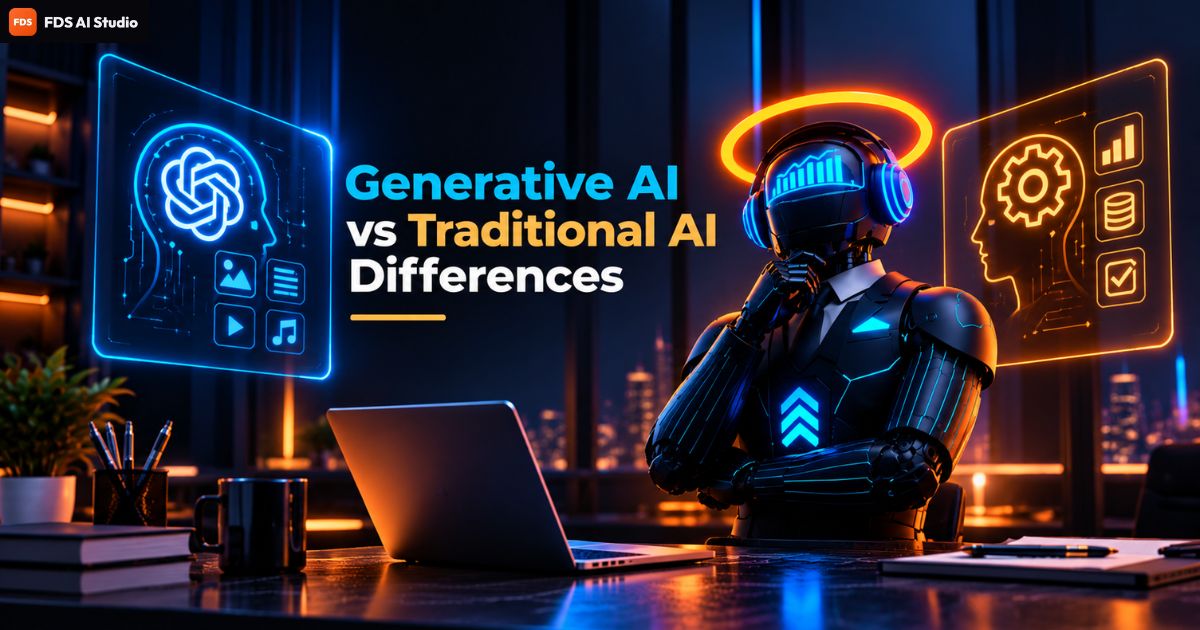
Artificial intelligence has been used for years to classify information, detect patterns, make predictions, and automate decisions. More recently, generative AI has expanded what AI systems can do by creating new text, images, audio, video, and computer code.
This has made generative AI vs traditional AI an important comparison for businesses, students, marketers, developers, and anyone trying to understand modern artificial intelligence.
The main difference is simple: traditional AI is commonly designed to analyse existing data, classify information, or predict an outcome, while generative AI is designed to create new content based on patterns learned from training data. Google Cloud similarly distinguishes traditional AI around classification and prediction, while generative AI is used for tasks such as content creation, summarisation, and conversational experiences.
Both approaches are useful. The right choice depends on what you want the AI system to accomplish.
What Is Traditional AI?
Traditional AI is a broad term commonly used to describe AI systems that primarily analyse data and produce predictions, classifications, recommendations, or predefined decisions.
It is important to note that "traditional AI" is not one single technical model category. It can include rule-based systems, machine learning classifiers, recommendation systems, predictive models, and other forms of narrow AI.
Traditional AI commonly answers questions such as:
- Is this email spam?
- Is this transaction suspicious?
- Which customer is likely to buy?
- What will next month's sales be?
- Is this product defective?
- Which movie should this user see next?
Google Cloud describes traditional AI use cases as particularly suited to classification and predictive tasks based on existing historical data.
The system normally returns a category, score, probability, recommendation, or numerical prediction rather than generating a completely new article, image, or video.
What Is Generative AI?
Generative AI is a type of artificial intelligence designed to create new content in response to prompts or other inputs.
This content can include:
- Text
- Images
- Video
- Audio
- Software code
- Summaries
- Presentations
- Conversations
Generative AI models learn patterns and relationships from large amounts of training data and use those patterns to produce new outputs. IBM describes generative AI as AI capable of creating content such as text, images, video, audio, and software code in response to user requests.
Large language models are one important form of generative AI used for text-based applications. Other generative models are designed for images, audio, video, or multimodal tasks.
For example, a user can ask a generative AI system:
"Write a product description for a stainless steel lunch box."
The system can produce a new piece of text rather than simply classifying the request.
Generative AI vs Traditional AI: Key Differences
The easiest way to understand the two approaches is to compare what they are designed to do.
Feature
Traditional AI
Generative AI
Primary purpose
Analyse, classify or predict
Create new content
Typical output
Label, score, prediction or recommendation
Text, image, audio, video or code
Common input
Structured or historical data
Prompts, documents, images, audio and other data
Example task
Predict customer churn
Write a customer retention email
Common models
Classification, regression, recommendation models
LLMs, diffusion models and foundation models
Creativity
Limited to configured task
Can produce varied new outputs
Main business use
Prediction and decision support
Content, assistance and conversational workflows
The important point is that generative AI has not replaced traditional AI.
The two approaches solve different problems and are often used together.
1. Difference in Purpose
Traditional AI is usually built to answer a specific question.
For example:
"Will this customer cancel their subscription?"
The model may analyse historical customer behaviour and return a probability.
Generative AI handles a different type of task:
"Write a personalised email encouraging this customer to remain subscribed."
The first task is predictive. The second is generative.
A company could combine them by using traditional AI to identify customers at risk and generative AI to prepare personalised communication.
2. Difference in Output
Output is one of the clearest differences between generative and traditional AI.
Traditional AI may produce:
- Yes or no
- Spam or not spam
- Fraud or legitimate
- Risk score
- Revenue forecast
- Recommended product
- Predicted category
Generative AI can produce:
- Blog posts
- Emails
- Images
- Video scripts
- Code
- Product descriptions
- Summaries
- Chat responses
Traditional AI generally makes a decision or prediction about available information. Generative AI produces new material based on an instruction or context.
3. Difference in Training and Data Use
Both traditional and generative AI can learn from data, but their objectives may differ.
A traditional classification model might be trained on thousands of emails labelled "spam" or "not spam." It learns patterns that help it classify new emails.
A generative language model can learn relationships across very large text datasets and then generate language based on an input prompt.
Google Cloud notes that generative AI commonly uses foundation models, while traditional predictive AI is often particularly effective for structured data and specialised prediction or classification tasks.
4. Difference in Flexibility
Traditional AI systems are often developed for narrower tasks.
A fraud detection model may be extremely useful at recognising suspicious transactions, but it is not normally designed to write an advertisement or summarise a report.
Generative AI models can often perform a broader range of language or content tasks from natural-language instructions.
For example, the same language model may be able to:
- Summarise a document
- Rewrite an email
- Generate ideas
- Explain a concept
- Draft code
- Analyse supplied information
However, broader flexibility does not automatically mean better performance for every problem.
A specialised predictive model may be more appropriate for a clearly defined prediction task.
Generative AI vs Predictive AI
Generative AI and predictive AI are also frequently confused.
Predictive AI focuses on estimating what is likely to happen based on existing data.
Examples include:
- Predicting sales
- Forecasting demand
- Estimating customer churn
- Detecting financial risk
- Predicting machine failure
Generative AI focuses on producing new content.
Examples include:
- Writing a sales email
- Creating an advertisement
- Generating an image
- Summarising a meeting
- Producing software code
IBM also distinguishes predictive AI as its own class of AI rather than simply another name for generative AI.
A useful way to remember the difference is:
Predictive AI asks: "What is likely to happen?"
Generative AI asks: "What can I create from this information?"
Traditional AI Examples
Traditional AI is already present in many everyday systems.
Spam Detection
Email systems can classify incoming messages as spam or legitimate based on learned patterns.
Fraud Detection
Financial systems may analyse transaction behaviour and flag activity that appears unusual.
Recommendation Systems
Streaming platforms and online stores use AI to recommend movies, music, or products based on previous behaviour.
Demand Forecasting
Businesses can analyse historical sales data to estimate future demand.
Quality Inspection
Computer vision models can classify manufactured products as acceptable or defective based on visual data.
Customer Churn Prediction
Businesses can use historical customer behaviour to estimate which users may stop purchasing or cancel a subscription.
These are strong examples of AI creating value without necessarily generating new content.
Generative AI Examples
Generative AI focuses more heavily on content creation and human-computer interaction.
Content Creation
Marketing teams can generate:
- Blog outlines
- Ad copy
- Social captions
- Email drafts
- Product descriptions
Image Generation
Generative image systems can produce illustrations, concepts, product backgrounds, and marketing visuals from written instructions.
Customer Support
Generative AI can help answer customer questions in conversational language.
Software Development
AI coding tools can generate, explain, or modify code based on developer instructions.
Document Summarisation
Large reports, meeting transcripts, and other documents can be condensed into shorter summaries.
Brainstorming
Users can ask AI to generate ideas for campaigns, products, presentations, videos, and other creative tasks.
Generative AI vs Discriminative AI
Another useful comparison is generative versus discriminative AI.
Discriminative models usually learn how to distinguish between categories.
For example:
Given an email, is it spam or legitimate?
A generative model learns enough about patterns in the data to produce a new output.
For example:
Write a professional email responding to this customer.
In simple terms:
Discriminative AI separates or classifies.
Generative AI creates.
However, modern AI systems can combine several techniques, so real applications do not always fit perfectly into one category.
Which Type of AI Is Better for Business?
Neither approach is automatically better.
The correct choice depends on the problem.
Use Traditional AI When You Need:
- Predictions
- Classification
- Risk scoring
- Forecasting
- Anomaly detection
- Recommendation systems
- Structured data analysis
Use Generative AI When You Need:
- Content creation
- Summarisation
- Conversational assistants
- Document drafting
- Image generation
- Code generation
- Natural-language interaction
Google Cloud recommends choosing AI based on measurable business needs rather than adopting generative AI simply because it is newer.
This is an important point for businesses considering AI investment.
Can Generative AI and Traditional AI Work Together?
Yes. In many practical business applications, combining the two can be more useful than choosing only one.
Imagine an ecommerce company.
Traditional AI might:
- Analyse purchase history.
- Predict which customers are likely to buy again.
- Identify the products they may prefer.
Generative AI could then:
- Create personalized email copy.
- Generate product recommendations in natural language.
- Prepare advertising variations.
Another example is customer support.
Traditional AI can categorise incoming support tickets according to urgency, while generative AI can prepare a draft response for the support team.
Businesses researching generative ai vs traditional ai should therefore focus less on choosing one technology and more on identifying which combination can solve a specific workflow or business problem.
Limitations of Traditional AI
Traditional AI also has limitations.
A specialised system may:
- Work only for the task it was trained to perform
- Require quality historical data
- Need retraining when patterns change
- Struggle outside its original training conditions
However, narrow specialisation can also be an advantage when a business needs a consistent prediction or classification system.
Limitations of Generative AI
Generative AI is flexible, but users should understand its limitations.
It may:
- Generate incorrect information
- Produce inconsistent outputs
- Invent details that were not provided
- Reflect biases in training data
- Require human review
- Introduce privacy or security concerns when sensitive data is handled improperly
Generated content should therefore be reviewed before being used for important business, legal, financial, medical, or customer-facing decisions.
How to Choose Between Generative AI and Traditional AI
Start by defining the business problem.
Ask:
Do You Need a Prediction?
Use traditional or predictive AI.
Example: "Which customers are likely to leave?"
Do You Need a Classification?
Traditional AI is often suitable.
Example: "Is this transaction fraudulent?"
Do You Need New Content?
Generative AI is usually the more suitable approach.
Example: "Create three email variations for this campaign."
Do You Need Both?
Combine the two approaches.
Example: predict which customer segment is most likely to purchase, then generate personalised marketing content for that segment.
The technology should follow the business objective, not the other way around.
Conclusion
Understanding generative AI vs traditional AI becomes easier when you focus on purpose and output.
Traditional AI is typically used to analyse information, classify data, detect patterns, make recommendations, or predict outcomes. Generative AI is designed to produce new content such as text, images, audio, video, and software code.
Traditional AI might predict which customer will purchase a product. Generative AI might write the personalized message sent to that customer.
Both technologies have strengths, limitations, and different use cases.
For businesses, the most effective approach is to identify the problem first and then select the AI technology that matches the required outcome. In many modern workflows, traditional AI and generative AI can work together to combine accurate analysis with flexible content creation.
The future of practical AI is therefore not necessarily generative AI replacing traditional systems. It is increasingly about using the right type of AI, or the right combination of technologies, for each specific task.