How AI is Transforming Digital Marketing in 2026
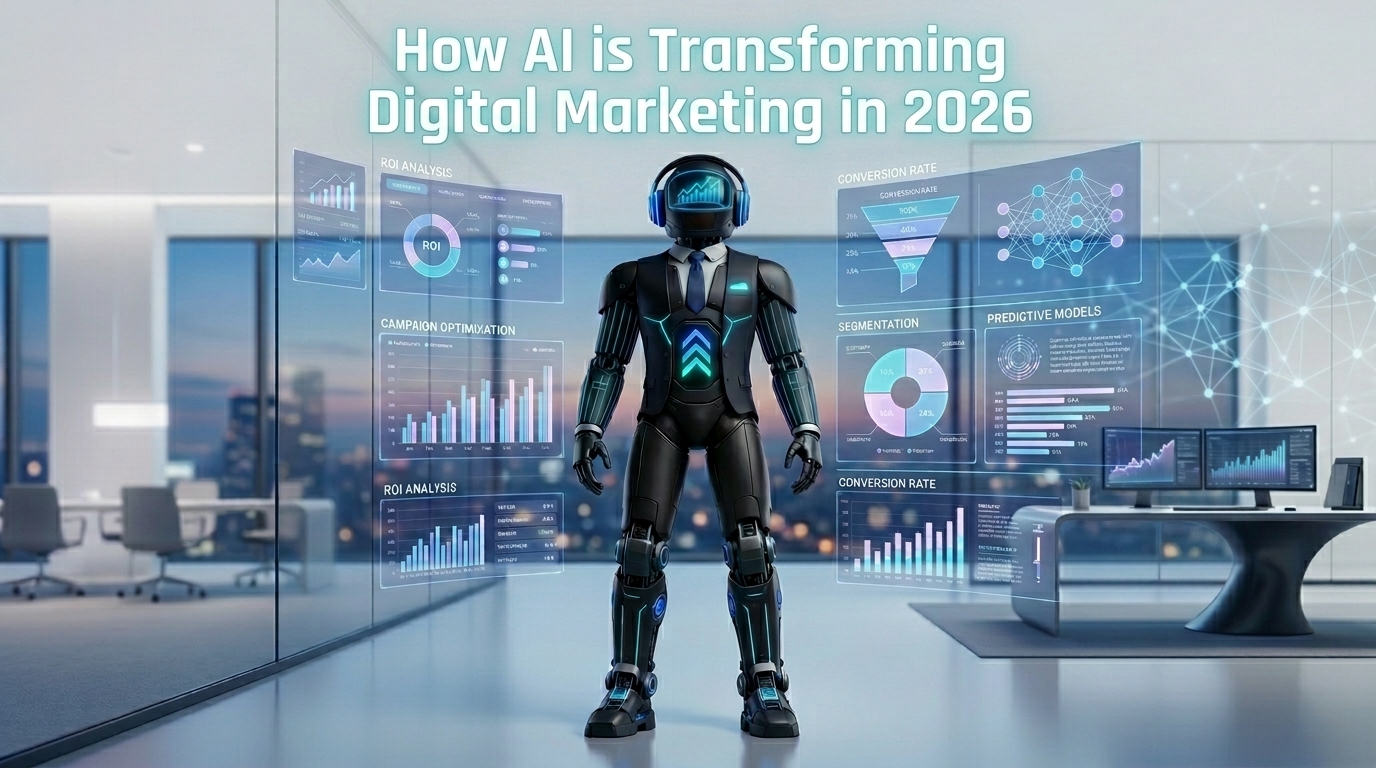
Artificial intelligence is no longer a future trend in marketing. It is the operating layer. In 2026, 88% of marketers use AI tools daily. The global AI marketing industry has crossed $47 billion in value and is projected to reach $107 billion by 2028. AI-driven campaigns are delivering 22% higher ROI and 32% more conversions than campaigns run through traditional methods.
But the numbers only tell part of the story. What has actually changed is how marketing works at a structural level. AI is not just another tool added to a marketer's stack. It is reshaping how brands find customers, how content gets created, how ads get optimized, and how entire marketing departments operate.
For business owners, marketers, and students trying to understand the role of AI in digital marketing, this guide covers:
- What AI in digital marketing actually means in 2026
- How AI is being applied across every major marketing channel
- The real impact, benefits, and risks of AI-powered marketing
- Where the entire discipline is heading next
What AI in Digital Marketing Actually Means
AI in digital marketing refers to the use of artificial intelligence technologies — including machine learning, natural language processing, computer vision, generative AI, and predictive analytics — to automate, optimize, and personalize marketing activities across digital channels.
That definition has existed for years. What has changed is the depth and scale at which AI now operates within marketing workflows. In 2023, most marketers were using AI for surface-level tasks: generating blog drafts, creating social media captions, or running basic A/B tests. In 2026, AI has moved deeper into the stack.
It now powers:
- Real-time bidding in programmatic advertising
- Recommendation systems that personalize customer journeys across channels
- Sentiment analysis on thousands of social mentions simultaneously
- Conversational AI systems that handle customer engagement around the clock
- Predictive analytics models that forecast campaign performance before a single rupee is spent
The shift is from AI as an add-on to AI as infrastructure. Marketing teams that have made this transition are not just saving time. They are operating with a fundamentally different level of speed, precision, and scalability than teams that have not.
How AI is Used in Digital Marketing — Channel by Channel
The impact of AI on digital marketing is visible across every channel. Here is how it plays out in practice.
Search Engine Optimization and the Rise of GEO
Traditional SEO focused on keyword research, backlink building, and content optimization for Google's algorithm. AI has transformed every stage of this process. Machine learning models now analyze search intent, competitive positioning, and content gaps in seconds. Large language models generate content outlines calibrated for topical authority.
But the bigger shift is structural. Google AI Overviews now appear on approximately 48% of search queries, reaching 2 billion monthly users. ChatGPT processes 2.5 billion prompts daily with over 800 million weekly active users. This has given rise to two entirely new disciplines alongside traditional SEO:
- Generative Engine Optimization (GEO) focuses on making content visible and citable within AI-generated responses on platforms like Google AI Overviews, ChatGPT, and Perplexity.
- Answer Engine Optimization (AEO) ensures brands appear as direct answers in AI chat interfaces and voice search.
The data supports this shift. Content with statistics sees 28 to 40% higher visibility in AI search. AI search visitors convert at 4 to 5 times the rate of traditional organic traffic. Only 13.7% of citations overlap between Google AI Overviews and Google AI Mode, meaning marketers need to optimize for multiple AI surfaces simultaneously. Any marketer still optimizing exclusively for traditional blue links is optimizing for a shrinking surface.
Paid Advertising and Programmatic Media
AI has fundamentally changed how digital advertising operates. Programmatic advertising uses machine learning to automate the buying and placement of ads in real time, optimizing for audience, context, and performance simultaneously. Google Performance Max campaigns use AI to allocate budget across Search, Display, YouTube, Gmail, and Discover based on live conversion signals.
Key AI applications in paid media include:
- Dynamic creative optimization (DCO) — generates and tests hundreds of ad variations automatically, matching the right creative to the right audience at the right moment
- Real-time bidding — adjusts bids millisecond by millisecond based on predicted conversion probability
- Predictive budget allocation — shifts spend toward channels and audiences with the highest projected return
- Automated audience expansion — identifies high-value lookalike segments without manual configuration
The result is that AI-powered ad campaigns are reducing cost per acquisition while increasing conversion rates — a combination that manual campaign management simply cannot achieve at the same scale.
Content Creation and Generative AI
This is the most visible application of AI in digital marketing and the one most people associate with the AI revolution. Large language models can now produce blog posts, email sequences, social media copy, product descriptions, video scripts, and ad copy at a pace that was unimaginable three years ago.
But the real value is not in raw generation speed. It is in the ability to produce content that is personalized, data-informed, and strategically aligned. AI content tools can:
- Analyze what is ranking for a target keyword and identify gaps in existing content
- Produce structurally optimized drafts calibrated for both human readers and search engines
- Generate multiple content variations for testing across different audience segments
- Repurpose long-form content into platform-specific formats automatically
The risk is real too. 43% of businesses report concerns about AI content accuracy and bias. Content produced without human review can damage brand trust. The marketers getting the most value from generative AI are those who use it as a first-draft engine with human editors validating every piece before publication.
Email Marketing and Personalization
AI has moved email marketing far beyond the era of name-merge personalization. Modern personalization engines analyze customer behavior, purchase history, browsing patterns, and engagement data to deliver hyper-personalized email content at scale.
AI determines not just what to send but when to send it, using send-time optimization models that predict when each individual subscriber is most likely to open and engage. AI-driven email campaigns are increasing open rates by up to 41% in certain industries. Recommendation systems embedded within emails serve product suggestions based on each customer's unique behavior profile. For e-commerce businesses, this turns every email from a broadcast into a one-to-one conversation.
Social Media Marketing
AI powers nearly every layer of modern social media marketing:
- Sentiment analysis tools monitor brand mentions across platforms in real time, identifying emerging issues before they become crises
- AI scheduling tools analyze historical engagement data to determine optimal posting times
- Content generation tools produce platform-specific copy adapted for character limits, hashtag conventions, and audience expectations
- AI-driven audience targeting on Meta, LinkedIn, and TikTok uses machine learning to identify lookalike audiences, predict conversion likelihood, and dynamically allocate spend toward the highest-performing segments
Social listening powered by natural language processing can parse thousands of conversations to extract audience insights that would take human analysts weeks to compile.
Conversational AI and Customer Engagement
Chatbots and AI-powered virtual assistants have matured significantly. Modern conversational AI systems handle everything from lead qualification to customer support, operating 24/7 across website, WhatsApp, and social messaging channels. These systems go beyond scripted responses. They use natural language processing to understand context, maintain conversation history, and escalate to human agents when complexity exceeds their capability.
For businesses in India, where WhatsApp is often the primary customer communication channel, AI-powered conversational systems are not a luxury. They are a competitive requirement. The ability to respond to inquiries instantly, qualify leads automatically, and nurture prospects through automated sequences is transforming how small and medium businesses manage their sales pipeline.
The Real Impact of AI on Digital Marketing in 2026
Beyond individual channel applications, AI is driving three structural shifts that are reshaping how the entire marketing function operates.
From periodic reporting to real-time intelligence. Traditional marketing operated on weekly or monthly reporting cycles. AI-powered analytics and customer data platforms deliver insights in real time. Marketing mix modeling powered by machine learning provides a unified view of performance across all channels, replacing fragmented attribution models.
From manual execution to intelligent automation. AI-powered marketing automation is adaptive. It learns from campaign performance, audience behavior, and competitive signals to optimize execution dynamically. This includes automated budget reallocation, predictive lead scoring, and intelligent content distribution. AI saves marketers an average of 13 hours per week on daily tasks, translating to a 44% productivity increase.
From generic messaging to hyper-personalization. Personalization engines driven by deep learning can customize website experiences, email content, ad creative, and product recommendations for individual users based on behavioral data. 92% of marketers report that customers now expect this level of personalization, and brands that deliver it are seeing measurably higher engagement and conversion rates.
Challenges and Risks of AI in Digital Marketing
No honest discussion of artificial intelligence in digital marketing is complete without addressing the risks. The most significant ones include:
- Data privacy and compliance. AI systems require large volumes of customer data. 41% of CMOs identify data exposure as their top concern related to AI adoption. Responsible data handling with transparent consent mechanisms is non-negotiable.
- Content accuracy and brand safety. AI-generated content can contain factual errors, exhibit bias, or produce tonally inconsistent messaging. 30% of marketers identify generative AI as a significant risk to brand safety. Human oversight processes that catch errors before publication are essential.
- Over-reliance on automation. AI optimizes for the objectives it is given. If those objectives are poorly defined, AI will efficiently drive toward the wrong outcomes. The organizations seeing the strongest results combine intelligent automation with experienced human strategists who define goals, interpret data, and make judgment calls that machines cannot.
The Future of AI in Digital Marketing
Looking ahead, several trends are already shaping the next phase of AI in digital marketing:
- AI search becomes the primary discovery channel. With AI Overviews, ChatGPT, and Perplexity reshaping how consumers find information, GEO and AEO are becoming central to any credible marketing strategy — not optional add-ons.
- Machine customers emerge as a new audience. AI buying assistants and autonomous agents are beginning to make purchasing decisions on behalf of consumers. Forward-thinking organizations expect machine customers to generate 25% of total revenue by 2027.
- AI-generated video reaches production quality. Projections show AI-generated creative reaching 40% of all video ads by end of 2026, dramatically lowering the cost of video marketing for businesses of all sizes.
- Full-stack AI integration separates leaders from laggards. Only 30% of agencies have fully integrated AI into campaign lifecycles. The gap between organizations that have built AI into their marketing infrastructure and those still treating it as a peripheral tool will widen significantly through 2027 and beyond.
What This Means for Your Business
Whether you are a student studying digital marketing, a marketer evaluating how to integrate AI into your workflow, or a business owner deciding where to invest your marketing budget, the direction is clear. AI in digital marketing is not an experiment anymore. It is the foundation on which competitive marketing is being built.
The businesses that will thrive are those that move beyond treating AI as a content generation shortcut and instead build AI into their marketing operations — from audience research and content strategy through campaign execution and performance analysis.
If you are exploring how to bring AI into your marketing at a practical level, FDS AI Studio offers access to 26 plus integrated AI systems across content, SEO, advertising, sales, and analytics — all designed for Indian businesses at MSME-friendly pricing starting from zero. It is one way to experience what a fully AI-powered marketing operating system looks like in practice.
The shift has already happened. The question is whether your marketing has shifted with it.