How AI Transforms Performance Marketing — And Why It Only Works With a System Behind It
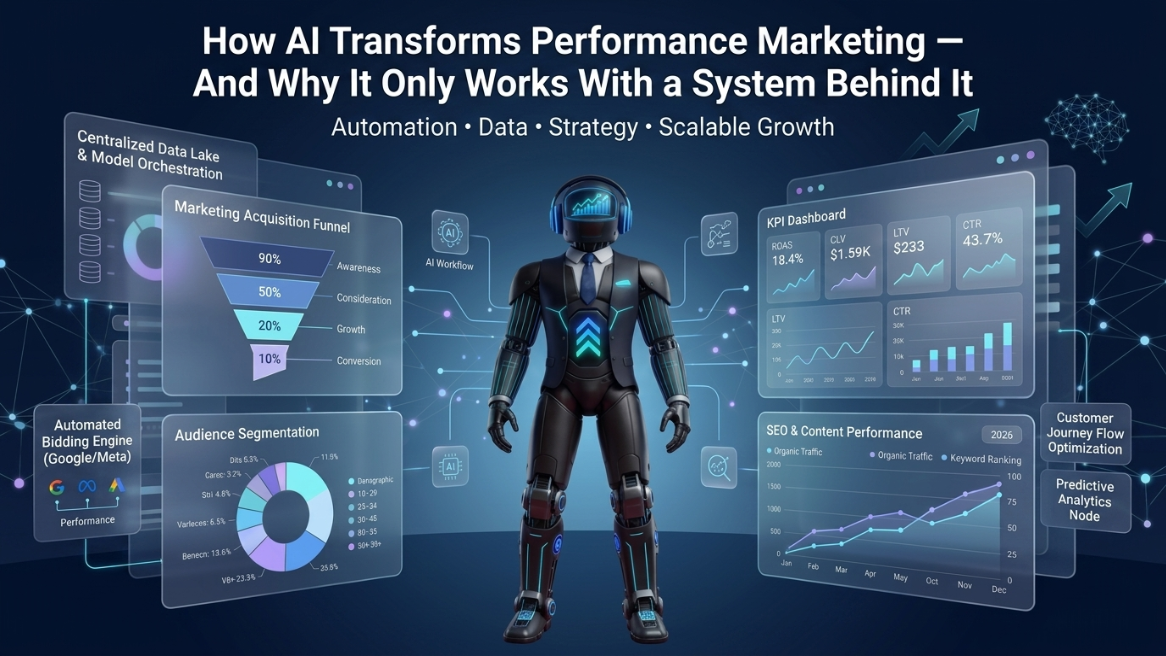
Global advertising spend will pass one trillion dollars for the first time in 2026. According to Dentsu's forecast, more than 71% of that spend is now directed by algorithms rather than by humans choosing inventory by hand. The decisions performance marketers used to make — which audience to target, what to bid, which creative to run — are increasingly resolved at machine speed inside platforms that most marketing teams cannot directly see into.
The job has not gotten smaller. It has moved.
It has moved from manually managing campaigns to governing the systems that manage them. From picking audiences to defining the outcomes AI should optimize toward. From testing two ad variations by hand to running hundreds of creative permutations simultaneously and letting data identify the winners.
For enterprise brands with dedicated media buying teams, this transition is already underway. For Indian MSMEs, founders, and solopreneurs — the businesses that performance marketing should serve most efficiently — the transition has barely started. Most are still running the 2021 playbook: one ad, one audience, one platform, hope for results, check the dashboard in a week.
This article breaks down how AI is actually transforming performance marketing in 2026, where it fails when the conditions are not right, and how Indian businesses can access these capabilities without enterprise budgets.
What AI Actually Changes in Performance Marketing
Strip away the vendor language and AI in performance marketing does something specific: it ingests large volumes of campaign and customer data, identifies patterns, generates predictions about future behaviour, and either recommends or directly executes decisions based on those predictions. It does this against goals the business has set — revenue, qualified leads, retained customers — rather than against intermediary metrics the platform finds convenient to report.
The transformation happens across five layers.
Layer 1 — Predictive Budget Allocation
The most underappreciated AI application in performance marketing happens before money is spent. Predictive models trained on historical campaign data, seasonality patterns, conversion rates, and audience saturation curves can model the likely outcome of a budget decision before that budget is committed.
For enterprise accounts, this means a finance director asking whether an additional ₹5 lakh against Meta will deliver pipeline or whether the channel has already hit diminishing returns can be answered with a defensible model rather than instinct.
For Indian MSMEs, the principle is identical even if the scale is different. A founder spending ₹30,000 per month on Meta ads needs to know whether increasing to ₹50,000 will produce proportionally more leads or just inflate the cost per lead. AI-powered budget forecasting answers this question before the money is spent, not after it is gone.
The practical reality: most Indian small businesses do not have access to standalone predictive budgeting tools. This capability only becomes accessible when it is embedded into the platform they are already using for campaign execution.
Layer 2 — Real-Time Campaign Optimization
In-flight optimization is where AI's compounding effect is most visible. Every active campaign generates a stream of signals — a creative performing well in one geography, bid prices softening in another, an audience segment converting at a rate the original plan did not anticipate.
A human team responds to these signals on a cycle of hours or days. A media buyer checking the campaign on Monday morning is working with data from Friday. By the time they make adjustments, the opportunity window has shifted.
AI responds in minutes. It reweights bids, reallocates spend across audiences, and pulls underperforming variants before they exhaust budget that was meant for the variants that are working. As the AI Digital article on this subject notes, the compound interest is in the cadence, not the cleverness. A campaign optimized 50 times a day across thousands of audience-creative combinations will outperform the same campaign optimized once a day, provided the optimization is pointed at a metric that genuinely correlates with business outcome.
This is where the distinction between platform automation and business optimization matters. Google Performance Max and Meta Advantage Plus optimize campaigns automatically — but they optimize toward the platform's reported conversions, not necessarily toward the conversions that drove actual revenue. A bidder optimizing toward platform-reported conversions will bid hardest for what the platform can measure, which is not the same as what actually created the sale.
Layer 3 — Audience Intelligence Beyond Demographics
Traditional targeting assigns campaigns to demographic groups — women, 25 to 44, metro cities. AI collapses this proxy step entirely. Instead of targeting who people are, AI targets what people do — browsing patterns, content engagement, return visits, search behaviour, cart abandonment signals, and platform-specific intent indicators.
Behavioural segmentation powered by machine learning identifies micro-segments that hand-built audiences would miss. It refreshes daily or hourly. It validates which clusters actually convert before serious budget moves toward them.
For Indian businesses, this shift is particularly powerful. The Indian digital audience is extraordinarily diverse — language preferences, device usage patterns, regional buying behaviour, and channel preferences vary dramatically across geographies. A 28-year-old founder in Jaipur searching for modular kitchen leads has fundamentally different intent signals than a 35-year-old marketing director in Bangalore evaluating SaaS tools. AI can distinguish between these audiences in real time. Manual targeting cannot.
Layer 4 — Creative Testing at Scale
This is the layer where AI transforms performance marketing most visibly for small businesses.
Traditional creative testing is sequential. You make one ad. You run it. If it does not work, you make another one. Each cycle takes days or weeks. By the time you find a winning creative, you have burned through significant budget on the losing ones.
AI-powered creative testing inverts this process. Instead of testing sequentially, you test simultaneously. You generate 5, 10, or 20 creative variations at once — each with a different hook, a different emotional angle, a different persuasion trigger — and let the algorithm identify the winners within 48 to 72 hours. The underperformers are killed automatically. The winners are scaled. Every testing cycle makes the next one more efficient because the data from previous cycles informs the next batch of creative.
The optimization gain is partly about doing more of what works. But as the AI Digital analysis notes, it is more often about doing less of what does not. The biggest efficiency gains in mature accounts come from subtraction — eliminating creative angles, audiences, and placements that consume budget without delivering conversions.
For Indian MSMEs, the bottleneck has always been creative production. A founder does not have a copywriting team to produce 5 ad scripts targeting 5 different angles. They write one ad based on instinct, boost it, and pray. AI removes this bottleneck entirely — generating multiple persuasion-driven scripts from a single business input, each targeting a different psychological buying trigger, each ready to test simultaneously.
Layer 5 — Eliminating Wasted Spend
Performance marketing has always wasted money on inventory that was never going to deliver. Low-attention placements, invalid traffic, audiences that look targetable but never convert, fraud signals that inflate impressions without generating real engagement.
AI identifies these patterns of waste and routes around them in real time rather than in post-campaign analysis. The media buying algorithms that previously bid on everything within the targeting parameters now selectively bid on inventory with predicted conversion probability above a threshold, avoiding the spend that was always destined to produce nothing.
WordStream's 2025 analysis of more than 16,000 Google Ads accounts recorded a 5.13% increase in average cost per lead, taking the benchmark to $70.11 (approximately ₹5,900). In a market where costs are rising structurally, eliminating waste is not an optimisation luxury — it is a survival requirement.
Where AI Fails in Performance Marketing
AI amplifies whatever underlying discipline a business brings to its marketing. A team that knows what it is optimizing toward will get a multiplier. A team that does not will get fast, expensive failure.
AI fails when it is pointed at the wrong metric. If you tell Meta's algorithm to optimize for link clicks, it will find the cheapest link clicks — which are often from audiences who click everything and buy nothing. If you optimize for messages, you get message volume, not message quality. The outcome you define is the outcome you get. AI does not judge whether that outcome is the right one for your business.
AI fails when the creative is generic. An algorithm can optimize bid strategy, audience targeting, and placement all day — but if the ad itself does not stop the scroll, does not hit a buying trigger, and does not give the viewer a reason to act, no amount of algorithmic optimisation will save it. The creative is the variable that AI cannot fix unless the creative itself was generated by a persuasion-driven system.
AI fails when there is no system beyond the ad. Optimizing the top of the funnel — more clicks, lower CPL — means nothing if the leads that come in have nowhere to go. No positioning video that builds trust. No content system that nurtures cold leads over time. No buyer journey that converts attention into revenue. AI brings traffic to the door. If the house is empty, the traffic leaves.
How FDS AI Studio Makes AI Performance Marketing Accessible
This is the core problem FDS AI Studio was built to solve. Indian MSMEs need AI-powered performance marketing — the creative testing, the real-time optimization, the behavioural targeting, the waste elimination — but they also need the system behind the ads that turns traffic into revenue.
The FDS Marketing Tools suite delivers both.
Creative testing at scale without a creative team. The Meta Video Ads tool generates 5 complete ad scripts from a single business input, each targeting a different buying trigger — Cost Pain, Trust Gap, Time Drain, Fear of Loss, Big Desire. Each script runs on the proprietary Stab & Twist persuasion engine (Hook → Pain → Differentiation → Proof → CTA). You launch all 5 simultaneously. The data identifies the winner within 48 to 72 hours. You scale the winner and kill the rest. This is AI-powered creative testing that enterprise brands spend lakhs to achieve, available to any Indian founder from a single input.
Positioning that converts attention into memory. The Positioning Video tool generates a 30-second script using the FDS positioning skeleton — 5 precise beats engineered to answer "why you, not them" for cold audiences. This is the asset that sits between the ad click and the conversion. Without it, traffic leaves. With it, traffic remembers your brand.
A system that catches every lead the algorithm brings. The Social Media Grid tool generates a complete 3-month buyer-journey content calendar using the MCB research method (Problem → Solution → Practical step). Month 1 attracts cold audiences. Month 2 builds trust. Month 3 converts. Remarketing is built in. The 90% of prospects who do not convert on first contact are nurtured through organic content until they do — at zero additional ad spend.
The results from live campaigns: 871 qualified leads at ₹9.54 average CPL. Peak ROAS of 9.86x. 65 plus brands across 13 plus years. Hinglish-native output. No agency retainer. No creative team required.
AI transforms performance marketing by compressing the loop between signal and decision from days to minutes. But the loop only produces business outcomes when there is a system — creative that persuades, positioning that differentiates, and content that nurtures — running underneath it.
The algorithm brings traffic. The system converts it.