Why Most Video Ad Scripts Get Clicks But Not Conversions
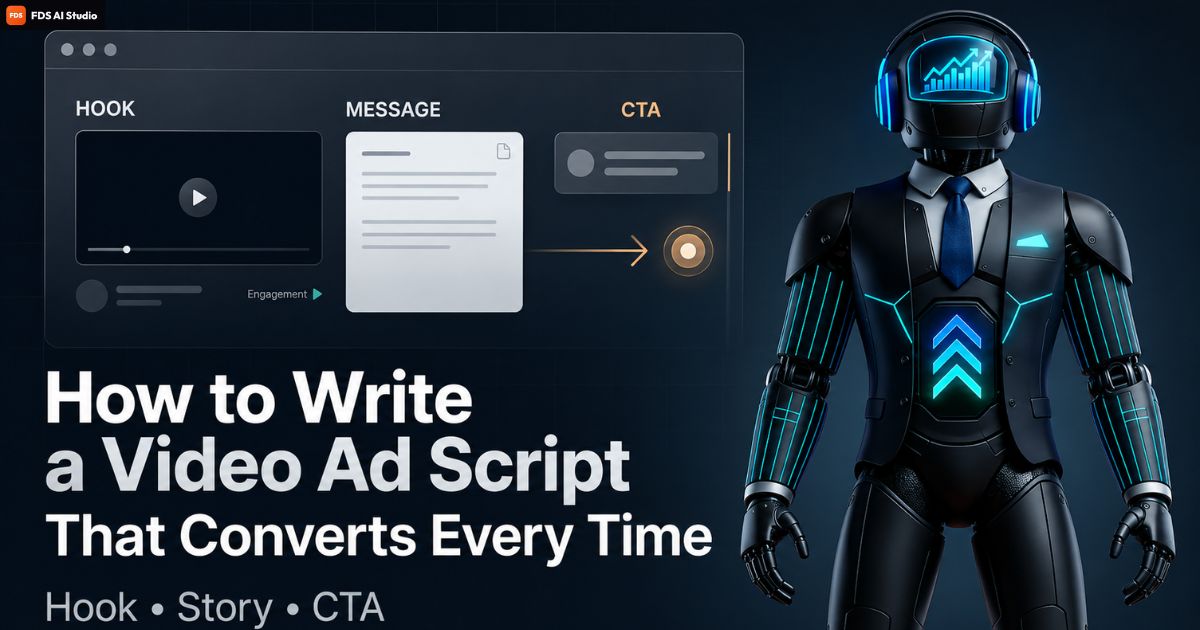
The 3-second hook rule is real. Mobile video ads pull in 1.8x more engagement than other formats, and a script that hooks someone in the first three seconds is not a nice-to-have — it is a requirement. Most founders know this. They write aggressive hooks. They start with a question. They use a pattern interrupt. They get the click.
And then nothing converts.
The reason is that the hook is only the first problem. The deeper problem is that your script is targeting one emotional state — one reason why a customer might buy — and your audience contains at least five distinct emotional states, each requiring a different message to convert.
Consider the range of people who might see your Meta ad for a digital marketing service:
- A founder currently paying an agency ₹50,000 per month and getting zero leads — driven by cost pain
- A founder burned by a previous agency and deeply sceptical of every marketing claim — driven by a trust gap
- A founder doing all their marketing manually at midnight because there is no one else — driven by time drain
- A founder watching competitors scale on social media while their own growth has stalled — driven by fear of loss
- A founder who has a clear vision of what their business could look like with a consistent lead flow — driven by aspiration
These are not the same person. They do not respond to the same hook. They do not respond to the same pain point. They do not respond to the same proof. A single script written for one of these states will convert some of your audience and be completely invisible to the rest.
This is the structural flaw in every "how to write a video ad script" guide that gives you one template. The template is not wrong. But one template is only ever one angle.
The Framework Behind a High-Converting Video Ad Script
Before we get into the 5-trigger system, you need a persuasion architecture that each script runs on. AIDA (Attention, Interest, Desire, Action) and PAS (Problem, Agitate, Solution) are the frameworks most guides recommend. They are directionally correct but structurally incomplete for short-form video ads in 2026.
The framework that consistently produces the lowest CPL across Indian Meta campaigns is the Stab & Twist structure — a 5-beat persuasion engine designed specifically for the scroll-first, sound-off, 3-second-attention environment of Instagram Reels and Facebook video ads.
The five beats are:
Beat 1 — Hook (Seconds 0 to 3). The Stab. Name an uncomfortable truth the viewer is living with. Not a question. Not a rhetorical opener. A declarative statement that is specific enough to feel personal. "₹40,000 ka ad spend, 3 leads mili." A viewer who recognises this situation cannot scroll past it. The hook does not ask for attention — it takes it.
Beat 2 — Pain (Seconds 3 to 10). Agitate the truth you just stated. Do not rush to your solution. Make the pain real, ongoing, and consequential. Name what continues to happen if nothing changes. "Har mahina budget jaata hai, agency excuses deti hai, aur phone silent rehta hai." The viewer needs to feel the weight of the problem before they can value the solution.
Beat 3 — Differentiation (Seconds 10 to 20). The Twist. Break the old belief that has kept the viewer stuck. The old belief is what they have been told about the category — agencies are necessary, marketing takes months, results are unpredictable. Your differentiation challenges this belief with a structural alternative. Not "we are better." Why the old approach is wrong and what the different approach looks like. This is where you introduce your mechanism — the specific, named system or framework that produces a different result.
Beat 4 — Proof (Seconds 20 to 25). One concrete number, one screenshot, one specific result. Not a vague testimonial. A precise claim: "871 qualified leads. Average CPL ₹9.54. Real Meta ad account." Proof that feels general does more harm than no proof at all. Proof that is specific and verifiable builds instant credibility in the 5 seconds the viewer allocates to evaluating your claim.
Beat 5 — CTA (Seconds 25 to 30). One action. Low friction. Language the viewer naturally speaks. Not "learn more" or "explore our offerings." A specific next step that delivers a clear, immediate benefit: "Link mein click karo — pehla script free milega." The CTA is not asking for trust. It is offering a demonstration. The viewer who watched 28 seconds of your video has already given you significant attention. Ask for one small action, not a commitment.
The 5 Buying Triggers — Why You Need All Five
Now apply this Stab & Twist structure to each of the five buying triggers. The structure is the same for every script. The trigger — the specific emotional reality you name in Beat 1 and agitate in Beat 2 — changes entirely.
Trigger 1 — Cost Pain. Hook: "₹50,000 agency fee. Zero leads. Phir bhi contract renew karna padta hai?" Pain: The financial bleeding continues monthly with no accountability and no outcome. Differentiation: A system where you pay for results, not for the agency's hours. Proof: Your CPL data against their retainer cost. CTA: First step free.
Trigger 2 — Trust Gap. Hook: "Pichli agency ne promising kiya, 3 mahine waste kiye, aur vanish ho gayi?" Pain: The scepticism that every new marketing claim now triggers. The wall that goes up. The budget that gets withheld. Differentiation: Not a promise but a proof — screenshots, not proposals. Proof: Specific campaign results from a named ad account. CTA: See the screenshots first, then decide.
Trigger 3 — Time Drain. Hook: "Raat 11 baje ad copy likh rahe ho khud?" Pain: The opportunity cost of a founder doing a copywriter's job. The hours stolen from actual product and client work. Differentiation: One input, five scripts, ready to shoot in minutes. Proof: Time-to-output comparison. CTA: Generate your first script in 2 minutes.
Trigger 4 — Fear of Loss. Hook: "Competitors ka lead flow systematic hai. Tumhara abhi bhi random hai." Pain: The widening gap while indecision continues. The market share that is moving to businesses with a system. Differentiation: A systematic 3-gear engine — ads, positioning, content — that operates on autopilot. Proof: 65 plus brands. 13 plus years of results. CTA: Start your system today.
Trigger 5 — Big Desire. Hook: "Imagine karo — consistent leads, autopilot par, bina agency ke." Pain: The gap between where the business is and where the founder can see it going. Differentiation: The system that closes that gap — not more tools but one engine. Proof: ₹9.54 average CPL across 871 qualified leads. CTA: Start building the engine now.
Five triggers. Five scripts. Same Stab & Twist structure throughout. The trigger changes. The structure holds.
Testing All Five Simultaneously — Why This Beats Sequential A/B Testing
Most performance marketers test ads sequentially. Run Ad A for two weeks. If it underperforms, pause it and run Ad B. This process is slow, expensive, and statistically unreliable because audience conditions, seasonal factors, and platform dynamics change between each test.
The correct approach is to run all five simultaneously from day one.
Here is why this works:
- You get statistically valid data from each trigger within 48 to 72 hours rather than 4 to 6 weeks
- Platform algorithms like Meta's favour accounts with creative diversity — running 5 distinct scripts signals creative health and avoids the creative fatigue penalty that causes CPL to rise over time
- The underperforming triggers are identified and killed quickly, concentrating budget on the winner before significant spend is wasted
- The winning trigger tells you something important about your audience's dominant emotional state — information that improves every subsequent campaign
Ad fatigue is the silent CPL killer on Meta. When your audience has seen the same ad angle 3 to 4 times, engagement drops and costs rise. Running 5 triggers simultaneously gives the algorithm 5 fresh creative pools to draw from, extending the lifespan of your ad set and keeping CPL stable for longer.
The businesses generating qualified leads at under ₹10 are not running better ads. They are running more angles tested faster with sharper persuasion structures behind each one.
Common Mistakes That Kill Conversion Even With a Good Hook
Understanding what to do right requires understanding what kills conversion even when the hook works.
Rushing to the solution. Beat 2 (Pain) is where most scripts cut corners. Founders are eager to talk about their product. They name the problem in one sentence and immediately jump to their offer. The viewer has not felt the weight of the problem yet. A solution presented before the pain is fully agitated is a solution looking for a problem. Give the pain room to breathe.
Generic proof. "Thousands of satisfied customers" is not proof. It is a claim. Proof is specific: a number, a timeframe, a named result. "871 leads. ₹9.54 average CPL. Live Meta ad account screenshots." The more specific the proof, the more credibility it carries. The more generic, the more it sounds like every other ad making the same empty claim.
Weak or multiple CTAs. A video ad that ends with "follow us, visit our website, or DM us for more information" is asking the viewer to make a decision the script should have made for them. One CTA. One action. One next step. Everything else is friction that converts curiosity into inaction.
Writing for yourself, not your viewer. Your differentiation section should not describe your product features. It should describe the viewer's life after the problem is solved. Not "our AI generates 5 scripts" but "you walk into every shoot with 5 ready-to-go scripts and zero blank-page stress."
Shooting one script and boosting it. Even a perfectly written Stab & Twist script will only convert the audience whose trigger it targets. Without the other four triggers running simultaneously, you are reaching 20% of your potential audience and wondering why your ROAS is below target.
How FDS AI Studio Applies This System
Writing five trigger-based scripts using the Stab & Twist framework manually takes hours — if you understand the framework. Most founders do not have the copywriting background to do this consistently.
The Meta Video Ads tool inside FDS Marketing Tools was built to solve exactly this problem. You provide a single business input — your product, your offer, your audience. The AI generates all five complete, ready-to-shoot scripts simultaneously. Each script targets a different buying trigger. Every script runs on the Stab & Twist persuasion engine. The output is Hinglish-native because that is the language Indian audiences convert in.
The system is built on 13 plus years of real Meta campaign data across 65 plus Indian brands — the same frameworks that have produced an average CPL of ₹9.54 across 871 qualified leads. You shoot all five scripts on your phone or brief them to a videographer. You run them simultaneously on Meta. The data identifies the winner within 48 to 72 hours. You scale the winner.
You can also explore the complete lead generation engine inside FDS AI Studio — Meta Video Ads, Positioning Video, and Social Media Grid running together as one closed-loop system that takes cold audiences from first ad view to conversion across 90 days.
Stop writing one script and hoping. Write five with a framework behind each one and let the data decide which one wins.