Human Creativity vs AI and Why the Two Work Best Together
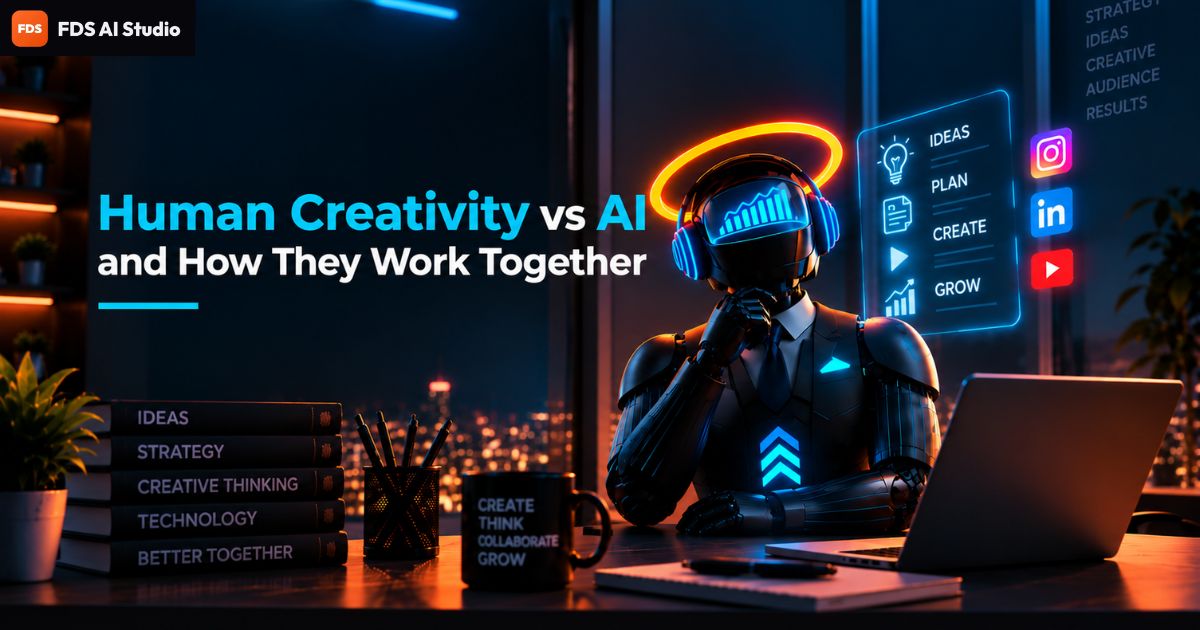
Artificial intelligence can write articles, generate images, compose music, create videos, suggest campaign ideas and even help design products.
Because of this, one question comes up again and again:
Can AI be more creative than humans?
The debate around human creativity vs AI is not really about choosing one side. Human creativity and artificial intelligence work in very different ways.
Humans create through emotion, lived experience, imagination, culture, memory and personal meaning. AI generates outputs by identifying patterns in data and responding to prompts.
This difference matters.
AI can accelerate the creative process, generate options and remove repetitive work. Humans, however, still provide judgment, intention, emotional depth, context and authorship.
In many cases, the strongest creative work comes from combining both.
This article explores AI vs human creativity, where each performs well, where each has limitations and why collaboration is likely to shape the future of creative work.
What Is Human Creativity?
Human creativity is the ability to create ideas, stories, designs, solutions and expressions that come from imagination, experience and interpretation.
Human creativity may be influenced by:
- Personal experiences
- Emotions
- Culture
- Memory
- Curiosity
- Observation
- Relationships
- Beliefs
- Individual taste
A writer may create a story based on grief or childhood memories.
A designer may build a visual identity inspired by local culture.
A filmmaker may create a scene based on an emotion they personally understand.
This connection between experience and expression gives human creativity depth and meaning.
What Is AI Creativity?
AI creativity refers to the ability of artificial intelligence systems to generate outputs that appear creative.
Generative AI can produce:
- Text
- Images
- Music
- Video
- Code
- Design concepts
- Advertising ideas
- Product concepts
AI does this by learning patterns from training data and generating outputs based on prompts.
For example, a user can ask an AI image tool to create:
“a futuristic Indian city during monsoon at night”
The AI can generate a visual based on patterns it has learned about cities, rain, lighting, architecture and composition.
The result may look creative, but the process behind it is different from human imagination.
Human Creativity vs AI: The Core Difference
The biggest difference between humans and AI is the source of creativity.
Humans create from experience and intention.
AI generates from patterns and probabilities.
Area
Human Creativity
AI Creativity
Source
Experience, emotion, imagination
Training data and patterns
Speed
Slower
Very fast
Emotional depth
Strong
Simulated
Original intention
Human-led
Prompt-driven
Volume
Limited by time
Can generate many variations
Context
Deep cultural and personal context
Depends on data and prompting
Judgment
Strong when experienced
Limited without human guidance
This is why comparing the two as direct competitors can be misleading.
They are different systems with different strengths.
Can AI Be Creative?
Yes, AI can produce outputs that appear creative.
It can combine concepts in unexpected ways, generate visual variations and suggest ideas that a human may not have considered immediately.
For example, AI can help brainstorm:
- 50 ad concepts
- 20 campaign headlines
- Multiple visual directions
- Video hooks
- Story ideas
- Product names
This can be extremely useful during ideation.
However, AI does not experience the world in the same way humans do.
It does not feel:
- Joy
- Grief
- Fear
- Nostalgia
- Ambition
- Love
- Cultural belonging
It can model the language and visual patterns associated with those emotions, but it does not experience them.
That distinction matters in creative work.
Where AI Is Stronger Than Humans
AI has several advantages in the creative process.
1. Speed
AI can generate ideas extremely quickly.
A creative team may take hours to brainstorm 20 campaign concepts.
AI can generate dozens of starting points in minutes.
This makes it useful for:
- Brainstorming
- Variation generation
- Rapid prototyping
- First drafts
- Concept exploration
2. Volume
AI can create many versions of the same idea.
For example, a marketer can generate:
- 30 headlines
- 20 captions
- 10 campaign angles
- 15 image prompts
Humans can then choose the strongest options.
3. Pattern Recognition
AI can identify patterns across large amounts of information.
This can help with:
- Trend analysis
- Content patterns
- Customer language
- Creative benchmarking
- Keyword ideas
4. Rapid Iteration
AI makes it easier to test variations.
A designer can explore several visual directions quickly before deciding which one to develop further.
5. Repetitive Creative Tasks
Not every creative task requires deep originality.
AI can help with repetitive tasks such as:
- Resizing copy
- Rewriting headlines
- Creating caption variations
- Turning long content into short content
- Drafting descriptions
This gives creative teams more time for strategic work.
Where Human Creativity Is Stronger
AI may be fast, but humans remain stronger in several areas.
1. Emotional Understanding
Humans understand emotion through experience.
A powerful story often works because the creator understands how people feel.
AI can imitate emotional language, but humans understand why a moment matters.
2. Cultural Context
Creative work is often shaped by culture.
Humans understand:
- Social behaviour
- Local language
- Humour
- Traditions
- Community references
- Cultural sensitivity
AI can learn patterns, but subtle cultural meaning may still require human judgment.
3. Original Intent
Humans create for reasons.
An artist may want to challenge an idea.
A filmmaker may want to communicate grief.
A brand may want to change perception.
AI does not independently choose why something should be created.
The creative intention still comes from humans.
4. Taste
Creative quality is often about taste.
Knowing when something feels:
- Too much
- Too generic
- Too obvious
- Too emotional
- Too commercial
- Just right
requires judgment.
Taste develops through experience, exposure and personal perspective.
5. Meaning
Humans assign meaning to creative work.
A simple photograph can have deep significance because of the story behind it.
AI can reproduce visual styles and compositions, but human meaning comes from lived experience.
AI Art vs Human Art
The debate around AI art vs human art is one of the clearest examples of human creativity vs AI.
AI can generate impressive visual work quickly.
It can create:
- Paintings
- Advertising visuals
- Concept art
- Product imagery
- Fashion ideas
- Architectural concepts
Human artists, however, bring personal perspective and intention.
The difference is not always visible in the final image.
The difference often exists in the creative process.
A human artist may spend years developing a style based on their life, beliefs and artistic influences.
AI generates based on patterns found in training data and user prompts.
Both can create useful visual outcomes, but their creative origins are different.
Originality in Human Creativity vs AI
Originality is a complex topic.
Human creators are also influenced by things they have seen before.
Writers read other writers.
Designers study other designers.
Musicians learn from other musicians.
Creativity often involves recombination.
AI also creates through recombination, but it does so at a much larger scale.
The key difference is human intention.
Humans can consciously reject patterns, break conventions and make creative decisions based on personal meaning.
AI requires direction from users to do this effectively.
The Role of Authorship
AI also raises questions about authorship.
If a person writes a detailed prompt, generates 100 variations, selects one, edits it and adds their own creative direction, who is the creator?
The answer may depend on:
- Human contribution
- Editing
- Creative control
- Legal frameworks
- Platform policies
As AI becomes more common, authorship will remain an important discussion in design, publishing, advertising, music and art.
How AI Can Support the Creative Process
The best use of AI is often not replacing creativity but accelerating it.
AI can support different stages of the creative process.
Research
AI can help organise information, identify trends and summarise references.
Brainstorming
AI can generate multiple starting points quickly.
Concept Development
Creative teams can explore alternative directions before choosing one.
Drafting
AI can help create first versions of scripts, headlines, descriptions and copy.
Visual Exploration
AI can generate moodboards, concept visuals and references.
Iteration
AI can quickly create variations based on feedback.
Humans then guide the final direction.
Human Plus AI: A Better Creative Model
Instead of asking whether AI will replace creativity, a better question is:
How can humans use AI to become more creative?
A human-plus-AI workflow might look like this:
- Human defines the goal.
- AI generates possible directions.
- Human selects the strongest ideas.
- AI creates variations.
- Human adds context, emotion and judgment.
- Human approves the final output.
This approach combines the speed of AI with the depth of human creativity.
AI and Creativity in Marketing
Marketing is one area where the combination is already useful.
AI can help marketers with:
- Campaign ideas
- Social media captions
- Video scripts
- Ad variations
- Visual concepts
- Content planning
Humans then decide:
- What fits the brand
- What feels original
- What customers will understand
- What should be published
AI may create 20 campaign options.
A human creative director decides which one actually works.
AI and Creativity in Design
Designers can use AI for:
- Moodboards
- Visual references
- Concept generation
- Layout exploration
- Product visualisation
AI helps speed up the exploration phase.
But human designers still need to control:
- Composition
- Brand consistency
- Typography
- Taste
- Emotional impact
This is why AI works best as a creative assistant rather than an automatic replacement for design thinking.
AI and Creativity in Writing
Writers can use AI for:
- Research support
- Outlines
- Headline ideas
- First drafts
- Editing suggestions
But good writing still requires:
- Voice
- Perspective
- Storytelling
- Emotion
- Experience
- Judgment
AI can help writers work faster, but human editing gives the content identity.
Can AI Replace Human Creativity?
AI can replace some creative tasks.
It may reduce the need for humans to manually produce repetitive variations.
However, replacing all human creativity is a different question.
Creative work often depends on:
- Meaning
- Emotion
- Context
- Strategy
- Culture
- Taste
- Human experience
These remain areas where people play a central role.
The more realistic future is collaboration rather than complete replacement.
Risks of Overusing AI in Creative Work
AI can improve creative productivity, but overuse creates problems.
Generic Output
If everyone uses similar prompts, content may start looking the same.
Loss of Brand Voice
AI-generated content can feel generic without clear human direction.
Lack of Original Thinking
Relying too heavily on AI may reduce independent brainstorming.
Accuracy Problems
AI may produce incorrect or misleading information.
Ethical Questions
AI-generated creative work raises issues around attribution, training data and intellectual property.
Human review remains essential.
How Creative Professionals Should Use AI
Creative professionals should treat AI as a tool, not as the creative decision-maker.
A useful approach is:
- Use AI for speed.
- Use humans for strategy.
- Use AI for variations.
- Use humans for selection.
- Use AI for execution support.
- Use humans for final judgment.
This keeps creative work efficient without losing identity.
Human Creativity and AI at FDS AI Studio
At FDS AI Studio, AI can support modern creative workflows while human strategy remains central to the process.
AI-assisted workflows can help with:
- Creative concepts
- Video scripts
- Campaign ideation
- Visual exploration
- Content planning
- Marketing execution
The goal is not to remove human creativity.
The goal is to help creative teams explore more ideas, test faster and spend more time improving the ideas that matter.
Final Thoughts
The debate around human creativity vs AI is not simply about deciding which one is better.
They have different strengths.
AI offers:
- Speed
- Scale
- Pattern recognition
- Rapid iteration
- Automation
Humans provide:
- Emotion
- Experience
- Meaning
- Imagination
- Judgment
- Taste
- Cultural context
The strongest creative future is likely to combine both.
AI can help humans create faster and explore more possibilities.
Humans can make sure those possibilities have meaning, purpose and originality.
The future of creativity is not human versus AI.
It is human creativity strengthened by AI.