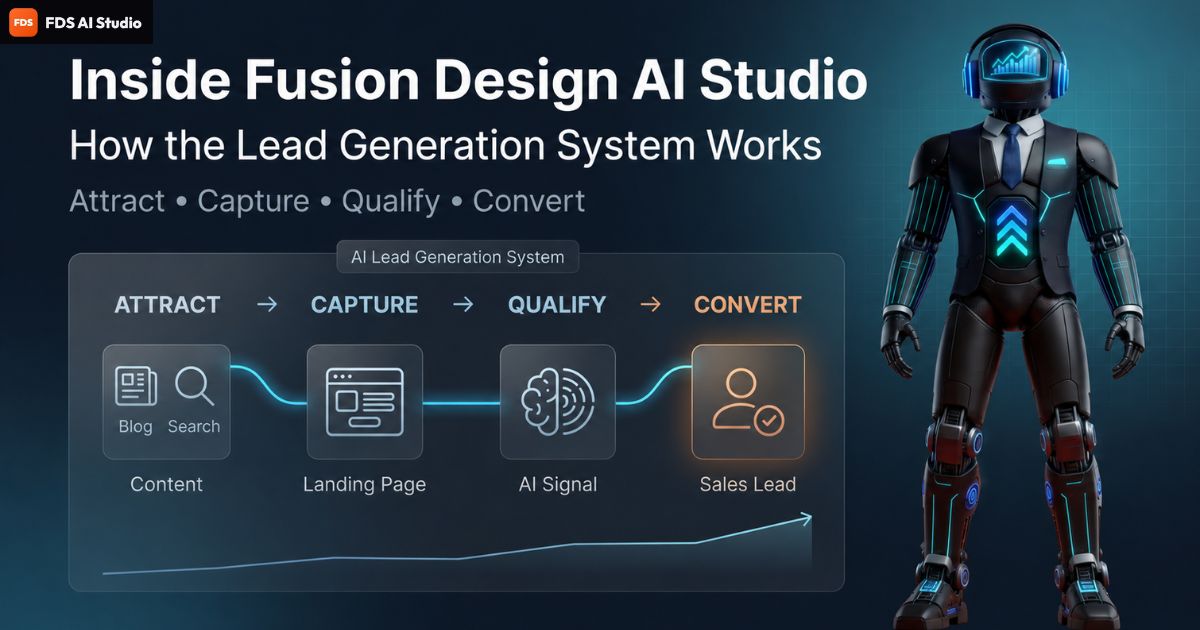
Inside Fusion Design AI Studio: How the Lead Generation System Works
The Problem the System Was Built to Solve
Before walking through the mechanics, it is worth being clear about what problem the system was designed to fix.
Why Most Small Business Ad Campaigns Fail
Most Indian MSMEs running Meta ads follow the same pattern:
- Write one ad based on what they think sounds compelling
- Set a target audience using broad demographic parameters
- Run the ad for two to four weeks
- Observe a cost per lead between ₹80 and ₹300
- Conclude that either Meta ads are too expensive or that their category does not convert on social media
Neither conclusion is usually correct. The problem is not the platform. The problem is that the campaign was built on a single message targeting a single emotional angle, with no testing system, no positioning layer, and no content infrastructure to catch the 90% of prospects who see the ad but do not convert immediately.
What a Lead System Actually Needs
A functioning lead generation system needs three things operating simultaneously:
- Multiple creative angles tested against the real emotional states of the target audience
- A positioning asset that answers the trust question every warm prospect carries before converting
- A structured content system that nurtures cold leads over time until they are ready to buy
The Fusion Design AI Studio system is built to deliver all three from a single starting point. Here is how.
Step 1: The Input
The entire system runs on one input. This is the starting point for everything the platform generates.
What You Actually Provide
You provide a description of your business in plain language. This includes:
- What your business does and what you sell or offer
- Who your target customer is and what problem they are trying to solve
- What makes your approach different from competitors
- Any proof points you have including results, client counts, years in business, or specific outcomes
You do not need to write ad copy. You do not need to know persuasion frameworks. You do not need to brief a creative team. The input is a business description, not a creative brief.
What the System Does With It
The AI processes the input through three proprietary frameworks simultaneously. The Stab and Twist persuasion engine determines how to structure every script and content piece around a hook, pain, differentiation, proof, and call to action. The MCB research method determines how to frame content as a problem, a solution, and a practical step. The LNT system architecture determines which output belongs to which stage of the lead generation and nurturing cycle.
The output from this single input is three categories of marketing assets: five video ad scripts, a positioning video script, and a three-month content calendar. The following steps explain each one.
Step 2: The Video Ads Engine
The first gear generates five complete, ready-to-shoot video ad scripts. Each script is different. Each targets a different psychological reason why a prospect might buy.
Why Five Scripts and Not One
The reason for five scripts is grounded in how buying decisions actually work. Every target audience contains multiple emotional segments. Some prospects are motivated by the financial cost of their current situation. Others are motivated by distrust of previous solutions. Others feel the time pressure of managing everything manually. Others feel competitive anxiety about falling behind. Others are motivated by a specific vision of what their business could become.
A single script reaches one of these segments and is invisible to the others. Five scripts tested simultaneously reach all five and let data identify which emotional state is dominant in that specific audience.
The Five Buying Triggers
The five scripts target the following buying triggers:
- Cost Pain speaks to prospects who are currently bleeding money on a solution that is not delivering results. The hook names the specific financial frustration. The script agitates the ongoing cost before presenting the alternative.
- Trust Gap speaks to prospects who have been let down by a previous agency, platform, or vendor. The script validates their scepticism before countering with specific, verifiable proof rather than more promises.
- Time Drain speaks to founders and business owners doing their marketing manually at the end of the working day because there is nobody else. The script names both the time cost and the opportunity cost of this situation.
- Fear of Loss speaks to prospects who can see competitors growing and building systems while their own business growth has stalled. The script makes the competitive gap feel immediate and consequential.
- Aspiration speaks to prospects who have a clear picture of what their business could look like with consistent leads. The script leads with the outcome and positions the system as the vehicle to get there.
How Each Script Is Structured
Every script follows the Stab and Twist persuasion engine regardless of which trigger it targets. The structure is as follows:
- Hook in the first 3 seconds: a declarative statement that names an uncomfortable truth the viewer is living with. Not a question. Not a feature. A specific, personal statement that makes scrolling past feel impossible.
- Pain from seconds 3 to 10: an agitation of the problem that gives it weight and consequence before the solution is introduced. Most scripts rush past this beat. The Stab and Twist framework holds here long enough for the viewer to feel the full cost of the problem.
- Differentiation from seconds 10 to 20: the Twist. This challenges the old belief that has kept the prospect stuck and presents a structural alternative. Not a product feature list. A single, clear reason why the old approach was wrong and the new approach changes the outcome.
- Proof from seconds 20 to 25: one specific, verifiable result. For Fusion Design AI Studio campaigns, this is typically the CPL number, the ROAS figure, or the lead count from a real ad account.
- CTA from seconds 25 to 30: one action in the language the viewer naturally speaks. Hinglish by default. Low friction. Specific rather than vague.
The Testing Workflow
All five scripts are shot and run simultaneously on Meta. This is not sequential A/B testing where you run one ad, evaluate it after two weeks, and then run another. It is parallel testing where all five angles compete in the live auction at the same time.
The data identifies the winning trigger within 48 to 72 hours. Losing scripts are paused immediately. Budget concentrates on the winning angle. The system then tests variations within the winning trigger to continue improving performance.
This is the mechanical reason that Fusion Design AI Studio campaigns produce an average CPL of ₹9.54 while most manually managed campaigns in the same categories produce leads at ₹80 to ₹300.
Step 3: The First Impression
The second gear generates a 30-second positioning video script. This is a different type of content from the ad scripts. Its job is not to generate a click. Its job is to answer the question every warm prospect carries after seeing your ad: why should I choose this business and not any of the others I have seen this week?
The Positioning Skeleton
The script follows the FDS positioning skeleton across five beats:
- Hook (0 to 3 seconds) opens with a pattern interrupt that says what the customer is thinking but no competitor has publicly said. It does not open with "Welcome to our company" or a product feature. It opens with the viewer's own internal dialogue spoken back to them.
- Pain (3 to 10 seconds) names the real problem underneath the surface problem. Competitors are all addressing the surface problem. Naming the systemic issue underneath it immediately positions the brand differently.
- Differentiation (10 to 20 seconds) states the structural reason to choose this business. Not a list of services. Not a comparison of features. One specific, clear, demonstrable difference that changes the outcome.
- Proof (20 to 25 seconds) delivers one number or one result that is too specific to be a marketing claim. For campaigns using Fusion Design AI Studio frameworks, this is typically the verified CPL or ROAS from a documented campaign.
- CTA (25 to 30 seconds) closes with one action. The viewer who has watched 28 seconds of this video has already decided whether they trust the brand. The CTA asks for the smallest reasonable next step, not a commitment.
Where the First Impression Lives in the System
This video lives permanently on the brand's social media profile. It runs as a standalone ad alongside the five trigger-based scripts. When a prospect sees a video ad, checks the brand's Instagram profile before deciding whether to inquire, and watches this positioning video, the trust question is answered before they ever send a message.
This positioning layer is what separates campaigns that generate clicks from campaigns that generate qualified leads. The ad attracts attention. The positioning video converts attention into trust.
Step 4: The Social Media Grid
The third gear generates a complete three-month content calendar mapped to the buyer's journey. This is the remarketing infrastructure of the system and it operates entirely through organic content at zero additional ad spend.
The Three-Month Structure
The calendar is divided into three monthly stages, each with a specific function in the buyer journey:
- Month 1 is for cold audiences. The content in Month 1 is designed for people who have seen the ads but not converted, or who have landed on the social profile through discovery. Content types include problem-hook reels, educational carousels, polls, and behind-the-scenes content. The job of Month 1 is recognition and relevance.
- Month 2 is for warm leads. The content in Month 2 is designed for people who are aware of the brand but are still evaluating. Content types include case studies, client results, testimonials, framework breakdowns, and comparison content. The job of Month 2 is credibility.
- Month 3 is for hot prospects. The content in Month 3 is designed for people who have been through Months 1 and 2 and are ready to make a decision. Content types include limited offers, urgency-driven posts, direct call-to-action reels, WhatsApp story prompts, and re-engagement posts for leads who went cold in Month 1. The job of Month 3 is conversion.
The MCB Research Method
Every post in the calendar follows the MCB research method regardless of content type or platform. The structure is:
- Problem: open by naming a problem the audience is already experiencing
- Solution: present the specific solution or insight that addresses it
- Practical step: give the reader or viewer one actionable thing they can do with the information
This structure ensures every piece of content delivers immediate value while moving the audience closer to a purchase decision. Content that only provides value without a direction produces engagement without leads. Content that only pushes offers without value produces resistance. The MCB method balances both.
Built-In Remarketing
The most important structural feature of the Social Media Grid is that remarketing is built into the monthly progression itself. Cold leads from Month 1 who did not convert do not require a separate retargeting ad campaign to re-engage. They encounter Month 2 content naturally as they continue following the brand. Prospects who are still on the fence after Month 2 encounter Month 3 conversion content without any additional paid spend being required.
This is the organic remarketing system. It does not replace paid retargeting. It reduces the dependency on it, which in turn reduces the overall cost of customer acquisition across the full campaign cycle.
How the Three Gears Work Together
Each gear functions independently. A business can use the Video Ads Engine without the Social Media Grid, or the Positioning Video without the ad scripts. But the system is designed to compound when all three run simultaneously.
The Closed Loop
The operational loop runs as follows:
- The five trigger-based ad scripts attract cold audiences and generate the initial lead flow at the lowest possible CPL
- The positioning video catches warm audiences who investigate the brand after seeing the ads and closes the trust gap before they reach out
- The social media grid nurtures all audiences over 90 days, converting cold leads from Month 1 through natural content progression without additional spend
No lead goes cold because the content system is always running. No prospect falls through the gap between the ad and the conversion because the positioning video is always present. No creative angle is left untested because all five triggers run simultaneously from day one.
How Data Feeds Back Into the System
After the first 48 to 72 hours of running all five scripts, the data identifies the dominant buying trigger for that specific audience. This is not just a campaign optimisation. It is audience intelligence that informs everything that follows.
The winning trigger tells the brand something specific about their audience's emotional state. That intelligence shapes the Month 2 and Month 3 content, the messaging in the positioning video, the angle of future ad campaigns, and the framing of any off-platform content like email sequences or WhatsApp broadcasts.
The system learns continuously because every campaign generates data that improves the next one.
The LNT Framework: The Architecture Underneath
The three gears sit inside a broader system architecture called the LNT framework: Lead Generation, Lead Nurturing, and Training.
- Lead Generation is what the Video Ads Engine handles. It brings qualified prospects into the system at the lowest sustainable CPL.
- Lead Nurturing is what the Social Media Grid handles. It moves prospects through the buyer journey from cold to warm to converted through structured, buyer-stage-aware content.
- Training is the continuous improvement layer. Every campaign cycle generates data that is fed back into the system to improve creative, targeting, and content strategy in the next cycle.
Most businesses have a lead generation function but no nurturing system. They spend on ads, collect leads, follow up manually a few times, and lose the 90% who were not ready to buy on first contact. The LNT framework closes this gap structurally rather than relying on manual follow-up.
Who Operates the System
One of the most common questions about Fusion Design AI Studio is how much marketing expertise is required to run it effectively.
What the Platform Handles
The system handles every component that previously required a marketing team:
- Copywriting and persuasion structure across all five ad scripts
- Positioning strategy and script writing for the 30-second video
- Content strategy and calendar planning for 90 days across three platforms
- Creative framework application ensuring every piece of content follows proven structures
- Hinglish adaptation ensuring all output is calibrated for Indian audiences
What the Human Role Looks Like
The founder or business owner is responsible for:
- Providing the initial business input in plain language
- Shooting the five video ad scripts on a phone or briefing a videographer
- Shooting the positioning video using the generated script
- Publishing the social media content on the schedule provided
- Reading the campaign data after 48 to 72 hours to identify and scale the winning trigger
No copywriting experience needed. No marketing strategy background required. No agency team necessary. The system does the strategic and creative work. The human provides the business context and executes the output.
What the System Produces
The verified output from Fusion Design AI Studio campaigns across 65 plus brands and thirteen years is as follows:
- 871 qualified leads from recent campaigns
- Average cost per lead of ₹9.54
- Lowest individual campaign CPL of ₹6.05
- Peak return on ad spend of 9.86x
- 1,37,000 visuals delivered across the studio's full creative history
These results are from businesses in real Indian markets with real budget constraints using the same system described in this article.
Getting Started
The entry point to the full system is through the FDS Marketing Tools suite. The free plan provides 100 credits with no card required, giving access to all three tools and all 26 plus AI systems on the broader platform.
The fastest path to a complete lead generation system is to run all three tools from the same business input in one session. The Video Ads Engine, the Positioning Video, and the Social Media Grid all draw from the same input and are designed to be generated together.
Explore the full system at FDS Marketing Tools and start with the free plan to see what the output looks like for your specific business before making any financial commitment.