From Data to Decisions: How Marketing Intelligence Transforms
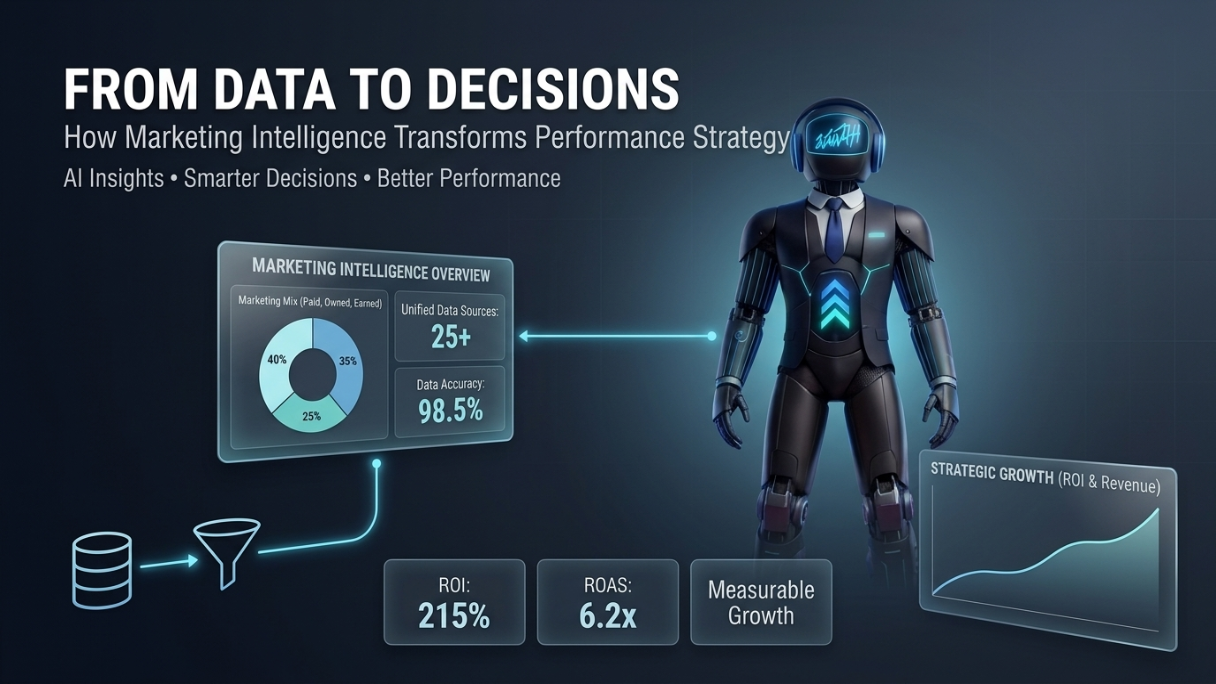
Most businesses today aren't short on data. They're short on decisions.
Walk into any marketing team's dashboard and you'll find Meta Ads reports, Google Analytics, WhatsApp broadcast numbers, Shopify sales data, and a dozen spreadsheets nobody has opened in three weeks. The data is all there. What's missing is the bridge between that data and the next move.
That bridge has a name — marketing intelligence. And it's quietly becoming the difference between brands that scale predictably and brands that guess, spend, and hope.
This blog breaks down what marketing intelligence actually means, why most businesses collect data without ever turning it into strategy, and how a proper intelligence system changes the way performance decisions get made — from ad spend to content to customer targeting.
What Is Marketing Intelligence, Really?
Marketing intelligence is the process of converting raw marketing data — ad performance, customer behavior, competitor moves, market trends — into decisions you can actually act on.
It's not the same as marketing analytics. Analytics tells you what happened. Intelligence tells you what to do about it.
A report that says "CTR dropped 2% last week" is analytics. A system that tells you "CTR dropped because your Reel-heavy creative fatigued after day 9 — rotate in UGC-style content and expect recovery within 72 hours" — that's intelligence. One is a number. The other is a decision waiting to be made.
Why Most Businesses Are Data-Rich but Decision-Poor
Here's the pattern we see across almost every MSME and D2C brand before they build a real intelligence layer: three ad accounts, two analytics tools, a WhatsApp inbox full of leads, and zero connection between them.
The result is a business that's constantly reacting instead of planning. A campaign underperforms, someone notices two weeks late, budget has already leaked out, and the "fix" becomes a guess dressed up as a strategy meeting.
This isn't a tooling problem. Most brands already have enough tools. It's a translation problem — nobody is turning the numbers into a next step. And that gap is exactly where growth quietly dies, one unoptimized campaign at a time.
The Core Components of Marketing Intelligence
A proper marketing intelligence setup pulls from four sources, not one.
Customer Data
Who's buying, why they're buying, and what they do right before and after they buy. Purchase history, browsing behavior, review sentiment, WhatsApp conversation patterns — this is the layer that tells you who to talk to.
Campaign Performance Data
Meta Ads, Google Ads, organic reach, email open rates. Not just the vanity metrics — the ones that connect to revenue: cost per qualified lead, cost per sale, and return on ad spend by campaign stage, not just by campaign.
Competitive Intelligence
What competitors are running, what messaging is getting engagement, where the market gap sits. This is the layer most Indian MSMEs skip entirely — and it's often the fastest source of new positioning ideas.
Market Trend Data
Category-level shifts, seasonal demand patterns, emerging platforms. This is what keeps a strategy from going stale the moment the market moves.
None of these four, on their own, tell you what to do. Put together, they start pointing at a decision.
How Marketing Intelligence Transforms Performance Strategy
From Guesswork to Precision Targeting
Without intelligence, targeting is a hypothesis: "young professionals in metro cities probably like this." With intelligence, targeting is a pattern pulled straight from the data — who actually converted, what they had in common, and where the next 100 people like them are sitting.
Real-Time Optimization
A campaign that's bleeding budget doesn't need to run for two more weeks before someone notices. An intelligence system flags the drop in days, sometimes hours, so the fix happens while there's still budget left to fix it with.
Predictive Decision-Making
Once there's enough history in the system, patterns start repeating — which creative fatigues fastest, which offer converts best in which week of the month, which lead source actually closes. That turns planning from a guess into a forecast.
A Unified Cross-Channel View
The biggest shift is simple: instead of five dashboards telling five different partial stories, there's one view that shows how ads, content, and WhatsApp follow-ups are actually working together — or working against each other.
Building a Marketing Intelligence System for Your Business
You don't need an enterprise budget to start. You need a sequence.
Step 1: Centralize Your Data
Pull ad performance, website analytics, and lead data into one place. Even a well-structured spreadsheet connected through automation is a massive upgrade from five disconnected tabs.
Step 2: Define the Metrics That Actually Matter
Every business has what we call its 9 Critical Numbers — the handful of metrics that actually move revenue, not the twenty vanity metrics that just look busy on a slide. Cost per lead, lead-to-sale conversion rate, and customer lifetime value matter more than impressions ever will.
Step 3: Automate the Reporting Layer
Weekly manual reporting eats hours and still arrives too late to act on. Automation — through tools like n8n workflows connected to your ad accounts and CRM — turns a two-hour Monday task into a report that's sitting in your inbox before you wake up.
Step 4: Build a Decision Framework Around the Data
This is the step almost everyone skips, and it's the one that matters most. Data without a decision framework is just noise with better formatting. Every report should end with one question answered: what do we do next, and why?
This is precisely the layer we build at FDS AI Studio — turning scattered dashboards into AI-powered Revenue Infrastructure that MSMEs and manufacturers can actually act on, not just admire.
Common Mistakes Businesses Make With Marketing Data
The most common one is collecting data without a question attached to it. Teams pull reports because it's Monday, not because they're trying to answer something specific.
The second is treating every metric as equally important. Not every number deserves a place on the dashboard — only the ones tied to revenue.
The third, and the costliest one, is reacting to a single week of data. One bad week isn't a trend. Intelligence means reading patterns over time, not panicking over noise.
Final Thought
Data was never the hard part. Every business has more of it than it knows what to do with. The businesses that pull ahead are the ones that build a system to turn that data into a decision, every single week, without waiting for someone to notice the numbers three weeks too late.
That's what marketing intelligence actually is — not another dashboard, but the missing link between what your numbers are saying and what your business does next.