Fusion Design AI Studio: Fifty Years of Craft, One AI Engine
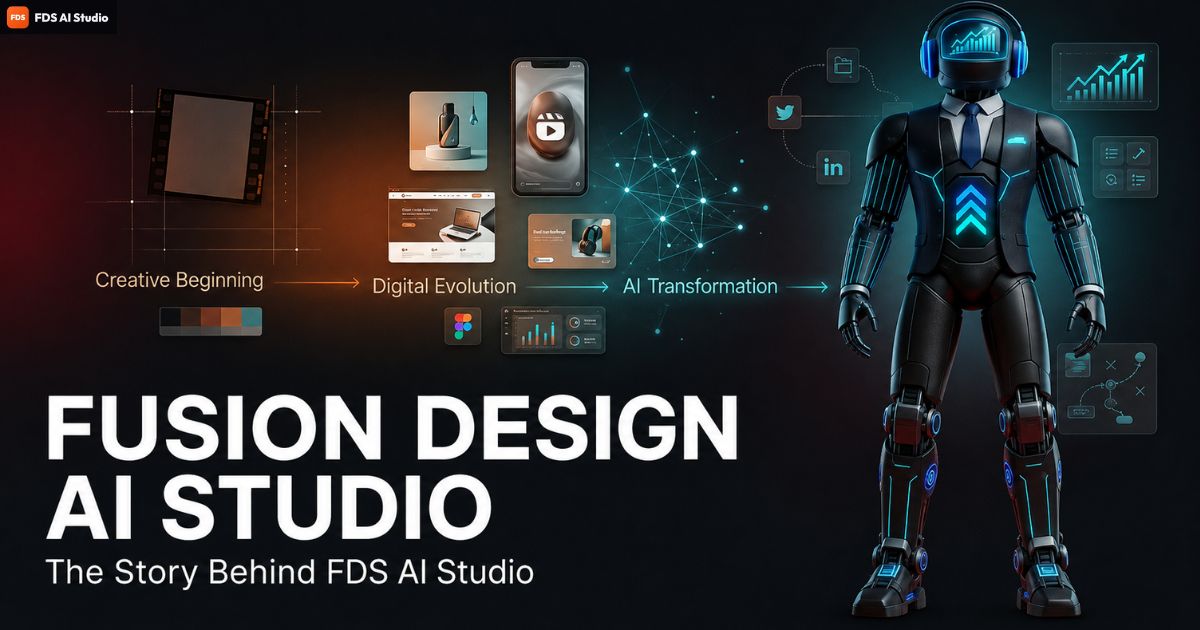
Two Men. Fifty Years. One Company That Became Three.
In 2012, two people came together in New Delhi with a combined fifty years of advertising and visual craft between them. Neither of them had founded a technology company before. Both of them understood something about persuasion that most technology companies never learn. The difference between content that converts and content that simply exists is not a matter of volume or velocity. It is a matter of judgement.
Kuldeep Soni spent his career inside the architecture of Indian advertising. JWT. Lowe Lintas. McCann. Seventeen years as the head of McCann Delhi's Digital Studio, one of the most demanding creative environments in the country. He learned what it means to operate at scale without sacrificing the quality that makes scale worth having.
Manish Soni came from a different direction. The early 2000s at MAGPPIE. Sunrises spent on a single frame, learning that obsession and attention are not the same thing as perfectionism. They are the only reliable way to make an image that sells. Creative Head at KUSE from 2007, where the discipline of commercial visual craft was sharpened into something that could work across categories, clients, and conditions.
Fifty years between them. All of it earned before a prompt existed.
What they built in 2012 was not immediately an AI company. It was a photography and brand studio called FDS Photography, doing commercial content at a standard where error was not tolerated. Over time, the studio expanded into brand strategy through Scale Up Your Brand, and eventually into the infrastructure that now carries both: FDS AI Studio.
Thirteen years. 65 plus brands spanning D2C startups, manufacturers, service businesses, and education companies. 1,37,000 visuals delivered. That works out to twenty-seven finished visuals every day for fourteen years, including the days nobody was watching.
That volume is not a boast. It is how judgement gets built.
The Number That Changed Everything
For most of those thirteen years, the studio operated in the space where craft and commerce intersect, producing visual and strategic marketing content for brands that needed quality at scale. Then came a number that forced a structural rethink.
That number was ₹6.05.
That is the cost of one qualified lead. A real name, a real phone number, a real prospect generated through a campaign built on the frameworks that Fusion Design AI Studio had developed across a decade of real advertising work. Not impressions. Not reach. Not clicks that evaporate on contact. A lead with a name, for less than the price of a cup of tea.
The full proof point as it stands today: 871 qualified leads across recent campaigns at an average CPL of ₹9.54. The lowest individual campaign bringing leads at ₹6.05 each. Peak return on ad spend of 9.86x, meaning every rupee put into the campaign returned almost ten rupees in tracked sales. Total spend of ₹8,305 for 871 qualified leads, verified against live Meta ad account screenshots.
What this number exposed is a gap that most Indian MSMEs have never been able to bridge. Not a gap in budget. Not a gap in intent. The gap was in system. In structure. In the persuasion frameworks that determine whether an ad stops a scroll or disappears into it.
Fusion Design AI Studio stopped being purely a creative studio and became something else entirely: a machine for turning a single business input into a complete lead generation and nurturing engine.
One Engine. Three Gears. One Lead System.
The engine that emerged from this shift has three components, each doing a specific job in the sequence from cold audience to qualified lead.
The Video Ads Engine. A business provides one input covering their product, their offer, and their audience. The system generates five complete, ready-to-shoot ad scripts. Not five versions of the same script. Five entirely different scripts, each targeting a different psychological buying trigger.
The five triggers are cost pain (the prospect is bleeding money on a solution that is failing them), trust gap (they have been burned before and approach every claim with scepticism), time drain (they are doing a specialist's job manually because there is nobody else), fear of loss (competitors are building systems while they are still running random ads), and aspiration (they can see what their business could be if the lead flow was consistent and predictable).
All five run simultaneously on Meta. The data identifies the winner within 48 to 72 hours. The losing triggers get cut. The winning angle gets scaled. This is the structural difference between a business generating leads at ₹200 and a business generating leads at ₹9.54. Not better targeting. Not higher budgets. A system that tests the full range of emotional states in a target audience before committing to a single direction.
The First Impression. A 30-second positioning video script built on the FDS positioning skeleton. Five beats: the hook that pattern-interrupts the scroll, the pain that names the real problem and not just the surface one, the differentiation that gives a structural reason to choose this business over every other option, the proof that provides one verifiable number or result, and the CTA that asks for one low-friction action in the language the audience actually speaks. This is the asset that answers the question every cold prospect asks before they convert. Why you, not the twelve other options I have seen this week?
The Remarketing Engine. A complete three-month content calendar mapped to the buyer's journey. Month 1 content attracts and connects with cold audiences. Month 2 builds trust with warm leads through case studies, testimonials, and framework explanations. Month 3 converts through offers, urgency, and direct calls to action. Remarketing is built into the structure. The 90% of prospects who do not convert on first contact are re-engaged through organic content over time, at zero additional ad spend.
Underneath all three gears runs the LNT framework: Lead Generation, Lead Nurturing, and Training. Get them. Warm them. Teach them. The system is designed so that no lead goes cold, no follow-up requires manual attention, and every campaign makes the next one smarter.
The Agentic Shift
The current chapter of Fusion Design AI Studio is not about better tools. It is about a fundamentally different category of AI capability.
Most AI tools give advice. They generate a suggestion, present an option, and wait for a human to evaluate it and take the next step. An agentic system does the work. The difference is the difference between a consultant and an employee. One tells you what should be done. The other has already done it.
Ask the system for five ad scripts and it writes them. Ask which leads went cold after the first contact and it finds them and follows up. An AI calling agent qualifies prospects. A WhatsApp agent replies to inquiries at 2 AM. A remarketing agent re-enters a buyer at the precise stage of their journey where they dropped off. No leave. No fatigue. No lead forgotten. 168 hours a week of consistent, documented, system-driven marketing work.
This is what Fusion Design AI Studio means by six departments in one command centre. Creative AI covers image generation, video creation, carousel design, and content writing. B2B Marketing AI covers brand research, LinkedIn automation, the email engine, and competitor intelligence. Sales and Conversion covers AI calling, WhatsApp automation, and CRM. Retention and Growth covers reviews, referrals, and social media automation. Analytics and Intelligence covers the marketing score, ad analyzer, and ROI tracking. Community covers the hub, academy, marketplace, and training frameworks. Not a collection of tools. A marketing department that runs on autopilot.
The mission is specific: agentic AI for Indian MSMEs. Built in Hinglish, calibrated to how Indian buyers actually behave, priced for the economic reality of Indian small business, and proven across the market it was built to serve.
The One Thing That Cannot Be Subscribed To
There is something at the centre of Fusion Design AI Studio that no model or training dataset ever put there.
You know when a reflection on steel is wrong. You know that jewellery needs one specific fall of light or the frame reads false. You know the second in a thirty-second film where the viewer decides to stay or scroll. You know the line in a nurturing sequence that makes a cold lead reply after six weeks of silence.
That knowledge did not come from a prompt. It came from 1,37,000 visuals, seventeen years inside McCann, a decade of sunrises on commercial shoots, and the accumulated discipline of working in an industry where getting the creative wrong costs a client real money.
AI removed the cost of doing the work. It did not remove the judgement of knowing what to do.
Fifty years bought that judgement. It is the one thing at Fusion Design AI Studio that cannot be replicated by any company that started with a subscription.
Every brand has potential. Most do not lack creativity. They lack an engine.
The numbers are on the record: 871 qualified leads, ₹9.54 average CPL, 9.86x peak ROAS, 65 plus brands, thirteen years. The only number that matters now is yours.