How to Reduce Cost Per Lead on Meta Ads India: A Practical CPL Optimization Strategy
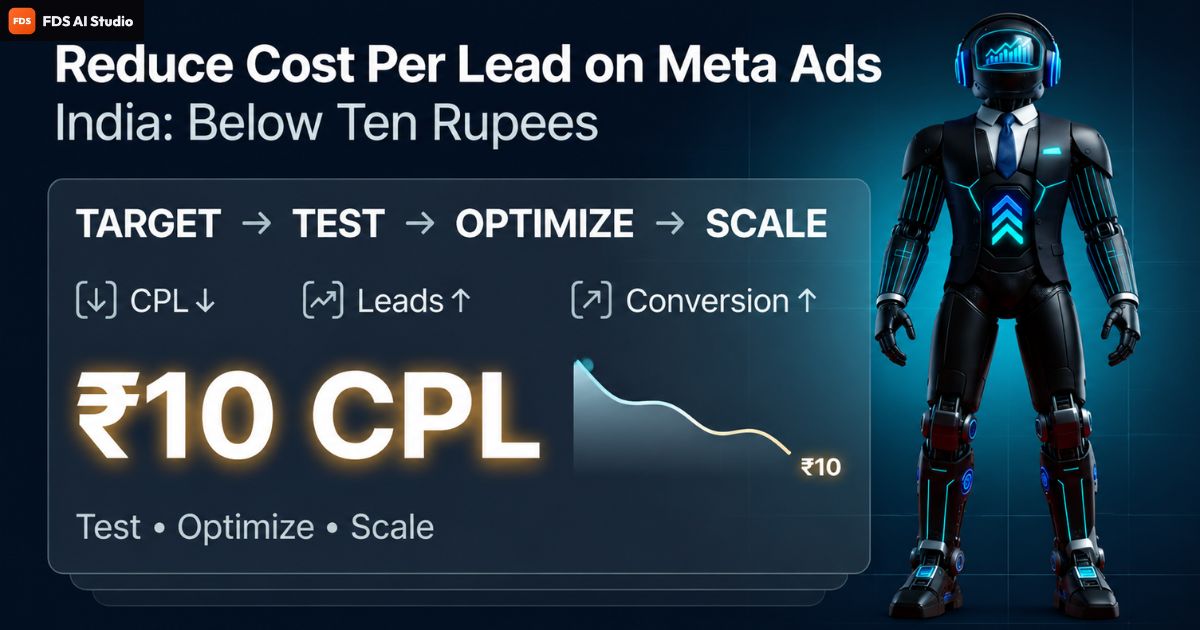
Running Meta Ads in India can feel unpredictable.
One month your campaign generates affordable leads, and the next month the same campaign suddenly becomes expensive.
Your budget remains the same, your offer has not changed, but your cost per lead (CPL) keeps increasing.
So the real question is:
How do you reduce cost per lead on Meta Ads India without sacrificing lead quality?
Many businesses try increasing the budget, changing targeting repeatedly, or creating one new advertisement and hoping for better results.
But reducing CPL is not about one single trick.
It requires improving multiple factors together:
- Better creative testing
- Stronger audience understanding
- Clear buying triggers
- Improved lead forms
- Better conversion tracking
- Continuous campaign optimisation
For Indian businesses, especially MSMEs and service brands, reducing Meta Ads costs requires a system built around local audience behaviour.
This guide explains practical strategies to lower your Meta Ads CPL and generate more affordable, higher-quality leads.
What Is Cost Per Lead (CPL) in Meta Ads?
Cost Per Lead (CPL) is the amount you spend to generate one potential customer enquiry through your advertisement.
The formula is simple:
CPL = Total Ad Spend ÷ Number of Leads Generated
For example:
If you spend ₹10,000 on Meta Ads and receive 100 leads:
₹10,000 ÷ 100 = ₹100 CPL
A lower CPL usually means your campaign is generating leads more efficiently.
However, cheaper leads do not always mean better results.
A campaign generating ₹20 leads with poor quality may perform worse than a campaign generating ₹100 leads with customers ready to buy.
The goal is:
Reduce CPL while maintaining lead quality.
Why Is Your Meta Ads CPL Increasing?
Before reducing CPL, you need to understand what is increasing it.
Common reasons include:
1. Ad Fatigue
When the same audience repeatedly sees the same creative, performance declines.
Signs of ad fatigue:
- Increasing CPM
- Lower click-through rate
- Higher CPL
- Reduced engagement
The audience is no longer reacting because the message feels repetitive.
2. Weak Ad Creatives
Meta's algorithm rewards advertisements that create strong user response.
A generic creative saying:
“Best service provider. Contact us today.”
usually does not create enough interest.
Your creative must answer:
- Why should someone care?
- Why now?
- Why your brand?
- What problem are you solving?
3. Wrong Audience Targeting
Many businesses overcomplicate targeting.
They add too many interests and restrictions, reducing Meta's ability to find potential buyers.
Modern Meta campaigns often perform better when the algorithm has enough flexibility to identify valuable users.
4. Poor Lead Form Experience
If your form creates unnecessary friction, fewer people complete it.
Common mistakes:
- Too many questions
- Asking unnecessary information
- No clear value exchange
- Slow landing pages
5. Lack of Creative Diversity
Meta's Andromeda algorithm increasingly relies on creative diversity to identify different user responses.
Running multiple variations of the same advertisement limits learning.
The Biggest Mistake: Optimising Only Targeting
Many Indian advertisers immediately change audiences when CPL increases.
But today, creative quality often plays a bigger role.
Two businesses can target the same audience.
One gets ₹50 CPL.
The other gets ₹300 CPL.
The difference is often:
- Message
- Creative angle
- Offer presentation
- Customer psychology
The audience is seeing the advertisement.
The creative is what convinces them.
The 5-Angle Creative Testing Framework to Reduce CPL
One of the most effective ways to reduce Meta Ads CPL is testing multiple creative angles simultaneously.
Instead of creating five similar ads, test five different reasons why someone should buy.
Angle 1: Problem-Based Creative
Highlight the customer's pain point.
Example:
“Still struggling to generate consistent business enquiries every month?”
This works because it immediately connects with existing frustrations.
Angle 2: Solution-Based Creative
Show how your product or service solves the problem.
Example:
“A complete marketing system designed to generate predictable leads.”
The customer understands the outcome.
Angle 3: Proof-Based Creative
Build trust using evidence.
Examples:
- Client results
- Case studies
- Testimonials
- Numbers
- Before-after comparisons
People trust proof more than promises.
Angle 4: Comparison-Based Creative
Help customers understand why your approach is different.
Example:
“Why businesses move from random posting to performance marketing systems.”
This creates a buying trigger.
Angle 5: Authority-Based Creative
Position expertise.
Examples:
- Years of experience
- Industry knowledge
- Unique process
- Specialist positioning
Authority reduces trust gaps.
Why Creative Diversity Matters for Meta Ads India
Meta's algorithm needs different signals to understand who responds best.
Different people react to different messages.
One person may respond to:
- Price advantage
Another may respond to:
- Quality
Another may respond to:
- Trust
Another may respond to:
- Results
Creative diversity helps Meta discover these buying triggers.
Instead of asking:
“Which audience should we target?”
Ask:
“Which message will make the right audience respond?”
How to Get Cheaper Leads on Facebook India
1. Use Stronger Offers
Your offer directly affects CPL.
Weak offer:
“Contact us for more information.”
Strong offer:
“Get a free 15-minute business growth audit.”
The second creates a reason to take action.
A good offer reduces hesitation.
2. Improve Your Ad Hook
The first few seconds decide whether people stop scrolling.
Strong hooks include:
- Questions
- Unexpected statements
- Specific benefits
- Customer pain points
Example:
Instead of:
“We provide digital marketing services.”
Try:
“Why are your ads generating clicks but not customers?”
3. Use Meta Instant Forms Strategically
Meta Instant Forms can reduce friction because users do not leave the platform.
Benefits:
- Faster submission
- Mobile-friendly experience
- Less loading delay
However, low-friction forms may sometimes attract lower-intent leads.
Balance quantity with quality by adding qualifying questions.
4. Optimise Your Lead Form Questions
Do not ask unnecessary questions.
A good lead form should capture:
- Name
- Phone number
- Relevant qualification question
Examples:
For real estate:
“Which budget range are you considering?”
For services:
“What is your monthly marketing budget?”
For B2B:
“How many employees does your company have?”
Qualification improves lead quality.
Audience Targeting Strategy for Lower CPL
Avoid Over-Restricting Your Audience
Many advertisers add too many filters.
This can:
- Increase CPM
- Reduce delivery
- Limit algorithm learning
Allow Meta enough audience size to optimise.
Use Retargeting
People who already interacted with your brand are more likely to convert.
Create audiences from:
- Website visitors
- Video viewers
- Instagram engagement
- Previous leads
Warm audiences often have lower acquisition costs.
Use Lookalike Audiences
Lookalikes help Meta find people similar to your existing customers.
Good source audiences include:
- Previous customers
- Qualified leads
- High-value buyers
Landing Page Optimisation for Lower CPL
If your advertisement gets clicks but leads are expensive, the problem may be after the click.
Improve:
Page Speed
Slow pages lose potential customers.
Message Match
Your landing page should continue the same promise shown in your advertisement.
Clear CTA
Visitors should immediately know what action to take.
Trust Elements
Add:
- Testimonials
- Results
- Reviews
- Certifications
- Client logos
Trust reduces hesitation.
Meta Ads CPL Benchmark India: What Should You Expect?
CPL varies significantly depending on:
- Industry
- Location
- Offer
- Competition
- Audience quality
- Creative quality
There is no universal CPL number.
A real estate lead may cost very differently from an education lead or local service lead.
Some businesses achieve very low CPLs through:
- Strong offers
- High-performing creatives
- Good audience matching
However, the cheapest lead is not always the best lead.
Always measure:
- Lead-to-call ratio
- Qualified lead percentage
- Conversion rate
- Customer acquisition cost
- ROAS
How FDS AI Studio Approaches CPL Reduction
Reducing Meta Ads CPL requires more than adjusting campaign settings.
It requires understanding:
- Customer psychology
- Creative strategy
- Buying triggers
- Testing systems
- Data analysis
At FDS AI Studio, the approach focuses on combining AI-powered creative systems with performance marketing strategy.
Instead of producing random advertisements, the focus is on creating:
- Multiple creative angles
- Data-driven testing
- Customer-focused messaging
- Performance-based optimisation
Explore more performance marketing insights through the FDS AI Studio blog.
A Simple CPL Reduction Checklist
Before increasing your Meta Ads budget, check:
Creative
Are you testing multiple angles?
Are your hooks strong?
Are creatives refreshed regularly?
Audience
Is your audience too restricted?
Are you using retargeting?
Are lookalikes available?
Lead Form
Is the form simple?
Are you qualifying leads?
Is the offer valuable?
Tracking
Is Meta Pixel installed correctly?
Are conversions measured?
Are you tracking lead quality?
Final Thoughts
Reducing cost per lead on Meta Ads India is not about finding one hidden setting.
It is about creating a complete optimisation system.
The businesses that achieve lower CPL usually do these things consistently:
- Test multiple creative angles
- Understand customer buying triggers
- Refresh advertisements before fatigue
- Optimise forms and landing pages
- Use data instead of assumptions
Your competitors may be spending the same amount on Meta Ads.
The difference is how effectively they turn attention into action.
When your message becomes clearer, your creative becomes stronger, and your system becomes smarter, reducing CPL becomes a predictable process—not a guessing game.