The Practical Use of AI in Digital Marketing That Is Delivering Real Results Right Now
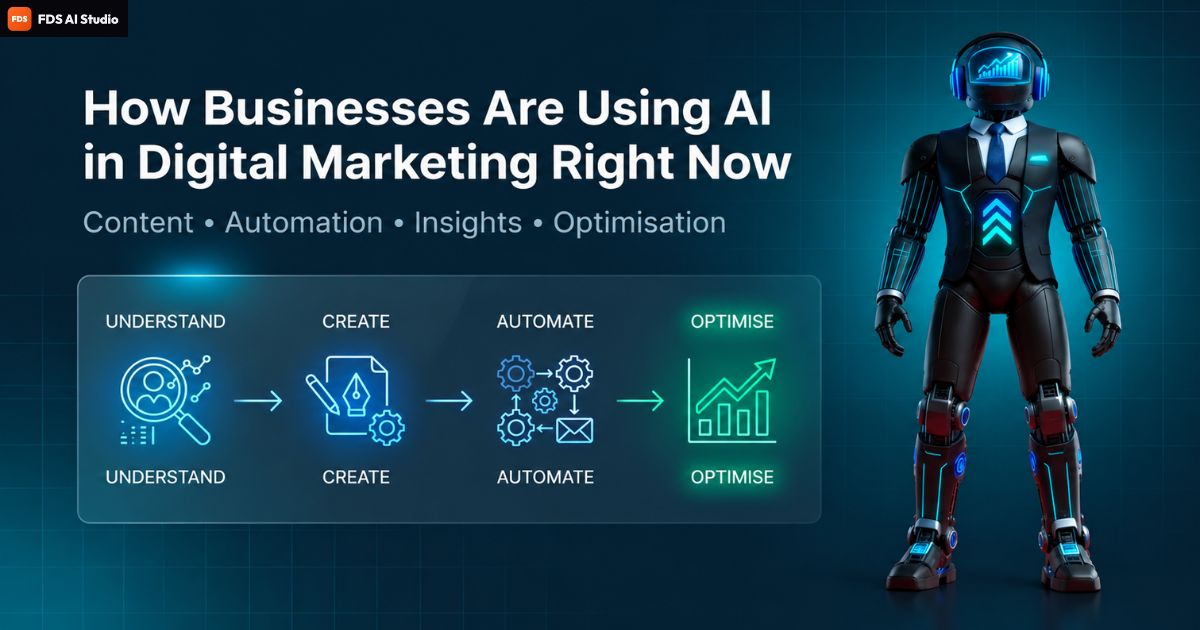
Artificial intelligence is no longer just a future technology discussed by marketers.
It is already changing how businesses create content, run advertisements, understand customers, and improve campaign performance.
From small businesses to global brands, companies are using AI to make marketing faster, smarter, and more data-driven.
The use of AI in digital marketing is expanding across almost every area:
- Content creation
- Ad optimisation
- Customer segmentation
- Email personalisation
- SEO
- Lead scoring
- Campaign reporting
- Customer support
- Conversion optimisation
But AI is not replacing marketing strategy.
Instead, it is helping marketers reduce manual work, discover patterns faster, and make better decisions.
This guide explains the practical applications of AI in digital marketing, the tools businesses use, and how these technologies are changing modern marketing.
What Is the Use of AI in Digital Marketing?
The use of AI in digital marketing refers to applying artificial intelligence technologies to improve marketing activities.
AI uses technologies such as:
- Machine learning
- Natural language processing (NLP)
- Predictive analytics
- Automation systems
- Data analysis
to help businesses understand customer behaviour and improve marketing performance.
Traditional marketing often depends on:
- Manual research
- Human analysis
- Trial and error
AI-powered marketing adds another layer:
- Faster insights
- Automated processes
- Predictive decision-making
- Personalised customer experiences
How AI Is Used in Digital Marketing
AI is being applied across different marketing functions.
Let us understand the most important AI applications in digital marketing.
1. AI Content Creation
One of the most visible uses of AI in marketing is content creation.
AI tools can help marketers create:
- Blog ideas
- Social media captions
- Email drafts
- Advertisement copy
- Video concepts
- Content outlines
Instead of starting from zero, marketers can use AI to speed up the creative process.
However, effective content still requires human input.
AI can generate content faster, but marketers are still responsible for:
- Brand voice
- Strategy
- Audience understanding
- Storytelling
The best results come from combining AI efficiency with human creativity.
2. AI-Powered Ad Optimisation
Advertising is one of the biggest areas where AI is creating measurable impact.
Platforms like:
- Meta Ads
- Google Ads
already use AI-driven systems to optimise campaigns.
AI helps with:
- Audience selection
- Budget distribution
- Bid optimisation
- Creative performance analysis
- Conversion prediction
Instead of manually analysing every campaign element, marketers can use AI insights to improve performance faster.
3. AI in Audience Segmentation
Not every customer behaves the same way.
AI helps businesses divide audiences into meaningful groups based on:
- Interests
- Behaviour
- Purchase history
- Engagement patterns
- Online activity
This process is called customer segmentation.
For example:
A customer who repeatedly visits a product page may receive a different message compared with someone discovering the brand for the first time.
AI helps create more relevant communication.
4. Personalised Marketing Campaigns
Modern customers expect brands to understand their needs.
AI helps businesses create personalised experiences through:
- Product recommendations
- Custom email messages
- Targeted offers
- Relevant advertisements
Instead of showing the same message to everyone, AI helps deliver content based on individual behaviour.
This improves:
- Engagement
- Customer experience
- Conversion chances
5. AI Email Automation
Email marketing is another area where AI creates significant improvements.
AI can support:
- Personalised email campaigns
- Automated follow-ups
- Customer journey emails
- Subject line optimisation
- Send-time optimisation
For example, AI can analyse when users are most likely to engage and improve campaign timing.
This allows businesses to communicate more effectively without increasing manual effort.
6. AI-Powered SEO Optimisation
Search behaviour is changing.
AI is influencing how people discover information through:
- Search engines
- AI-powered search experiences
- Conversational queries
AI helps marketers with:
- Keyword research
- Content optimisation
- Search intent analysis
- Topic discovery
- Content gap identification
Modern SEO is no longer only about adding keywords.
It is about understanding what users actually want to find.
7. AI Chatbots and Customer Support
AI-powered chatbots are becoming common across websites and platforms.
They help businesses handle:
- Customer questions
- Product enquiries
- Appointment bookings
- Basic support requests
- Lead qualification
Benefits include:
- Faster responses
- 24/7 availability
- Reduced support workload
For businesses generating online leads, chatbots can also help move customers further through the buying journey.
8. AI Lead Scoring
Not every lead has the same value.
A business may receive hundreds of enquiries, but only some are likely to convert.
AI-powered lead scoring helps identify stronger opportunities by analysing:
- User behaviour
- Previous interactions
- Engagement levels
- Customer data
This helps sales teams prioritise leads with higher conversion potential.
9. Predictive Analytics in Marketing
Traditional analytics tells marketers what already happened.
Predictive analytics helps answer:
What is likely to happen next?
AI can analyse patterns to predict:
- Customer behaviour
- Purchase probability
- Campaign outcomes
- Audience response
This helps businesses make more informed decisions.
10. AI Campaign Reporting and Performance Analysis
Marketing generates large amounts of data.
Manually analysing every report can take significant time.
AI helps simplify reporting by analysing:
- Campaign performance
- Customer behaviour
- Conversion trends
- Marketing efficiency
It can identify:
- What is working
- What needs improvement
- Where budget should be adjusted
11. AI Creative Generation and Testing
Marketing performance depends heavily on creative quality.
AI helps businesses create and test multiple creative variations.
Examples include:
- Different ad headlines
- Multiple image concepts
- Video variations
- Different audience messages
This allows marketers to discover which creative direction performs best.
Instead of guessing, businesses can test and learn faster.
12. AI in Performance Marketing
Performance marketing focuses on measurable outcomes such as:
- Leads
- Sales
- Customer acquisition
- ROAS
AI supports performance marketing through:
- Real-time optimisation
- Predictive bidding
- Audience analysis
- Conversion tracking
This helps businesses make better use of their advertising budgets.
Benefits of AI in Digital Marketing
Businesses are adopting AI because it creates several advantages.
1. Faster Execution
Tasks that previously required hours can now be completed much faster.
Examples:
- Content drafts
- Reports
- Audience analysis
- Creative variations
2. Better Personalisation
AI helps businesses create more relevant customer experiences.
3. Improved Decision Making
Instead of relying only on assumptions, marketers can use data-driven insights.
4. Reduced Manual Work
Automation helps teams focus on higher-value activities.
5. Better Campaign Optimisation
AI continuously analyses performance and helps improve marketing decisions.
AI Tools Used in Digital Marketing
Different AI tools support different marketing functions.
Common categories include:
Content AI Tools
Used for:
- Writing assistance
- Content ideas
- Research
- Copy creation
Design and Creative AI Tools
Used for:
- Images
- Videos
- Creative concepts
Advertising AI Tools
Used for:
- Campaign optimisation
- Audience analysis
- Performance tracking
Analytics AI Tools
Used for:
- Reporting
- Prediction
- Customer insights
Automation Tools
Used for:
- Workflows
- Email sequences
- Customer communication
How AI Changes Digital Marketing in 2026
The impact of AI on digital marketing is becoming stronger.
Major changes include:
More Conversational Search
Customers are increasingly using AI-powered search experiences.
Brands need content that answers real questions clearly.
More Personalised Customer Journeys
Marketing will become less about broad targeting and more about individual customer experiences.
More Automated Campaign Management
AI will handle more optimisation tasks across advertising platforms.
Faster Creative Testing
Businesses will be able to test more ideas and identify winning strategies faster.
Does AI Replace Digital Marketers?
No.
AI changes the role of marketers.
The marketer of the future will spend less time on repetitive execution and more time on:
- Strategy
- Customer psychology
- Creative direction
- Brand positioning
- Decision-making
AI can process data and automate tasks.
But understanding people and creating meaningful marketing still requires human thinking.
How Businesses Can Start Using AI in Digital Marketing
Businesses do not need to adopt every AI tool immediately.
A practical approach:
Step 1: Identify Repetitive Tasks
Find activities that consume unnecessary time.
Examples:
- Reporting
- Content creation
- Customer responses
Step 2: Start With One Area
Begin with:
- Content
- Advertising
- SEO
- Automation
Step 3: Measure Results
Track:
- Leads
- Conversions
- Engagement
- Cost per acquisition
Step 4: Build Connected Systems
The biggest value comes when different AI applications work together.
For example:
Customer data → Audience segmentation → Creative generation → Ad optimisation → Conversion tracking
A connected system creates stronger results than isolated tools.
The Future of AI Digital Marketing
AI marketing is moving from simple automation toward intelligent systems.
Future marketing systems will increasingly combine:
- Machine learning
- Predictive analytics
- Automation
- Personalisation
- Real-time optimisation
The biggest advantage will not come from using one AI tool.
It will come from creating a connected marketing ecosystem where every activity improves the next one.
Final Thoughts
The use of AI in digital marketing is changing how businesses attract, engage, and convert customers.
AI is helping marketers move from manual decision-making to smarter, data-driven marketing systems.
From content creation and advertising to SEO and customer personalisation, AI is becoming an essential part of modern marketing.
However, the strongest results come from combining:
Artificial intelligence + human strategy + customer understanding
Businesses that learn how to use AI effectively will not just work faster—they will make smarter marketing decisions and build stronger connections with their customers.