What Is Fusion Design AI Studio? One Engine, Three Gears Explained
Before explaining what the platform does, it helps to understand why it exists and where the frameworks behind it were built.
The Founders and Their Background
Fusion Design AI Studio was founded in New Delhi in 2012 by Kuldeep Soni and Manish Soni. Between them, they brought over fifty years of advertising, visual craft, and brand strategy experience before a single AI system was built.
- Kuldeep Soni spent seventeen years heading McCann Delhi's Digital Studio after careers at JWT and Lowe Lintas. He learned what it means to run creative operations at scale without sacrificing the quality that makes scale worth having.
- Manish Soni built his craft in commercial photography at MAGPPIE in the early 2000s before serving as Creative Head at KUSE from 2007. He learned the discipline of commercial visual craft across categories and clients where getting the image wrong costs real money.
What the Studio Built Before the AI Platform
Over thirteen years, the studio operated across three entities:
- FDS Photography for commercial content at a standard where error was not tolerated
- Scale Up Your Brand for strategy and positioning
- FDS AI Studio for the growth infrastructure that now carries both
The combined output of this history is 1,37,000 visuals delivered across 65 plus brands. That works out to twenty-seven finished visuals every day for fourteen years, including the days nobody was watching. That volume is not a boast. It is how judgement gets built.
The Proof Point That Changed the Business
The frameworks behind Fusion Design AI Studio were not built in a lab. They were refined across hundreds of real campaigns before being turned into AI systems. The verified results from live Meta ad accounts are as follows:
- 871 qualified leads generated across recent campaigns
- Average cost per lead of ₹9.54
- Lowest individual campaign reaching ₹6.05 per lead
- Peak return on ad spend of 9.86x
- Total spend of ₹8,305 for 871 qualified leads
These numbers come from real Meta ad account screenshots, not projected benchmarks. They are the foundation of everything the platform does.
The Core Concept: One Engine, Three Gears
Most marketing platforms give you tools. Fusion Design AI Studio gives you a system. The distinction matters because tools require you to connect them manually, manage them separately, and figure out how they work together. A system runs them as a single connected operation.
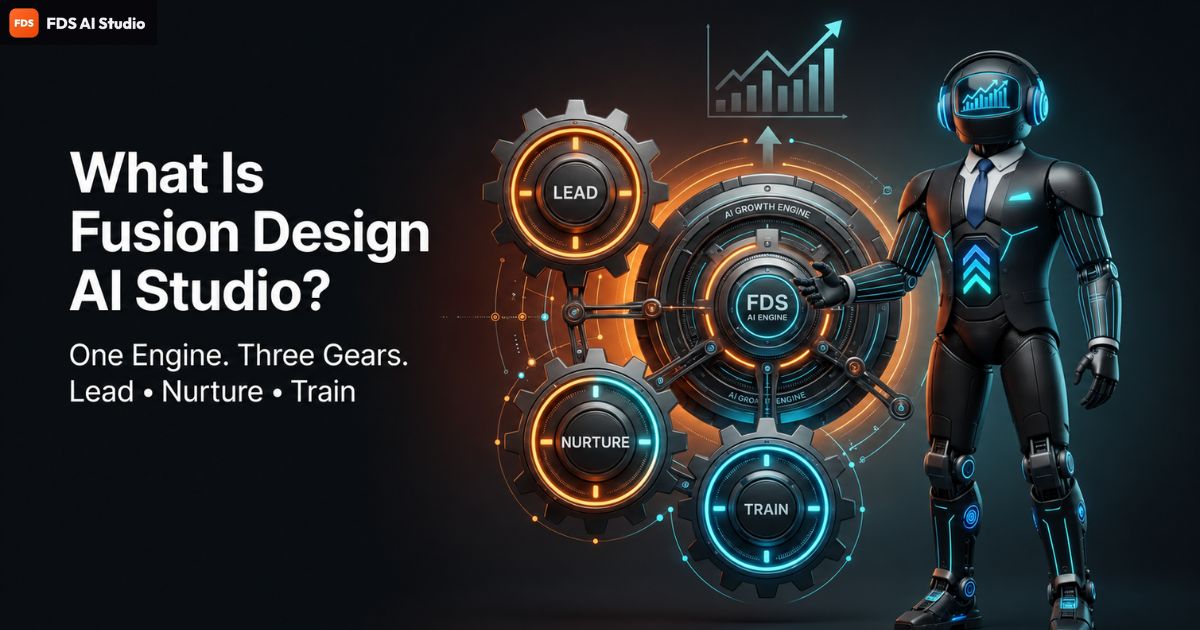
The system is described as one engine running on three gears. Each gear handles a specific stage of the lead generation process. When all three run together, they form a closed loop where ads bring cold traffic, positioning creates brand memory, and content nurtures leads over three months until they are ready to convert.
Gear 1: The Video Ads Engine
The first gear solves the most common problem in Indian MSME advertising: running one ad with one message and betting the entire monthly budget on a single angle.
How the Video Ads Engine Works
The Video Ads Engine generates five complete, ready-to-shoot video ad scripts from a single business input. Not five versions of the same script. Five entirely different scripts, each targeting a different psychological buying trigger.
The reason for five scripts rather than one is grounded in buyer psychology. Different prospects in the same target audience are driven to purchase by different emotional states. A single script reaches only the segment whose trigger it addresses and is completely invisible to the rest.
The Five Buying Triggers
Each of the five scripts targets one of the following triggers:
- Cost Pain targets prospects who are bleeding money on a solution that is not delivering results. The hook names the exact financial frustration they are feeling and agitates the ongoing cost of inaction.
- Trust Gap targets prospects who have been burned by a previous agency, vendor, or platform. This script validates the scepticism before offering specific proof as the antidote rather than more promises.
- Time Drain targets founders doing their marketing manually at the end of the working day because there is no one else to do it. This script names both the time cost and the opportunity cost before presenting a faster system.
- Fear of Loss targets prospects watching competitors grow while their own business growth has stalled. This script makes the competitive gap feel immediate and consequential before presenting the system that closes it.
- Aspiration targets prospects who have a clear vision of what their business could look like with a consistent lead flow. This script leads with the outcome rather than the problem.
The Framework Behind Every Script
All five scripts follow the Stab and Twist persuasion engine, a 5-beat framework developed by Fusion Design AI Studio across hundreds of real campaigns:
- Hook that pattern-interrupts the scroll in the first 3 seconds
- Pain that agitates the problem without rushing to the solution
- Differentiation that challenges the old belief keeping the prospect stuck
- Proof that delivers one specific, verifiable result
- CTA that asks for one low-friction action
The structure is identical across all five scripts. The trigger changes entirely.
Why Five Scripts Run Simultaneously
All five scripts run at the same time on Meta. The data identifies the winning trigger within 48 to 72 hours based on actual lead volume and cost per lead. Losing scripts are cut. The winner is scaled. This approach produces single-digit CPL in markets where most businesses are paying ₹80 to ₹300 per lead.
The scripts are Hinglish-native because that is the language Indian audiences convert in. They are designed to be shot on a phone without a production team.
Gear 2: The First Impression
The second gear addresses a problem that most marketing strategies ignore entirely. Once a prospect has seen your ad, why would they choose your business over any other option they encountered this week?
What the First Impression Produces
The First Impression gear generates a 30-second positioning video script using the FDS positioning skeleton. This is not a product demo. It is not a brand film. It is a single asset designed to answer one question for a cold audience: why you and not your competitors?
The Five Beats of the Positioning Script
The script follows five precise beats with a specific time allocation for each:
- Hook (0 to 3 seconds) delivers a pattern interrupt that says what the customer is thinking but no competitor has said out loud. It opens with a declarative statement that feels personal to the viewer, not a question or a feature.
- Pain (3 to 10 seconds) names the real problem, not just the surface-level one, in one or two sentences. Naming the deeper systemic issue positions the brand differently from the first ten seconds.
- Differentiation (10 to 20 seconds) challenges the old belief that has kept the prospect stuck and presents a structural alternative. Not a list of product features. A single clear reason why the old approach was wrong and the new approach works.
- Proof (20 to 25 seconds) provides one number, one screenshot, one specific result. Proof that is generic damages credibility. Proof that is precise builds it.
- CTA (25 to 30 seconds) asks for one action in low-friction language the audience naturally speaks.
Where the First Impression Lives
This 30-second video becomes the anchor asset for every campaign. It lives on the brand's social profile. It runs as a standalone ad. It is the first thing a warm prospect watches after seeing a video ad, and it is the asset that closes the trust gap that prevents most small business campaigns from converting.
Gear 3: The Remarketing Engine
The third gear solves the most expensive leak in any lead generation system: the 90% of prospects who do not convert on first contact and then disappear because there is no follow-up system in place.
What the Remarketing Engine Produces
The Remarketing Engine generates a complete three-month content calendar mapped to the buyer's journey. Every post has a specific job. Nothing is random filler designed to satisfy a posting schedule or please an algorithm.
The Three-Month Buyer Journey Structure
The calendar operates across three monthly stages:
- Month 1 attracts cold audiences through hook-driven reels, educational carousels, behind-the-scenes content, and polls that create recognition and relevance. The job of Month 1 is to make the brand familiar to people who saw the ads but did not convert immediately.
- Month 2 builds trust with warm leads through case studies, testimonials, client results, framework explanations, and comparison content. This content addresses the objections a warm lead carries before they are ready to decide. The job of Month 2 is credibility.
- Month 3 converts hot prospects through limited offers, urgency-driven posts, direct CTA content, WhatsApp call-to-action stories, and remarketing content that re-engages cold leads from Month 1. The job of Month 3 is action.
The Framework Behind Every Post
Every post in the calendar follows the MCB research method: Problem, Solution, Practical step. This structure ensures that every piece of content delivers immediate value to the reader while moving them closer to a purchase decision. It is the same logic that runs underneath the ad scripts, applied to organic social content.
How Remarketing Works Without Extra Ad Spend
Remarketing is built into the organic structure of the calendar itself. Cold leads from Month 1 who did not convert get re-engaged through Month 2 and Month 3 content without any additional paid spend. The content system does the work that most businesses pay for through retargeting campaigns.
How the Three Gears Work Together
Each gear solves a standalone problem:
- The Video Ads Engine solves the creative and multi-angle testing problem
- The First Impression solves the positioning and trust-gap problem
- The Remarketing Engine solves the nurturing and follow-up problem
The reason they are called gears rather than tools is that they are designed to mesh. The ads bring cold traffic. The positioning video catches that traffic and gives it a reason to remember the brand. The content calendar nurtures the traffic over 90 days until conversion happens naturally.
The system runs on the LNT framework: Lead Generation, Lead Nurturing, and Training. Gear 1 handles generation. Gear 3 handles nurturing. The training layer ensures every campaign cycle makes the next one smarter because the data feeds back into the system continuously.
Beyond the Three Gears: The Full Platform
The three gears are the core product accessible through the FDS Marketing Tools suite. The broader Fusion Design AI Studio platform extends this into a full marketing operating system with 26 plus AI systems across six pillars.
The Six Pillars of the Platform
- Creative AI covers image generation, video creation using VEO3, carousel design, content writing, UGC production, and ecommerce content
- B2B Marketing AI covers brand research, competitor intelligence, LinkedIn automation, the email engine, and proposal generation
- Sales and Conversion covers AI calling that reaches 50 prospects in 5 minutes, WhatsApp automation, remarketing funnels, and CRM
- Retention and Growth covers review generation, customer success systems, referral programs, and social media automation
- Analytics and Intelligence covers the Marketing Score from 0 to 100, the ad analyzer, ROI tracking, and SEO monitoring
- Community covers the hub, academy, marketplace, and training frameworks
Pricing and Access
Pricing starts at zero with a free tier giving access to 100 credits across all 26 plus systems with no card required. Paid plans run from INR 2,500 for 500 credits up to INR 75,000 for 15,000 credits. Credits never expire. There are no long-term contracts and no agency-style monthly retainers.
Who Fusion Design AI Studio Is Built For
The platform is built for a specific type of business. Understanding whether it fits starts with recognising the problem it was designed to solve.
Fusion Design AI Studio is the right fit for:
- Indian founders and MSME owners who are spending on ads but have no system and no predictable lead flow
- Solopreneurs who need an entire marketing department but can only afford a platform subscription
- D2C brands that want to reduce dependence on paid ads by building organic nurturing systems alongside their campaigns
- Service businesses in categories like modular kitchens, coaching institutes, clinics, real estate, interior design, and event planning where each lead carries high lifetime value and CPL needs to stay in single digits
- Any founder who has paid an agency ₹30,000 to ₹50,000 per month and received creatives instead of a lead system
It is not built for businesses looking for another tool to add to an existing fragmented stack. It is built for businesses that want to replace the stack with a system.