Why Traditional Digital Marketing Models No Longer Work — And What Replaces Them
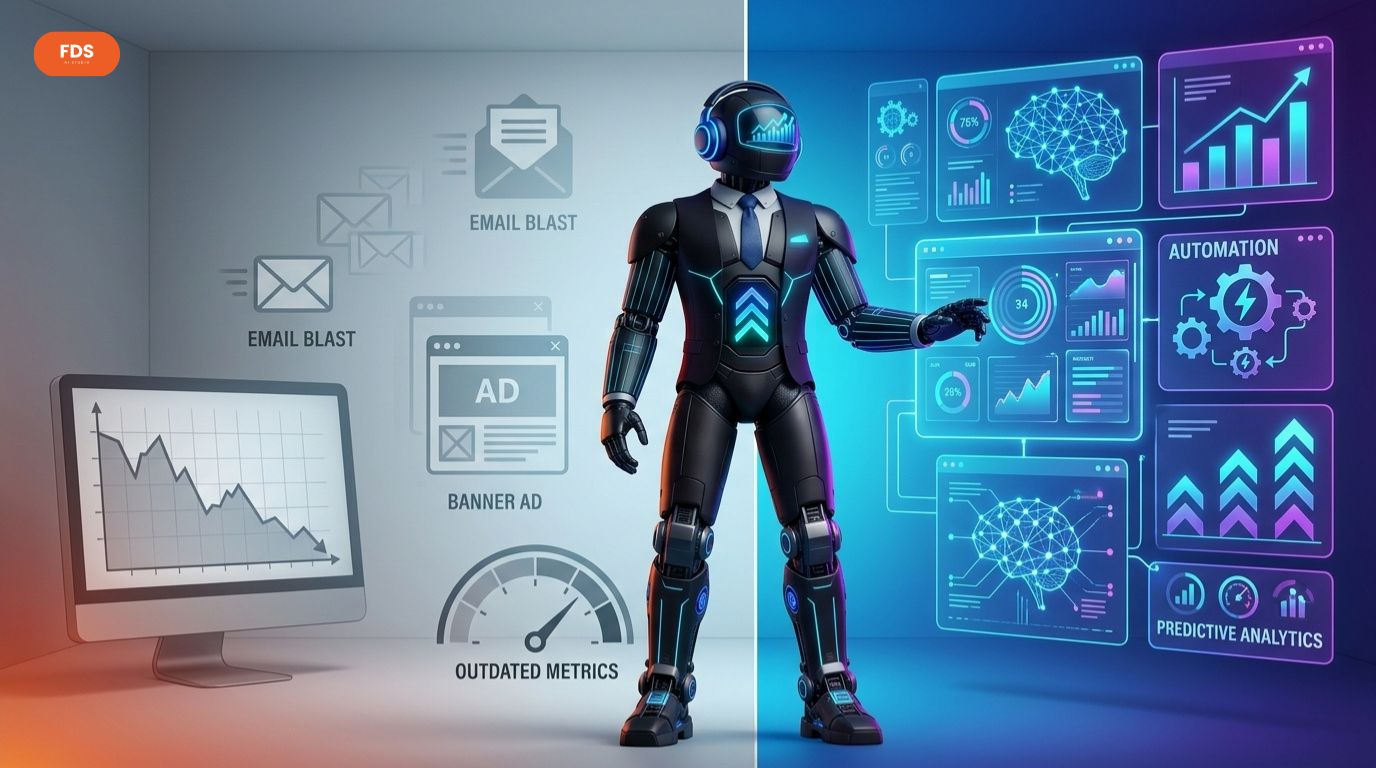
The digital marketing model that most Indian businesses operate on was designed for a simpler era. An era where customer journeys were linear, cookies tracked behaviour reliably, one ad platform could deliver consistent results, and hiring an agency at ₹30,000 to ₹50,000 per month was a reasonable path to growth.
That era is over.
In 2026, customer journeys are fragmented across 8 to 12 touchpoints before conversion. Privacy restrictions have gutted the tracking systems that attribution models depend on. Platform ecosystems operate as walled gardens where every channel claims credit for the same conversion. And the agency retainer model — the backbone of Indian MSME marketing for over a decade — is producing less value for more cost every year.
According to the IAB's State of Data 2026 report, 60 to 75% of buy-side marketers say current measurement approaches fall short on rigor, timeliness, trust, and efficiency. No respondents said their measurement models fully represent all paid media channels. The data infrastructure that traditional digital marketing was built on is no longer capable of reflecting what actually drives business growth.
This is not a minor shift. It is a structural collapse of the model. And the businesses that do not adapt to a system-first approach will continue burning budget on methods that stopped working two years ago.
Here is exactly where the traditional model breaks — and what replaces it.
The Attribution Model Is Broken
Traditional marketing attribution models were built for a world where a customer saw an ad, clicked it, visited a website, and converted — all within one traceable session. The model would assign credit to the touchpoint that "caused" the conversion. Last-click attribution gave all credit to the final interaction. First-click gave it to the first. Multi-touch spread it across several steps.
This made sense when customer journeys were visible and digital behaviour was trackable. In 2026, neither condition holds.
A prospect today might see your Instagram reel while commuting, hear about your business from a friend on WhatsApp, Google your brand name three days later, visit your website from a retargeting ad, leave without converting, see an organic post on LinkedIn the following week, return through a direct URL, and finally convert after receiving a remarketing email. That is 7 to 8 touchpoints across 4 platforms over 10 to 14 days.
Traditional attribution cannot track this journey. It sees fragments. It might capture the retargeting click and the email conversion. It misses the Instagram reel, the WhatsApp recommendation, the LinkedIn post, and the organic search. The model assigns credit to what it can measure, not to what actually influenced the decision.
The result is that businesses make budget decisions based on incomplete data. They overspend on channels that capture the last click and underspend on channels that create demand. They optimise for metrics that the platform reports rather than outcomes that the business actually needs.
For Indian MSMEs, this problem is amplified. WhatsApp is often the primary customer communication channel, and WhatsApp interactions are almost entirely invisible to standard attribution models. A prospect who received a forwarded message from a friend, visited your profile, and then called you directly appears as a "direct" visit in analytics — no channel gets credit, and the business has no idea what actually drove the lead.
The Agency Retainer Model Is Failing MSMEs
The second structural failure is the agency model itself.
The traditional model works like this: a business hires a digital marketing agency at a fixed monthly retainer. The agency assigns a team — account manager, designer, copywriter, media buyer. The team runs campaigns, produces creatives, manages social media, and sends a monthly report. The cost scales with headcount. More output requires more people, which requires a higher retainer.
This model has three fundamental problems for Indian small businesses.
First, the incentive structure is misaligned. The agency benefits when campaigns require more human hours, not fewer. Efficiency is penalised because efficient campaigns require smaller teams, which means smaller retainers. There is no structural incentive for the agency to build a system that runs on autopilot, because a self-running system would eliminate the need for the retainer.
Second, the output is often creatives, not outcomes. Most agencies deliver campaign assets — graphics, ad copy, social media posts, reports. But assets are not leads. A beautifully designed carousel that generates 200 likes and zero inquiries is a failure by any business metric, yet it looks like work in a monthly report. The gap between "marketing activity" and "business outcome" is where most agency retainers disappear.
Third, the cost does not scale with Indian MSME economics. A ₹50,000 monthly retainer might be modest by agency standards, but for a service business generating ₹3 to ₹5 lakh in monthly revenue, it represents a significant percentage of income. If the leads do not cover the retainer within the first 60 days, the founder has effectively funded the agency's payroll without any return on investment.
Single-Channel Dependency Is a Trap
The third failure is strategic: over-reliance on one platform.
Most Indian MSMEs run their entire digital marketing through Meta (Facebook and Instagram ads). Some add Google Ads. Very few have a diversified presence across organic social, search, WhatsApp, YouTube, email, and content marketing operating as an integrated system.
This creates dangerous dependency. When Meta changes its algorithm — which happens regularly — campaigns that were performing well suddenly stop working. When ad costs rise during festive seasons, the cost per lead doubles or triples overnight with no alternative channel to absorb the load. When the platform faces technical issues or policy changes that restrict ad accounts, the business has zero lead flow until the problem resolves.
Single-channel dependency also means the business has no organic moat. Every lead requires ad spend. Turn off the ads and the leads stop immediately. There is no content system building long-term visibility. No SEO generating organic traffic. No buyer-journey content on social media warming cold audiences for free. The business is renting attention month after month without ever building an asset that generates leads independently.
The Creative Stagnation Problem
The fourth failure is creative. Traditional digital marketing produces the same types of ads, the same content formats, and the same messaging structures month after month.
Most agencies follow a predictable pattern. Produce a few static graphics. Write generic ad copy. Run A/B tests between two variations that are only marginally different. Repeat. The creative process is not driven by a persuasion framework or psychological buying triggers. It is driven by what the design team can produce within the hours allocated to your account.
The result is creative fatigue. Audiences see the same style of content from every business in the category. Nothing stops the scroll. Nothing creates a pattern interrupt. Nothing targets the specific psychological reason why that particular viewer might buy.
In 2026, ad platforms reward creative diversity. Meta's algorithm favours accounts that test multiple creative angles simultaneously. Google Performance Max requires creative variety across formats. The businesses generating the lowest cost per lead are the ones running 5 to 10 creative variations at once, each targeting a different buying trigger, each following a proven persuasion structure.
The traditional agency model is not built for this. Producing 5 unique persuasion-driven ad scripts per campaign requires a framework, not just a creative team. It requires a system that generates multiple angles from a single input, tests them simultaneously, and scales the winners — all at a speed that manual teams cannot match.
What Replaces the Traditional Model
The shift is from a service model to a system model. Instead of hiring people to do marketing tasks, you build a system where AI handles the mechanical execution and proven frameworks ensure the strategic quality.
A system-first approach to digital marketing has four characteristics that the traditional model lacks.
Multiple creative angles tested simultaneously. Instead of one ad and one message, a system generates 5 scripts targeting 5 different buying triggers — cost pain, trust gap, time drain, fear of loss, and aspiration. The data identifies the winner. The system scales it. This is how businesses push cost per lead from ₹150 down to single digits.
Positioning built into the system. A 30-second positioning video — hook, pain, differentiation, proof, CTA — gives every prospect a clear reason to choose your business. This asset does not need to be recreated every month. It anchors the entire marketing system and reduces the trust gap that kills conversion rates.
A buyer-journey content calendar that nurtures automatically. Month 1 content attracts cold audiences. Month 2 builds trust with warm leads. Month 3 converts. Remarketing happens organically through strategic posting, at zero additional ad spend. The content system runs alongside paid ads, catching the 90% of prospects who do not convert on first contact.
Real-time measurement tied to business outcomes. Instead of monthly PDF reports showing impressions and reach, a system tracks what matters — cost per qualified lead, return on ad spend, conversion rate by creative angle, and content performance by funnel stage. The measurement is continuous, not periodic.
How FDS AI Studio Replaces the Old Model
FDS AI Studio was built because the traditional model stopped working — and Indian MSMEs were paying the price.
The platform operates as a complete Lead Generation plus Lead Nurturing engine with three integrated tools inside the FDS Marketing Tools suite.
Meta Video Ads generates 5 complete, ready-to-shoot ad scripts from a single business input — each targeting a different buying trigger, each built on the proprietary Stab & Twist persuasion engine (Hook → Pain → Differentiation → Proof → CTA). Hinglish-native output. No copywriter needed.
Positioning Video creates a 30-second positioning script using the FDS positioning skeleton — 5 beats engineered to answer "why you, not them" for cold audiences who have never encountered your brand. One input. One script. One asset that anchors every campaign.
Social Media Grid builds a complete 3-month content calendar mapped to the buyer's journey. Month 1 attracts. Month 2 builds trust. Month 3 converts. Every post follows the MCB research method (Problem → Solution → Practical step). Remarketing triggers are built in. Instagram, Facebook, and LinkedIn covered.
The results from real campaigns: 871 qualified leads at ₹9.54 average cost per lead. Peak ROAS of 9.86x on e-commerce campaigns. 65 plus brands served across 13 plus years.
No monthly retainer. No agency team billing hours. No monthly PDF reports showing metrics that do not connect to revenue. Just a system that generates qualified leads on autopilot — built for Indian founders, MSMEs, and solopreneurs who need the output of a marketing department without the overhead of one.
The traditional model is broken at every level — attribution, agency structure, channel dependency, and creative process. The replacement is not a better agency. It is a better system.