Why You, Not Them? Marketing Differentiation Strategy That Makes You the Choice
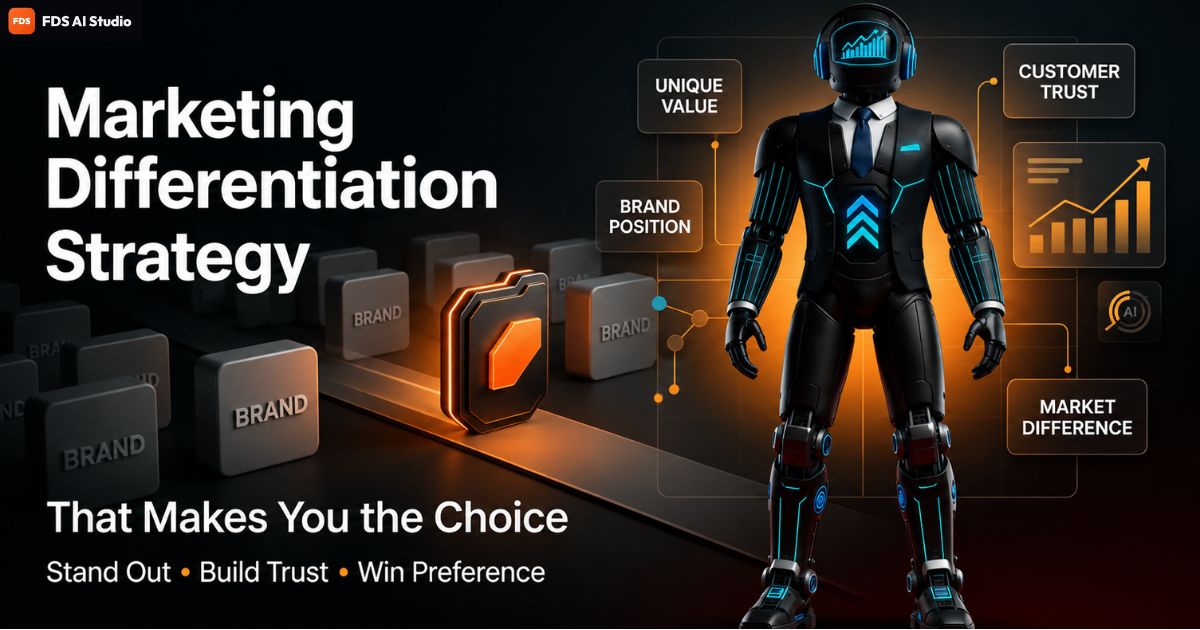
Your business may have better services, stronger expertise, better customer support, or years of experience—but prospects still choose your competitors.
Why?
In many cases, it is not because your competitors are actually better.
It is because they are easier to understand.
In a crowded market, customers rarely spend hours comparing every business. They make quick judgments based on what they immediately understand:
- Who is this brand for?
- What problem does it solve?
- Why should I trust it?
- What makes it different from others?
This is where brand differentiation strategy becomes important.
A strong differentiation strategy helps customers instantly answer:
“Why should I choose you instead of them?”
For founders, MSMEs, and growing brands in India, differentiation is not about saying you are the best. Everyone says that.
It is about creating a clear reason why your brand is the obvious choice.
This guide explains how to build a practical why you not them marketing differentiation strategy that can help your business stand apart from competitors.
What Is Marketing Differentiation?
Marketing differentiation is the process of creating a clear and meaningful difference between your brand and competitors.
It answers one important question:
Why should a customer choose your business over another option?
A strong differentiation strategy creates a unique position in the customer's mind.
For example:
A clothing brand may not simply say:
“We sell premium clothes.”
Many brands can say that.
Instead, it could position itself as:
“Premium everyday wear designed specifically for Indian professionals who want comfort without compromising style.”
The second statement creates a clearer identity.
That clarity creates preference.
Why Do Customers Choose Competitors?
Many businesses assume customers choose competitors because they offer:
- Lower prices
- Better products
- More features
- Bigger teams
Sometimes that is true.
But often the real problem is a communication gap.
Your prospect may not understand:
- What makes you different
- Why your approach is better
- Who you are best suited for
- Why they should trust you
A competitor with average services but clearer messaging can often win over a stronger business.
This is why differentiation is not only about what you do.
It is about how quickly customers understand your value.
The Difference Between Being Better and Being Different
Many businesses compete by saying:
- Better quality
- Better service
- Better experience
- Better results
The problem?
Every competitor says the same thing.
Being better is difficult to prove.
Being different is easier to remember.
For example:
Instead of saying:
“We provide digital marketing services.”
A differentiated message could be:
“We help Indian MSMEs turn their marketing from random posting into a predictable customer acquisition system.”
The second statement creates a specific category and audience.
The 5-Beats Differentiation Framework
A strong positioning message should quickly communicate five important things.
This framework helps brands create a video-ready and customer-focused positioning statement.
Beat 1: The Market Problem
Start by identifying the frustration customers already feel.
Example:
“Most businesses are spending money on marketing but still don't know which activities are actually bringing customers.”
This creates relevance.
Your audience should immediately think:
“That is exactly my problem.”
Beat 2: The Common Alternative
Explain what most businesses currently do.
Example:
“They hire agencies that create content but don't build a complete growth system.”
This creates contrast.
You are showing the gap in the current market.
Beat 3: Your Different Approach
This is where your unique positioning begins.
Explain what you do differently.
Example:
“We combine strategy, creative execution, and AI-powered systems to create marketing that is designed around business growth.”
This is your competitive advantage.
Beat 4: The Proof or Reason to Believe
A differentiation claim becomes stronger when supported by evidence.
Your proof could include:
- Experience
- Case studies
- Results
- Process
- Expertise
- Client outcomes
- Industry knowledge
Example:
“Our framework has helped brands improve their visibility, generate leads, and create consistent marketing systems.”
Beat 5: The Customer Choice
End with a clear reason why customers should choose you.
Example:
“So if you want marketing that creates business outcomes—not just content—you know who to choose.”
This creates a memorable buying trigger.
How to Differentiate Your Business From Competitors
1. Identify Your Real Competitive Advantage
Ask:
- What do we do better?
- What do customers appreciate most?
- Why do existing clients stay with us?
- What process makes us different?
- What expertise do competitors lack?
Your differentiation should come from reality, not imagination.
A fake USP does not create trust.
2. Choose a Specific Position
Many brands try to appeal to everyone.
This usually creates unclear messaging.
A strong brand knows:
- Who it serves
- What problem it solves
- Why it is different
For example:
Weak positioning:
“We help businesses grow.”
Strong positioning:
“We help Indian manufacturing companies generate qualified B2B leads through performance-driven digital systems.”
Specificity creates trust.
3. Create a Memorable USP
A Unique Selling Proposition (USP) is the reason customers remember you.
A strong USP should be:
- Clear
- Specific
- Relevant
- Easy to repeat
Examples of differentiation angles:
Speed-Based Differentiation
“We deliver campaigns faster without compromising strategy.”
Expertise-Based Differentiation
“We specialise only in healthcare brands.”
Process-Based Differentiation
“Our three-step growth framework removes guesswork from marketing.”
Experience-Based Differentiation
“We combine traditional industry knowledge with modern technology.”
Brand Differentiation Strategies for Indian Businesses
Indian businesses, especially MSMEs, often compete in crowded categories.
A clear differentiation strategy can come from:
1. Niche Specialisation
Instead of serving everyone, own a category.
Example:
Not:
“We provide accounting services.”
Better:
“We help startups manage compliance and finance operations.”
2. Customer Experience
Sometimes the product is similar, but the experience is different.
Examples:
- Faster response
- Better onboarding
- Personal support
- Transparent communication
3. Unique Process
Your process can become your identity.
For example:
“5-step brand growth system”
or
“30-day customer acquisition framework”
A named process creates memorability.
4. Strong Brand Personality
People connect with brands that feel human.
Your communication style, values, and storytelling can become a competitive advantage.
Why Clear Positioning Matters for Cold Audiences
A warm audience already knows your brand.
A cold audience does not.
Cold audiences decide quickly.
They need immediate clarity.
Your first impression should answer:
- Who are you?
- What do you solve?
- Why should they care?
- Why choose you?
If your message requires a 10-minute explanation, your positioning is probably unclear.
Strong differentiation creates instant understanding.
Common Differentiation Mistakes Businesses Make
1. Saying the Same Thing as Competitors
Statements like:
- Best quality
- Customer satisfaction
- Innovative solutions
- Affordable pricing
are too common.
They do not create distinction.
2. Competing Only on Price
Price can attract customers, but it rarely builds a strong brand.
A lower price can always be copied.
A unique position is harder to replace.
3. Trying to Target Everyone
A message designed for everyone often connects with nobody.
Specific brands are easier to remember.
4. Not Showing Proof
Claims without evidence create doubt.
Support your differentiation with:
- Results
- Testimonials
- Data
- Examples
- Case studies
5. Changing Positioning Too Frequently
Building brand memory requires consistency.
Your audience should repeatedly hear the same core message.
How FDS AI Studio Helps Brands Build Differentiation
Modern brands need more than attractive visuals.
They need strategic clarity.
A strong marketing system combines:
- Brand positioning
- Creative direction
- Content strategy
- AI-powered execution
- Customer-focused messaging
FDS AI Studio helps businesses create stronger brand communication by combining strategy and creative systems designed for modern marketing challenges.
Instead of simply creating content, the focus is on building a message customers understand and remember.
You can explore more insights on branding, marketing systems and growth strategies through the FDS AI Studio blog