Competitor Analysis AI How to Actually Use It Not Just Buy a Tool
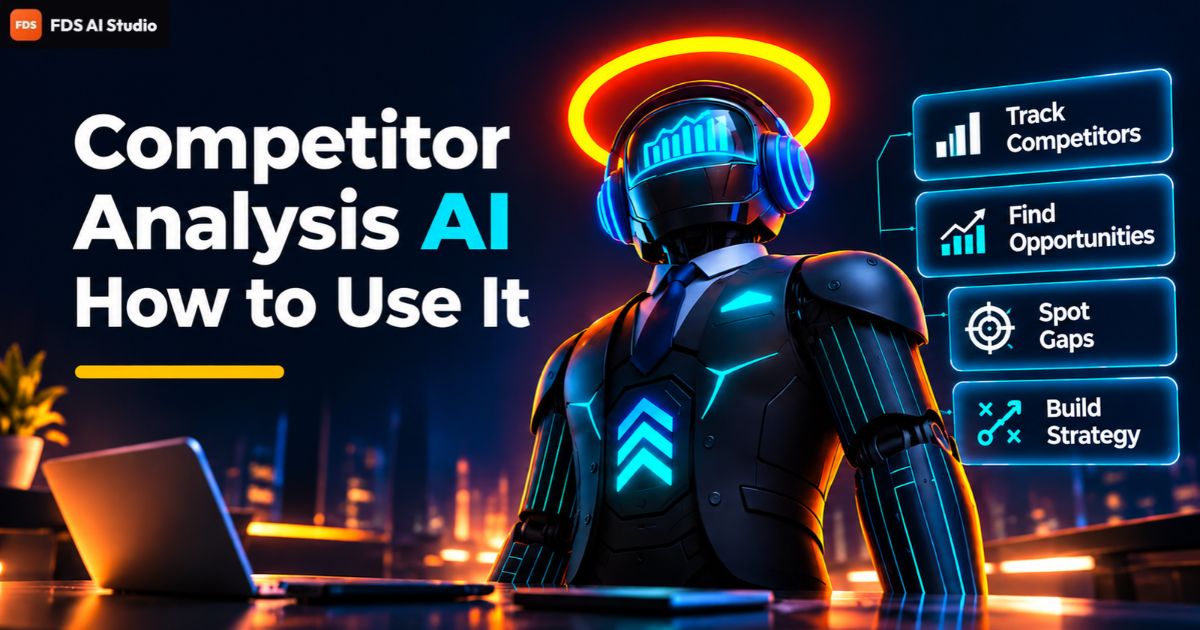
Most small businesses don’t lack competitors to watch. They lack the hours to watch them. A rival changes a price on Tuesday, runs a new ad on Wednesday, and picks up three good reviews by Friday, and the average owner finds out weeks later, if at all. Competitor analysis AI exists to close that gap, but buying a subscription and actually running a system are two different things, and most people only do the first one.
This piece is about the second one: what AI realistically changes in competitor research, where it still needs a human, and a workflow you can set up this week without hiring anyone.
What AI actually changes in competitor research
Traditional competitor analysis meant someone on your team manually checking rival websites, screenshotting ads, and building a spreadsheet once a quarter. That worked when “competitor intelligence” meant three local shops. It stops working once your rivals include anyone running a national ad campaign, posting daily on four platforms, and shipping product updates every sprint.
Small business owners have historically been left out of competitive intelligence because the serious tools were built for enterprise budgets and enterprise teams, while a basic search alert barely scratches the surface of what’s actually changing in a market. The idea of watching competitors isn’t new.
What changed is the cost. Constant, automated monitoring is now affordable and fast enough for a business with no research department at all.
The practical shift sits in five areas: SEO and content gaps, ad and pricing moves, social sentiment, product and feature comparisons, and increasingly, whether you even show up when someone asks an AI chatbot for a recommendation in your category. Dedicated AI tools can scan keyword rankings, backlinks, and site health in minutes, while others benchmark your pricing and feature set directly against named competitors.
Where AI actually helps and where it falls short
It helps with volume and speed. An AI system can check twenty competitor websites every morning before your coffee is done, something no small team will keep up by hand past the second month. It’s also good at summarizing: feeding a stack of competitor reviews, ad copy, or landing pages into a model and getting back a plain list of what changed is faster than any manual audit.
It struggles with judgment. A model can tell you a competitor dropped their price by 12%. It can’t reliably tell you why, whether that’s a panic move or a planned campaign, or whether matching it would help or hurt your margins.
There’s a useful distinction worth keeping in mind here: analysis is drawing conclusions, research is fast scanning with sources, and conflating the two inside one tool usually means neither job gets done well. A monitoring tool that flags changes is doing research. Deciding what to do about those changes is still analysis, and that part stays yours.
AI also inherits the accuracy problems of whatever it’s reading. If a competitor’s site has stale pricing or a scraped data source is a quarter old, the summary built on top of it will be confidently wrong. A competitor snapshot from an AI tool is a lead worth checking, never a finished fact.
Free tools versus paid systems what each tier actually buys you
Free and freemium tools can still surface real signal. Keyword gaps, backlink opportunities, estimated traffic, active ad creative, the technology stack a competitor runs on, local search visibility, and mentions in AI-generated answers are all things a no-cost tool can pull up today.
That’s a solid starting list for a business that has never run a formal competitor check before, and most of it costs nothing beyond the time to set it up.
Paid, enterprise-grade platforms add things a free tier won’t: auto-summarized intelligence briefs, win-loss tracking, and ready-made battlecards for a sales team. They’re built for teams that run competitive intelligence as a formal program with a dedicated owner, not for a founder checking in between everything else they do.
The honest trade-off is this. A free stack gets you visibility. A paid platform gets you a program. Most small and mid-sized businesses don’t need a program. They need visibility that’s actually checked every week instead of once a year, which is a workflow problem more than a budget problem.
The workflow that matters more than the tool
Buying a tool without a routine behind it is why most competitor analysis subscriptions get used once and forgotten. A workable system looks like this.
Start by naming three to five real competitors, the ones you actually lose deals or customers to, rather than every business that could theoretically compete with you someday. A longer list only means more dashboards nobody checks.
Set one AI tool to watch pricing and ad changes weekly, since that’s the fastest-moving signal and the one most likely to need an immediate response from you. Set a second pass, monthly, on content and SEO: what topics they’re ranking for that you aren’t, which pages they’ve recently updated, and what backlinks they’ve picked up since the last check.
Then build a 15-minute review habit around the output, because a dashboard nobody opens is worse than no dashboard, and a report with no decision attached to it is just noise with better formatting. Write down one action per review, even if the action is “no change needed this month.” That single habit is what separates a business that actually uses competitor analysis AI from one that pays for a tool it opens twice a year.
If this workflow sounds like more structure than you want to build and maintain yourself, that’s exactly the kind of system an AI-powered Brand OS is meant to run on autopilot across marketing, sales, and operations, rather than as one more dashboard tab you have to remember to check. For a look at how that works for other brands and founders, the Bigg Daddy Talks series covers real numbers from businesses that scaled by fixing exactly this kind of operational gap. You can also read more frameworks like this one on the blog, or get in touch if you’d rather have a working system built for you than build one yourself. More on the people behind this approach is on the About page