Exploring AI Agent Directories: Find AI Solutions Fast
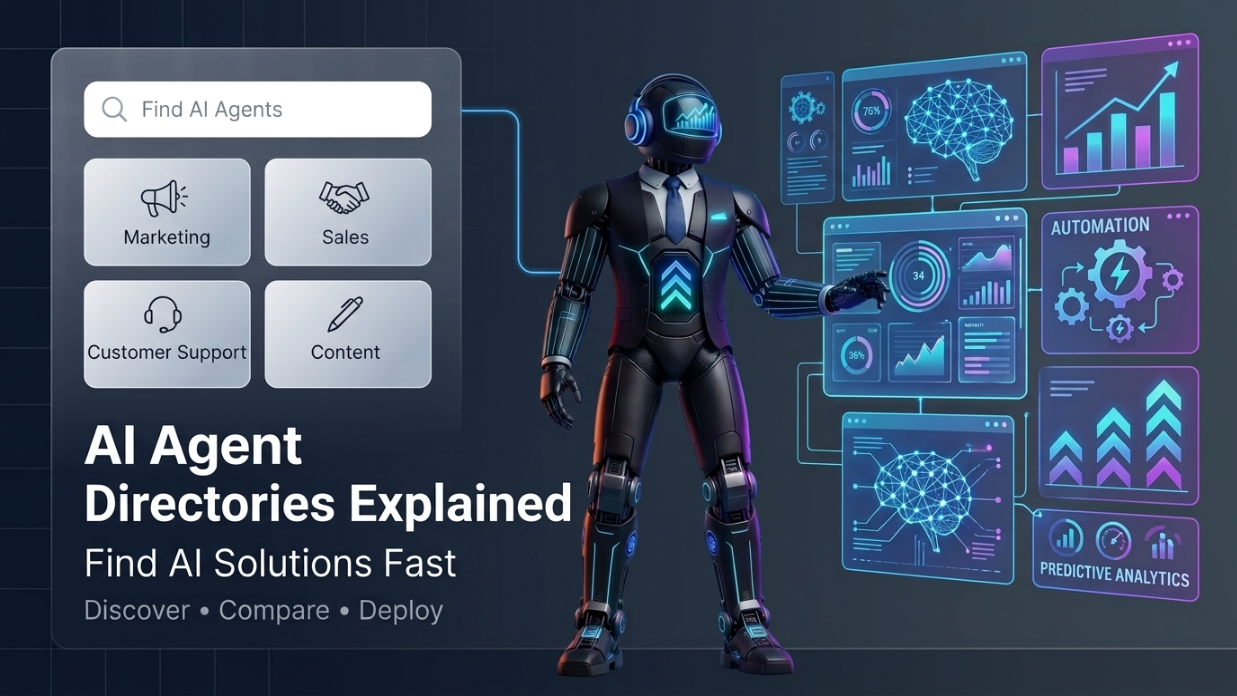
Every week seems to bring another wave of AI agents promising to automate your sales, your content, your customer support, or your entire marketing funnel. For a business owner trying to figure out what actually works, that flood of options has become a problem of its own — too many tools, too little time to test them all, and no easy way to compare one against another.
This is exactly the gap AI agent directories are stepping in to fill. Instead of Googling "best AI tool for X" and wading through affiliate-stuffed blog posts, directories organize agents by category, function, and use case — turning tool discovery into something closer to browsing a catalogue than running a research project. In this article, we'll break down what these directories actually are, how to use them well, and — just as importantly — where they fall short for businesses that need more than a single automated task handled.
What Exactly Is an AI Agent Directory?
An AI agent directory is a curated listing platform where AI tools and autonomous agents are organized, filtered, and compared side by side. Rather than scattered reviews across dozens of websites, a directory brings agents into one place, typically sorted by categories like:
- Sales and lead generation agents
- Marketing assistants and social media agents
- Content creation and SEO optimization tools
- Customer support chatbots and conversational agents
- Workflow automation and data enrichment bots
- Voice AI, coding assistants, and industry-specific agents
Most directories let you filter by pricing model, access type (free, freemium, enterprise), and industry, with individual listings covering an overview, key features, and sometimes user reviews. Given that the AI agent market is projected to grow well past $50 billion by the end of the decade, it makes sense that a whole discovery layer has formed just to help buyers make sense of the options.
Why AI Agent Directories Are Becoming the Smarter Way to Search
Compared to generic web searches, a good directory saves real time and reduces decision fatigue in a few specific ways:
- Category-first browsing — you start from the problem you're solving (lead gen, content, support) instead of guessing which brand name to search
- Side-by-side comparison — features, pricing, and use cases sit next to each other instead of across ten open browser tabs
- Faster shortlisting — filtering by industry or budget cuts a list of hundreds down to a handful worth trialing
- Reduced trial-and-error cost — every wrong tool choice costs time and, often, a subscription fee; directories reduce that guesswork upfront
- Visibility into new entrants — the AI agent space moves fast, and directories tend to surface newer, narrower tools that wouldn't rank on a standard search
For a founder or marketing head juggling ten priorities, this structure alone is often the difference between finding the right tool in twenty minutes versus losing an afternoon to open tabs.
How to Actually Use an AI Agent Directory
Browsing a directory well is a slightly different skill than browsing a search engine. Here's a practical approach:
- Define the exact task first, not the category — "qualify inbound leads on WhatsApp" narrows things down far better than browsing "sales agents" broadly.
- Filter by your business size and budget before comparing features, so you're not evaluating enterprise tools against your MSME budget.
- Read the use-case examples, not just the feature list — a tool built for e-commerce catalog automation won't necessarily translate well to a B2B service business.
- Shortlist three, not one — directories make comparison easy, so use that to your advantage instead of picking the first listing.
- Check for integration compatibility with what you already use — a brilliant agent that can't connect to your CRM or ad account creates more work, not less.
- Treat reviews as directional, not definitive — most listed tools serve a wide range of businesses, and your results will depend heavily on your specific setup and inputs.
The Gap Directories Don't Solve: A Tool Isn't a System
Here's where most businesses run into trouble after finding a promising agent in a directory: a single tool solves a single task. It might write ad copy, qualify a lead, or schedule a social post — but it doesn't know your buyer's journey, your positioning against competitors, or how today's ad connects to next month's remarketing sequence.
This distinction matters more than most directory listings let on. We've written about this decision problem in more depth in AI Marketing Tools: The Decision Framework for Marketers, which walks through how to evaluate tools by category instead of chasing whatever's trending. It's a useful companion read if you're actively shortlisting from a directory right now.
The businesses that get real ROI from AI aren't the ones with the most tools installed — they're the ones with tools working inside a connected system. We go deeper into what separates a genuine AI-powered growth partner from a tool reseller in How to Choose the Best AI Digital Marketing Agency, which is worth reading before you commit budget to any single agent or agency.
What to Look for Beyond the Directory Listing
Once you've shortlisted a few options, here's what actually predicts whether a tool will move the needle for your business:
- Does it connect to the next step, or does it dead-end? A great ad script generator that doesn't feed into a nurture sequence just produces content, not conversions.
- Is it trained on real results, or generic prompts? Tools built on proven persuasion frameworks and real campaign data tend to outperform ones built on generic AI writing.
- Can you see the actual cost per outcome? Look past the subscription price to what the tool costs you per qualified lead, per conversion, or per hour saved.
- Does it speak your customer's language? For Indian MSMEs, this often means Hinglish-fluent copy and messaging rooted in local buying behavior — not a direct English template.
- Is there a human system behind the automation? The best-performing setups pair AI output with strategic oversight, not a fully hands-off black box.
This is precisely the standard we hold our own systems to. Across recent live campaigns, FDS AI Studio's ad engine has delivered qualified leads at an average of ₹9.54 each, with purchase ROAS reaching up to 9.86× on e-commerce accounts — numbers built on 13+ years of ad results across 65+ brands, not a generic template.
Where FDS AI Studio Fits Into This Picture
If a directory search leaves you with five disconnected tools — one for ad scripts, one for social scheduling, one for remarketing — FDS AI Studio was built to close exactly that gap. Instead of a single-task agent, it installs a complete Lead Generation + Lead Nurturing engine: five ad scripts targeting different buying triggers, a first-impression video that answers "why you, not the competitor," and a 3-month buyer's-journey content plan with remarketing that keeps leads warm until they convert.
If you want to see what a full AI-built lead system looks like in practice rather than piecing one together from directory listings, How to Build an AI-Powered Lead Generation System for Your Business walks through the exact three-step structure. And for a broader look at where AI and marketing strategy intersect, How to Combine AI and Marketing with FDS AI Studio covers how the pieces connect end to end.